How U.S. funding propelled China’s robot dogs
Benchmarks
Nifty24,154.90-132.75
FEATURED FUNDS★★★★★
Motilal Oswal Midcap Fund Direct-Growth
5Y Return
23.3 %
Invest Now
Enter search text:
Business News›News›Defence›How U.S. military funding propelled China's robot dogs
Read Today's Paper
How U.S. military funding propelled China's robot dogs
Synopsis
The rise of Unitree, a Chinese company known for its impressive robot dogs, can be attributed to research breakthroughs funded by the US military. These innovations, which originated in American universities, have propelled Unitree's expansion into the market. Unlike smaller US manufacturers, Unitree's economical designs benefit from China's robust industrial strategies, raising concerns about the competitive landscape for American high-tech industries.
 Reuters
Washington: China's Unitree Robotics – among the world's biggest producers of humanoid and quadruped robots – based designs for its most successful robot dogs on innovations funded by the U.S. military, according to a former U.S. defense technology official and three top researchers involved in the project. Unitree's $1,600 Go2 model, launched in 2023, helped the company rapidly dominate the global quadruped robot market – its Shanghai IPO has drawn frenzied demand. Another Unitree robot has been shown on Chinese state television, armed and accompanying People's Liberation Army (PLA) troops on an exercise.
These robots draw on breakthroughs in quadruped movement financed by the U.S. DEVCOM Army Research Laboratory (ARL) and other military programs, the researchers and the former official told Reuters.
The Army-funded project turned into, "basically, the first Unitree robot that had any kind of scale," said Gavin Kenneally, a former University of Pennsylvania researcher involved in the program.
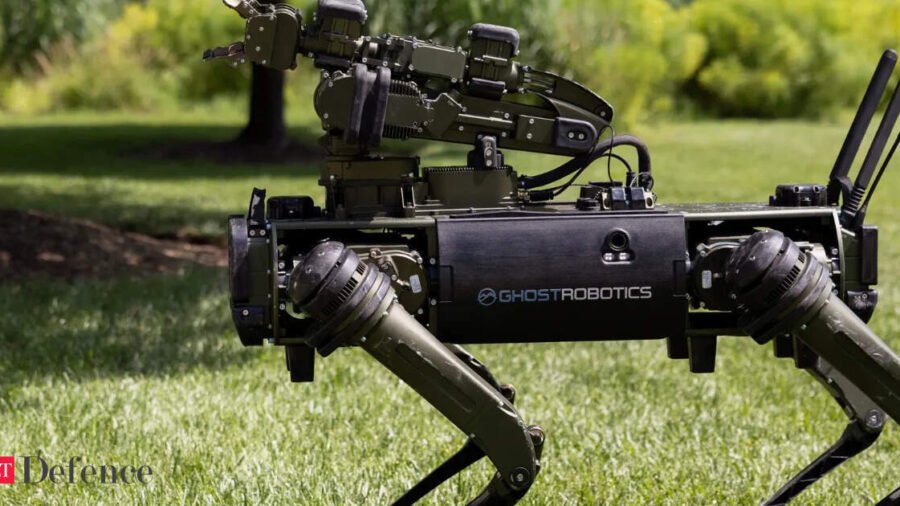
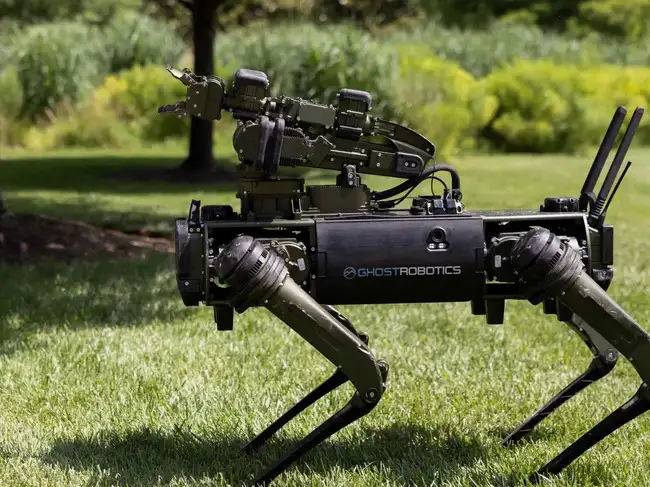
Kenneally commercialized the U.S. breakthroughs through his company Ghost Robotics, which supplies U.S. special forces with advanced, ruggedized robots. But compared to Unitree, its production is small, and costly. In June, the Pentagon added Unitree to a list of Chinese military companies, calling it a "contributor to the Chinese defense industrial base." That designation falls short of a sanction but limits the U.S. military's future use of Unitree's technology. Unitree has said its robots are for civilian use.
Unitree, China's State Council and China's defense ministry did not respond to requests for comment.
Unitree did nothing underhanded in using the U.S. Army research. The program's findings were published openly to stimulate progress in the field, a common practice.
ARL spokesperson Amanda Ligon said the research "strengthened the broader U.S. robotics ecosystem" and informed subsequent work across government and the private sector.
ARL referred questions about Unitree's commercialization of the technology to the Pentagon, which declined to comment.
U.S. COMPANIES VS. CHINA INDUSTRIAL POLICY
Unitree sold more than 5,500 humanoids and 18,000 quadrupeds last year, company filings show, and it's now valued at about $9 billion ahead of its stock market debut on Wednesday.
By contrast, no U.S. company has mass-produced such robots, including Elon Musk's Tesla, which has displayed prototypes of its Optimus humanoid for years. On a January earnings call, Musk called China "incredibly good" at scaling production.
Boston Dynamics, the U.S. company whose 2019 canine, Spot, used different technology, recently argued in a Congressional hearing that China's low pricing would drive U.S. firms out of the market.
None of the U.S. robotics researchers who spoke with Reuters advocated for keeping such government-financed research secret. Instead, they said, U.S. policymakers should focus on enabling companies to quickly commercialize such advances to compete with China.
ARL also said publication was important to scientific and technological advancement.
The U.S. excels in innovation and software development but needs to ensure the capital, industrial base, highly skilled workforce and parts supply chains to scale-up breakthroughs, said Vijay Kumar, dean at Penn Engineering. For now, U.S. authorities often protect companies with trade restrictions on innovative Chinese products. In July, the Federal Communications Commission banned imports of future models of foreign-made humanoid and quadruped robots, including those from Unitree. China has threatened to retaliate to the FCC ban.
China's Washington embassy said in a statement its companies are making new technologies affordable and accessible internationally. It accused the U.S. of abusing administrative power, and of "market distortion and unilateral bullying."
Most of the experts who spoke to Reuters supported the U.S. ban but said the policy is not enough to build an industry to catch up with China.
"This isn't just a competition between U.S. and Chinese robotics companies," said Kenneally, the Ghost Robotics founder. "It's between private U.S. companies and China's coordinated national strategy."
In 2015, Chinese President Xi Jinping set out a 10-year plan to lead industries including green energy, electric vehicles and robotics. Since then, China has channeled capital into risky bets on low-margin 21st-century advanced manufacturing.
Chinese robot manufacturers' rapid reverse-engineering of products draws on the country's dominance in refining critical minerals needed for magnets in robotics applications and the density of suppliers of motors, gears, 'muscles' known as actuators, and other components clustered near Unitree's base in Hangzhou.
Reyk Knuhtsen, a robotics analyst at SemiAnalysis, called the United States' failure to commercialize domestic research a "dropped ball," citing U.S. venture capital's preference for high-return software startups. It would take more than trade barriers on China to boost robotics manufacturing, he said.
"This is a very big hill for the U.S. to climb," he said.
The White House did not respond to requests for comment about U.S. industrial policy. An FCC spokesperson said the commission was protecting Americans from foreign threats and preparing the country "to deliver on President Trump's vision to lead the world on the next generation of technologies."
Jaret Riddick, who as a former Army Research Laboratory director oversaw the Army-funded robotics project, said it did kick-start the U.S. quadruped industry. But in the end, without support for large-scale production, Unitree in China "just kind of consumed that space."
TEACHING ROBOT DOGS NEW TRICKS
The Army funded the Robotics Collaborative Technology Alliance (RCTA) between 2010 and 2020.
The RCTA gathered government, academic and industry researchers from UPenn, the Massachusetts Institute of Technology (MIT), Boston Dynamics, NASA's Jet Propulsion Laboratory, and other research institutions. The alliance's top commercial partner was General Dynamics Land Systems, the Michigan-based defense manufacturer that makes Abrams M1 tanks.
In 2016, UPenn researchers, including Kenneally, eliminated heavy central gearboxes and placed motors in robots' legs, enhancing the ability to sense and respond to terrain. UPenn's progress built on the MIT lab's work funded by the Defense Advanced Research Projects Agency, DARPA.
In 2019, the MIT lab presented the Mini Cheetah, building on UPenn features with increased strength – and the ability to do backflips.
Months earlier, Katz published his MIT masters thesis, detailing Mini Cheetah's actuators. Within six months, he found Chinese companies manufacturing actuator copies "you could buy on AliExpress," he said, referring to the Chinese online retail giant.
Unitree had been founded three years before by Wang Xingxing, then 26 years old. In his 2016 master's thesis from Shanghai University, which Reuters reviewed online, Wang cited the work done at MIT, including on earlier iterations of the Cheetah, and set out principles consistent with those developed at the U.S. lab. He acknowledged the lab's "pioneering" contributions. In his thesis, Wang explored design tweaks to speed up development, saying his findings could have future "defense, security, family and education" applications. He referenced Kenneally's ARL-funded UPenn paper.
On its website, Unitree says the company "independently developed the motors, reducers, controllers, and even some sensors of the quadruped robot."
Katz told Reuters he decided against taking his actuators into production, thinking there would be no market. He said China's ability to move fast had broad benefits: Robotics "has advanced a lot because of the availability of actuators."
Joao Ramos, who did research at the same time as Katz at the MIT lab, said Unitree copied the Mini Cheetah shape, structure and design. But he credited the company with doing "proper engineering" to perfect a mass-produced robot.
"The actual practical implementation, bringing it to real life, that's all on them," Ramos said.
GUN-TOTING ROBOT DOGS
Walking robots aren't yet widely deployed on battlefields, but the United States and Chinese militaries have both explored the prospect. In October, another Chinese company's "Robot Wolf" quadrupeds featured in Chinese media coverage of the PLA conducting mock beach landings.
Unitree has said in public statements that its products are intended for civilian use. In 2022, the company signed an open letter along with U.S. companies pledging not to weaponize robots, citing risks of harm and serious ethical issues. But Chinese state television has featured Unitree's Go2 model robots alongside Chinese troops and a modified version of the firm's B1 series robot firing a mounted assault rifle. In September 2023, the U.S. Army secured a federal waiver from laws requiring government agencies to prioritize American-made products, in order to purchase two Unitree Go2s, according to procurement records that described the devices as crucial tools in the absence of sufficient commercial quantities of U.S.-produced alternatives "of a satisfactory quality." Reuters could not establish whether the purchases went ahead. Later that month, U.S. Marines conducted an exercise attaching a rocket launcher to a Go1 to enable remote firing.
Kenneally's Ghost Robotics has shipped about 1,000 of its Vision 60 robots, mostly to military and government customers for surveillance and search applications in harsh environments. The company's first customer was Navy Special Warfare Command, which oversees Navy SEAL teams.
Some components for the Vision 60s, which sell for upwards of $165,000, are built in China, though the company has sought to move its supply chain. By comparison, Unitree lists its B series robot, for below $100,000 in the U.S.
Ghost Robotics shifted its motor supply from China to South Korea two years ago, though it still finds it difficult to eliminate Chinese magnets and some metal components, Kenneally said.
The only way to escape China's chokehold on the robotics supply chain, he said, is to secure supplies from other countries that have the manufacturing capacity that the United States lacks. In 2024, South Korea's LIG Defense & Aerospace acquired a 60% stake in Ghost Robotics for $240 million. The company is exploring production in Taiwan, Kenneally said.
"We need to work closely with our allies," he said. "There's absolutely no path forward without them."
Add 

(You can now subscribe to our WhatsApp channel)
(You can now subscribe to our WhatsApp channel)
Read More News on
Unitree RoboticsChina robot dogsquadruped robotsU.S. military fundingmilitary technologyrobotics competitionU.S. industrial policyrobots in defenseGhost Roboticsrobot arms race


Enter search text:
Continue reading with one of these options:
Limited Access
Free
Login to get access to some exclusive stories
& personalised newsletters
Login Now
Unlimited Access
Starting @ Rs120/month
Get access to exclusive stories, expert opinions &
in-depth stock reports
Subscribe Now
ET
Unlock Access to All Exclusives with ETPrime FREE TRIAL
15 Days Free: Unlock All ETPrime Exclusives, Market Tools & ePapers
Trial offer expiring in00 : 05 : 00
I'd rather pay ₹2599 now


Uh-oh! This is an exclusive story available for selected readers only.
Worry not. You’re just a step away.

Prime Account Detected!
It seems like you're already an ETPrime member with
Login using your ET Prime credentials to enjoy all member benefits
Log out of your current logged-in account and log in again using your ET Prime credentials to enjoy all member benefits.
Unlock ETPrime's Exclusive Stories Today!
Subscribe to gain powerful insights on business, stock market and industry trends.
Big Price Drop! Flat 40% Off
Student Only Offer
Already a Member? Sign In now
Already a Member? Sign In now
Already a Member? Sign In now
Offer Exclusively For You
Save up to Rs. 700/-
ON ET PRIME MEMBERSHIP
Avail Offer
Offer Exclusively For You
Get 1 Year Free
With 1 and 2-Year ET prime membership
Avail Offer
Offer Exclusively For You
Get 1 Year Free
With 1 and 2-Year ET prime membership
Avail Offer
Offer Exclusively For You
Get Flat 40% Off
Then ₹ 1749 for 1 year
Avail Offer
Offer Exclusively For You
ET Prime at ₹ 49 for 1 month
Then ₹ 1749 for 1 year
Avail Offer
Special Offer
Get flat 40% off on ETPrime
Avail Offer
Avail Offer
Claim NowAlready a Member? Sign In now
Need Assistance?
Connect with an ETPrime expert for personalized support and guidance
+91 9484700004
' + h3 + '
' + h4 + '
- ' + listing + '
What’s Included with

1Exclusive Insights That Matter
Uncover the truth with our investigative stories
Make strategic moves using the real-world case studies
Read industry-specific stories to identify emerging trends
Spot opportunities with in-depth insights that matter

Trump temper on H-1B visas is forcing Indians to do these things to stay put in US

What Adani’s US indictment means for India Inc’s overseas fundraising

Why veterans like Reliance, L&T are on acquisition spree? Aswath Damodaran has an answer.

Will China’s dollar bond sale in Saudi Arabia trump the US in financial world?

Huawei launches its own OS to compete with Google and Apple. But can it win beyond China?

The problem with lab grown diamonds

Why a falling rupee is a better option for the economy

A list of top 20 momentum stocks that have delivered massive returns in one year
2Invest Wisely With Smart Market Tools & Investment Ideas
Alpha Trade

Get daily trade ideas from SEBI-registered research analysts.
Investment Ideas

Grow your wealth with stock ideas & sectoral trends.
Stock Reports Plus

All-in-one stock research with Stock Score, peer comparison & key signals.
BigBull Portfolio

Get to know where the market bulls are investing to identify the right stocks.
Stock Analyzer
Check the score based on the company's fundamentals, solvency, growth, risk & ownership to decide the right stocks.
Market Mood

Analyze the market sentiments & identify the trend reversal for strategic decisions.
Stock Talk Live at 9 AM Daily

Ask your stock queries & get assured replies by ET appointed, SEBI registered experts.
3Stay informed anytime, anywhere with ET ePaper
ePaper – Print View

Read the PDF version of ET newspaper. Download & access it offline anytime.
ePaper – Digital View

Read your daily newspaper in Digital View & get it delivered to your inbox everyday.
Wealth Edition

Manage your money efficiently with this weekly money management guide.
4Times Of India Subscription (1 Year)
ePaper

Read the PDF version of newspaper. Download & access it offline anytime.
Deep Explainers

Explore the In-depth explanation of complex topics for everyday life decisions.
Health+ Stories

Get fitter with daily health insights committed to your well-being.
Personal Finance+ Stories

Manage your wealth better with in-depth insights & updates on finance.
New York Times Exclusives

Stay globally informed with exclusive story from New York Times.
5Enjoy Complimentary Subscriptions From Top Brands
Docubay Subscription

Stream new documentaries from all across the world every day.
Stories you might be interested in

US EIA lifts Brent forecast to $98 as Iran war tightens global supplies
By Sohail Khan · 6 Oct
Panel rejects child images on syrups
By Sohail Khan · 6 Oct