France protest holds a mirror to India
Synopsis
Young students in France have recently mobilized to demand improvements in education funding and resources. Protests have spread across hundreds of schools and universities, emphasizing the need for more teachers and smaller class sizes. Despite significant government spending on education, many school facilities remain dilapidated and overcrowded. The unrest has led to clashes with police, raising concerns about the treatment of youth during protests.
 ET Bureau
Paris: India isn't the only country where young people are taking to the streets to protest. For more than two weeks, high school students – lyceens – in France have been protesting to raise the alarm about the state of underfunding of education.
It began on Sept 21 in the Parisian suburb of Creteil, where parents, teachers and students gathered outside their lycee to demand more funding. Schools across the Parisian region followed. With the help of social media, more than 600 schools across the country have since joined the movement, which now extends to some universities, in solidarity.
Also read: Protests erupt across India demanding resignation of Chief Election Commissioner Gyanesh Kumar over voter list manipulation
The demands are disarmingly basic: more teachers, smaller classes, proper school buildings. Students are also targeting Parcoursup, the opaque university admissions platform launched by the government in 2018, which has turned the final year of school into a season of anxiety about the future.
Money alone isn't the problem. France spends 6.7% of its GDP on education overall (1.3% earmarked for higher secondary education), which is high, even though not the highest in Europe. Yet, the public education system, in which 79% of all lyceens enrol, has visibly decayed over the past decade.
The average age of high-school buildings is 61 yrs. Few have been renovated, and almost none is built for hotter weather. Class size has grown as nearly 9,500 secondary teaching posts have been cut since 2018 in anticipation of falling enrolment.
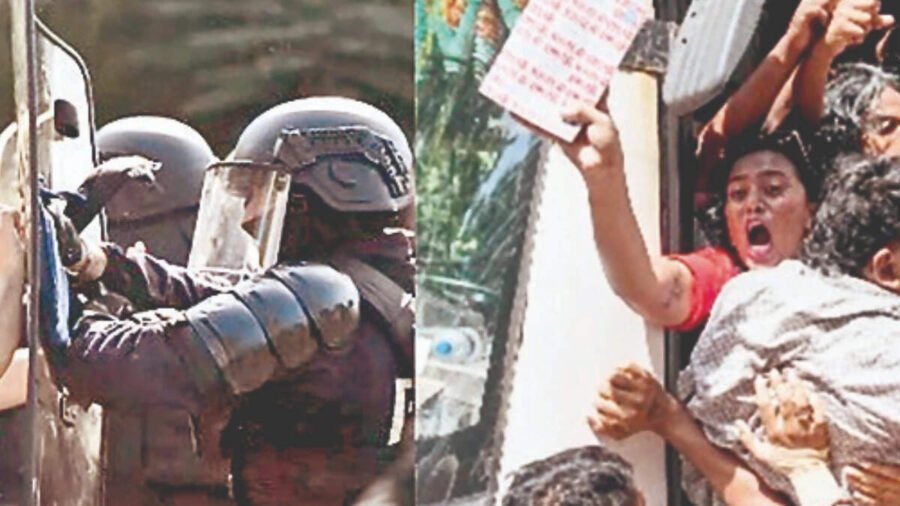
The state's answer so far has mostly been repression. In many places, protests have been marred by violence: attacks on police, arson, and disproportionate force against minors, including tear gas and rubber-bullets. According to Le Monde, 215 students, 85 education staff, and 715 police officers and gendarmes have been injured since the movement began. More than 6,000 protesters, mostly minors, have been arrested since Sept 28.
France has seen school protests before. But it has never policed teenagers on this scale, using the kind of violent, repressive crowd control tactics that have become routine when adults protest.
Behind the classroom crisis lies a crisis of governance. Since 2017, President Emmanuel Macron has gone through 7 prime ministers and 9 governments. Of these, more than half since 2024. Eight incumbents have run the education ministry. Jean-Michel Blanquer alone, from Macron's first presidential tenure, served a full 5 yrs. His successors have lasted under 8 mths on average. Students are not demanding government stability. But it explains much of what they are marching about: no minister stays long enough to fix anything.
That is what makes this movement significant. It's the largest youth mobilisation France has seen in decades. Its target is not a particular bill or reform, but the general state of public education. And it has erupted 7 mths before the first round of the upcoming presidential election.
Indian readers will recognise parts of this movement. The differences between the two school systems and conditions are obvious. But French lyceens and India's Cockroach Janta Party (CJP) movement share a striking resemblance.
The target is the system, not a single law
CJP began with the NEET paper leak. But it has grown into a fight for accountability across India's education system. French students, too, are not protesting a specific reform but what school has become. Just as in India, there is no quick-fix solution the government can use to address protesters' demands.
Satire as weapon
After France's downslide in the latest PISA (Programme for International Student Assessment) rankings, French students carry deliberately misspelt signs, a joke that doubles as an indictment of the schools that failed to teach them.
Obstructed future
While Parcoursup is not corrupt the way NEET is, it's perceived to be arbitrary and unduly controlling of young people's choices and, therefore, their future.
Street and screen feed off each other
As schools shift classes online, 'Cyber blockades' are disrupting some virtual classrooms, while videos of these actions are racking up lakhs of views on social media, fuelling ground mobilisation.
Politicians follow, not lead
Opposition parties and unions in both countries have rushed to express solidarity. But both movements were born outside them, and both remain decentralised and self-sustaining.
Repression the best recruiting agent
In both countries, the brutality of police response has added fuel to the protests, which have become as much about policing as schooling.
One contrast, however, is telling. In India, it took weeks of street protest to force an education minister out of office. In France, ministers leave without being pushed. They simply never stay long enough to be held to account. Entrenchment and churn are opposite pathologies. But they produce the same result: no one answers for the state of schools.
Neither government has a quick fix. Teachers can't be trained overnight and hired, or buildings rebuilt, or trust in exams restored within one budget cycle. But both governments can stop treating youth as a public order problem. From Creteil to Jantar Mantar, young people want the same thing: to be heard and taken seriously. They also share a deep mistrust of those in power. Tear gas will only reinforce it.
(The writer is a political scientist and researcher at CERI, Sciences Po Paris)
(Disclaimer: The opinions expressed in this column are that of the writer. The facts and opinions expressed here do not reflect the views of www.economictimes.com.)
Add 

(Catch all the Business News, Breaking News, and Latest News Updates on The .)
…more
Elevate your knowledge and leadership skills at a cost cheaper than your daily tea.
-
The world is witnessing a bond rout. Why should it matter to you? -
Q2 earnings season: Will it settle or add to confusion in the stock market? -
How Sebi busted Growpital’s ‘assured’ returns, LLPs and money trail -
The biggest assumption: From $600 billion to $2 trillion -
A for apple, Y for yak and, for the first time, a price next to it. Will this change the non-agri part of the rural economy? -
Six months after oil spiked, why are markets reacting so sharply now? -
Oil, money, and the shifting global order -
Gold paradox: Why India, a refining giant, is not a big bullion exporter -
A refinery is not a laptop: Why America's diesel problem can't be switched off -
Everyone asks who will fund AI. Few ask who pays if it burns

US EIA lifts Brent forecast to $98 as Iran war tightens global supplies
By Sohail Khan · 6 Oct
Panel rejects child images on syrups
By Sohail Khan · 6 Oct