How to define ‘industry’ under labour law: Inside SC’s split verdict
In a landmark judgment that brings the curtains down on a legal debate spanning multiple decades, a nine-judge Constitution Bench of the Supreme Court delivered a fractured verdict on what constitutes an “industry” under Indian labour law.
While the judgment comprises of five separate opinions that differ sharply on the interpretation of the law, they agreed on the practical position for pending proceedings: pending cases under the repealed Industrial Disputes Act, 1947, involving the definition of “industry”, will continue to be decided under the 1978 “triple test” laid down by a seven-judge Supreme Court bench in Bangalore Water Supply and Sewerage Board vs A Rajappa. The new Industrial Relations Code, 2020, will have to be interpreted independently under its own text and scheme.
History of dispute
The dispute centres on Section 2(j) of the erstwhile Industrial Disputes Act, 1947 which defined an “industry”. Its broad wording led to decades of judicial debate over whether workplaces such as hospitals, universities, charitable institutions and government departments came within the law’s ambit — and consequently whether their employees were entitled to statutory protections under the Act.
Story continues below this ad
In 1978, a seven-judge Supreme Court bench in Bangalore Water Supply adopted an expansive interpretation. Justice V R Krishna Iyer’s leading opinion laid down the “triple test”: an undertaking would qualify as an industry if there was systematic activity, organised through cooperation between employer and employee, for the production or distribution of goods or services calculated to satisfy human wants and wishes.
The court held that the absence of a profit motive was irrelevant. It also developed a “dominant nature” test for establishments carrying on several activities and recognised a narrow exception for genuinely sovereign functions.
The judgment was not unanimous. The effective majority was 4:3 (two concurring opinions). The dissenting judges favoured an additional requirement that the activity be carried on along commercial lines.
The expansive interpretation subsequently came under pressure. Parliament passed the Industrial Disputes (Amendment) Act in 1982, seeking to exclude, among other categories, hospitals, educational and research institutions, charitable and philanthropic bodies and certain government activities. But the amended definition was never notified — it never acquired legal effect.
Story continues below this ad
Meanwhile, the Supreme Court’s own decisions diverged over issues such as government welfare activities and sovereign functions. In 1996, a three-judge bench held that the Social Forestry Department could be an industry, while a later two-judge bench took a narrower view in relation to a forest department.
In 2005, a five-judge bench in State of UP vs Jai Bir Singh expressed reservations about Bangalore Water Supply and referred the matter to a larger bench. In 2017, a seven-judge bench directed that it be placed before the present nine-judge bench.
Validity of reference
CJI Surya Kant, writing for himself and Justices Satish Chandra Sharma, Alok Aradhe and Vipul M Pancholi, upheld the validity of the reference. Justice P S Narasimha and Justice Joymalya Bagchi also agreed that the reference could validly be considered by the bench.
Justice B V Nagarathna pointed out that the 2005 reference was based on an incorrect assumption that there was a conflict between two smaller bench decisions regarding the forest department.
Story continues below this ad
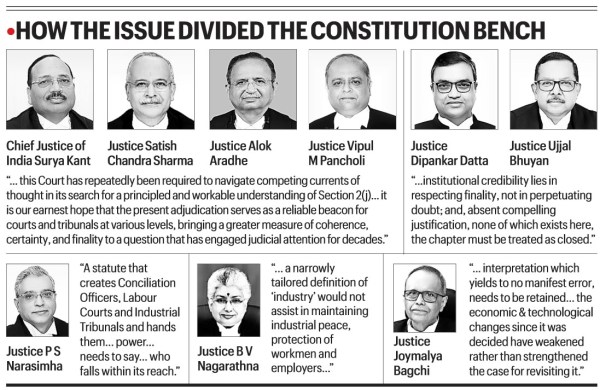 How the issue divided the Constitution Bench.
Justice Dipankar Datta termed it a “faltering reference”. He criticised the 2005 bench for wrongly assuming that the 1978 Bangalore Water Supply judgment was not a unanimous decision simply because some judges had written separate concurring opinions. He noted that a settled precedent, particularly one laid down by a seven-judge bench and followed for decades, should only be revisited upon the satisfaction of exacting tests like a manifest error or public mischief. He concluded that the 2005 bench failed to meet this threshold.
Thus, there was effectively a 6:3 split on the validity of the reference.
The triple test
Here, the judges differed more substantially.
CJI Kant’s opinion said the triple test required “calibration”. In his view, an activity should have a discernible commercial character analogous to trade or business to qualify as an industry. This would keep the profit motive irrelevant while excluding activities divorced from economic enterprise, including purely charitable initiatives and core sovereign functions.
But this was not made the governing test for pending cases which, he held, would continue to be governed by the extant triple test.
Story continues below this ad
Justice Nagarathna defended the 1978 approach, as did Justices Datta and Bagchi. They stressed the social-welfare purpose of labour legislation and argued that introducing a commercial requirement could deprive workers in institutions such as hospitals and schools of statutory protection merely because their employers were not profit-making entities.
Justice Bagchi described the triple test as possessing a “rare felicity in judicial interpretation”, while Justice Nagarathna emphasised the importance of the test in protecting workers amid privatisation and changing economic conditions.
Justice Narasimha adopted a different approach. He wrote that the debate over modifying the triple test had become “unnecessary” because the Industrial Disputes Act had been repealed.
Pending cases
This is where the judges found common ground despite their differences.
Story continues below this ad
The court declined to retrospectively replace the 1978 test with a newly formulated, narrower test. Pending proceedings under the old Industrial Disputes Act involving Section 2(j) will therefore continue to be decided in accordance with Bangalore Water Supply.
All the opinions also made it clear that the judgment does not have any bearing on the interpretation of the new Industrial Relations Code.
The Code defines “industry” as any systematic activity involving cooperation between an employer and workers to produce or supply goods and services, regardless of capital investment or profit motive. Unlike the previous law, the new Code explicitly excludes charitable and philanthropic institutions, domestic services, and sovereign government functions from this definition.The Supreme Court has made clear that its provisions must be interpreted independently.
Sovereign functions and government welfare
The judgment also dealt with the question of when government activities can be excluded as “sovereign functions”.
Story continues below this ad
The broad principle emerging from the opinions is that an activity does not become sovereign merely because it is performed by the State or is connected with a welfare objective. The exception is confined to core, inalienable governmental functions. This is consistent with the approach in Bangalore Water Supply.
Significance
The judgment resolves the immediate problem created by the repeal of the Industrial Disputes Act without creating a new category of law for long-pending cases. By retaining the 1978 test for those proceedings, the court has avoided reopening their legal basis. But it declined to carry that jurisprudence forward as the governing interpretation of the new labour code.

Delhi’s infra-governance problem
By Sohail Khan · 24 Sep
On the draw: September 24, 2026
By Sohail Khan · 23 Sep
7 cities to explore on India’s Golden Quadrilateral road trip
By Sohail Khan · 23 Sep