How periods became a live issue at badminton World Championships in Delhi
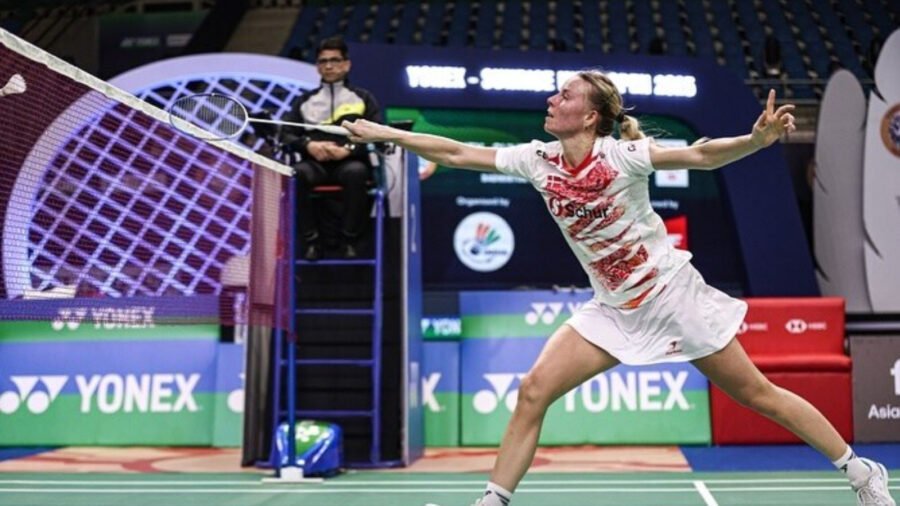
Kirsty Gilmour, the feisty jump smasher from Scotland, had once taken a set off World No 1 An Se-young, of South Korea, at the All England. “I had to run away immediately after because I was so aware I needed to use the washroom,” she recalls of a panicky situation when playing during her menstrual period. She copped a court violation card for taking longer than 2 minutes to return.
At the Delhi World Championships, her 10th since her first in 2013, Gilmour has noticed that the women’s washrooms in Delhi are all equipped with sanitary napkins, as the taboo topic amongst athletes is starting to lose its stigma. “You can be the most powerful female athlete on earth, but if you stain, the look that you get stays as a bad memory,” she says, pleading for rules to be more considerate.
Currently, players can seek permission to hop over to the washroom in the 60-second interval at the 11-point break or the 120 seconds after every 21-point set.
Organisers of the Badminton World Championships in Delhi have initiated their own small but important measure. “Access to sanitary napkins is a basic necessity, not an added facility,” says Sanjay Mishra, General Secretary, Badminton Association of India. “At an international sporting event of this scale, ensuring access to essential menstrual hygiene products should be part of the fundamental infrastructure. BAI has therefore ensured their availability across women’s washrooms at the venue, so that athletes, officials, media, volunteers and spectators have access to them whenever required,” Mishra added, of the first time that this competition has seen this.
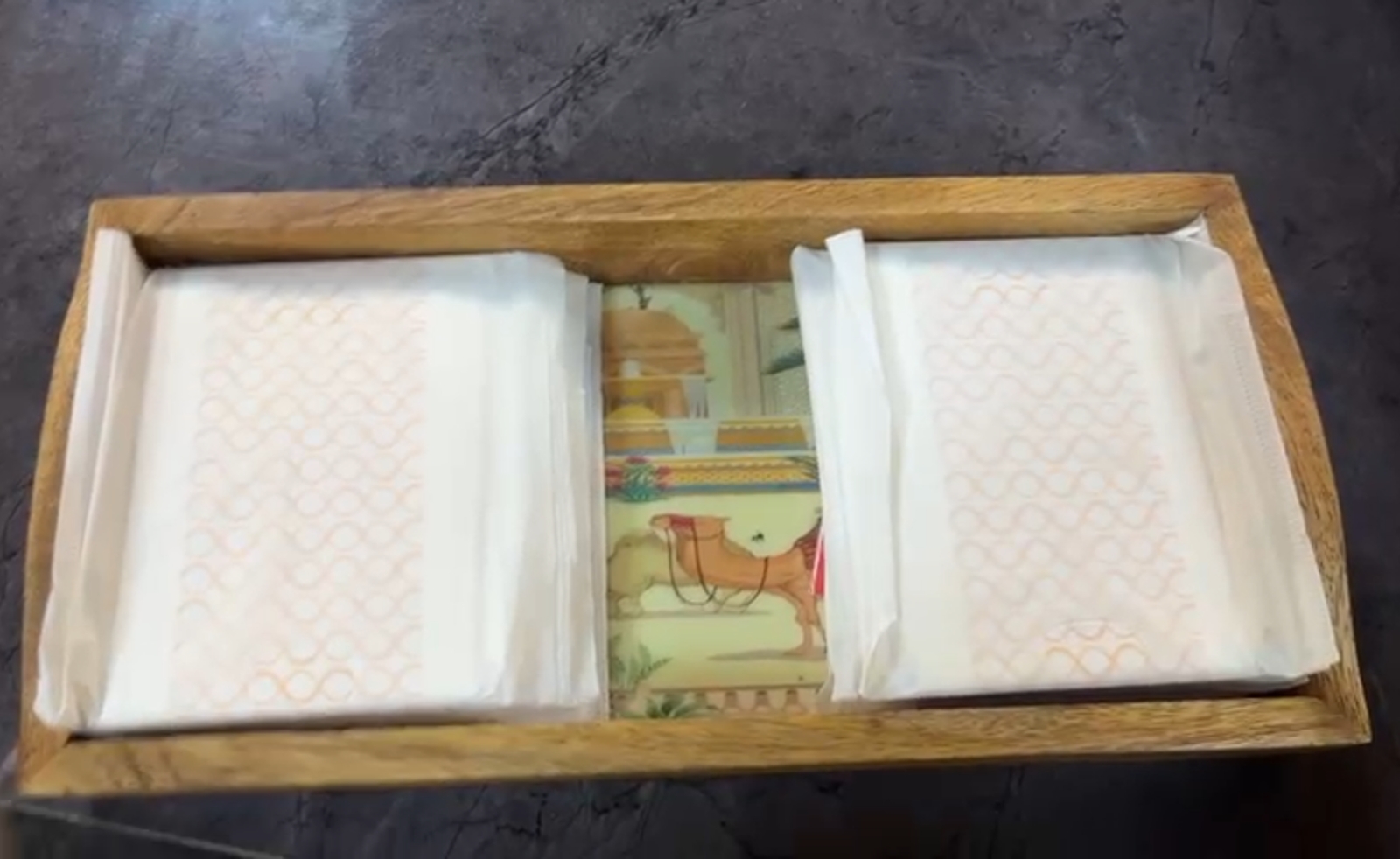 Gilmour has noticed that the women’s washrooms in Delhi are all equipped with sanitary napkins, as the taboo topic amongst athletes is starting to lose its stigma. (Special arrangement)
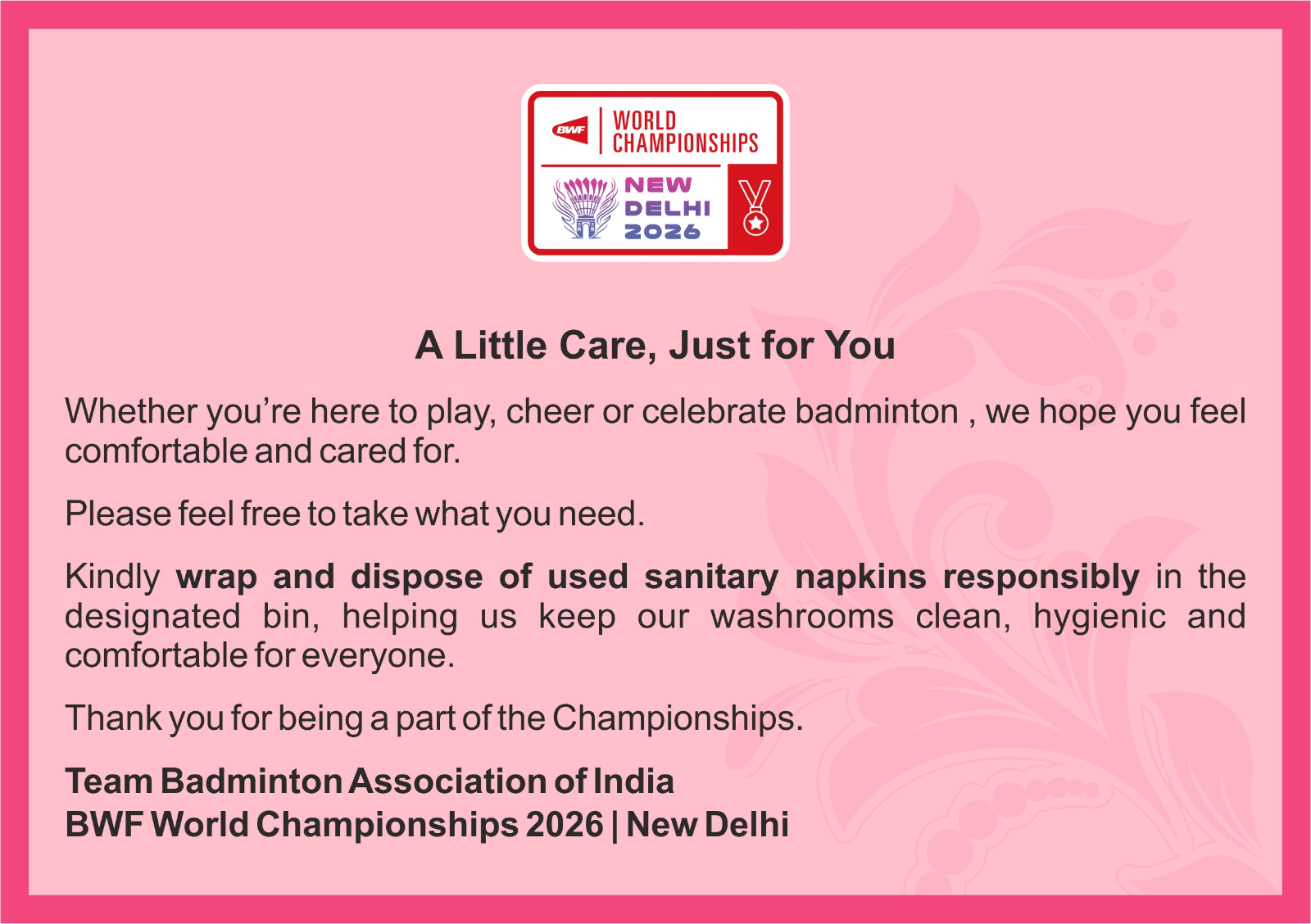 Organisers of the Badminton World Championships in Delhi have initiated their own small but important measure.
“I come from Scotland where every public washroom has sanitary products. So, it was great to see India has done this and people here speak openly and the little shame goes away,” she says. “Menstrual cycles are just a part of life. The main part of our lives. So as athletes, it’ll be great if there are protocols in place,” she stresses.
“No woman wants to stand in front of a packed All England arena to announce, ‘I’m on a period.’ So it’s not like anyone will cheat. It wasn’t the chair umpire’s fault – he was following the rules. But there is no piece of protocol in place to deal with this,” she says, hoping the Badminton World Federation will rethink its rigid rule that won’t be flexible. “It’s just like a medical break.”
Gilmour is part of the Women’s Badminton Collective (WBC), which initiated the conversation on the topic, alongside fellow shuttler Mia Blichfeldt. Ahead of the World Championships, the Danish shuttler got Chinese Huang Dong Ping, the 2021 Tokyo Olympics mixed doubles champion and thrice World Championship medallist, to speak about the tricky dynamics of mixed doubles, given the women’s menstrual cycles.
Story continues below this ad
“If there was one rule I would urge the BWF to change and take the opportunity to make badminton women-friendly, it’s to factor in that women have periods,” the Tokyo gold medallist told WBC.
“Sometimes we need to use the washroom, which becomes cumbersome because of the short break permitted. It happened to me at Sudirman Cup,” she added. “It also happened to the Scottish player (Kirsty Gilmour).”
Dong Ping would add nuance to the argument, particularly the dichotomy of the mindset needed in mixed doubles. “As an athlete in mixed doubles, I don’t distinguish between men and women on court. For what we are competing for, there’s no man or woman, only winning matters. But we have to admit we are physiologically different than men. In mixed doubles, as the lady on the court, there will be situations for two of us (her and her woman opponent) that aren’t same for men because sometimes we play in periods. The toilet-break rules are rigid, and need flexibility,” the Chinese hard-hitter, a contemporary legend, told the WBC.
Dong Ping is top-seeded at the Delhi World Championships with partner Feng Yanzhe, in pursuit of their first gold as a pair. “Women in badminton are about strength, resilience and tenacity and we fight and compete as equals in mixed doubles. But the rules need to consider that we can be playing on periods,” she told WBC.

Why is Tyson Bagent not starting vs Eagles? Reason behind Case Keenum as Bears QB1 explained
By Sohail Khan · 29 Sep
Asian Games Live Updates, Day 11: India’s hunt for elusive 5th gold continues
By Sohail Khan · 29 Sep