How did over 1 crore Karnataka voters end up in ASDDO category? | Explained
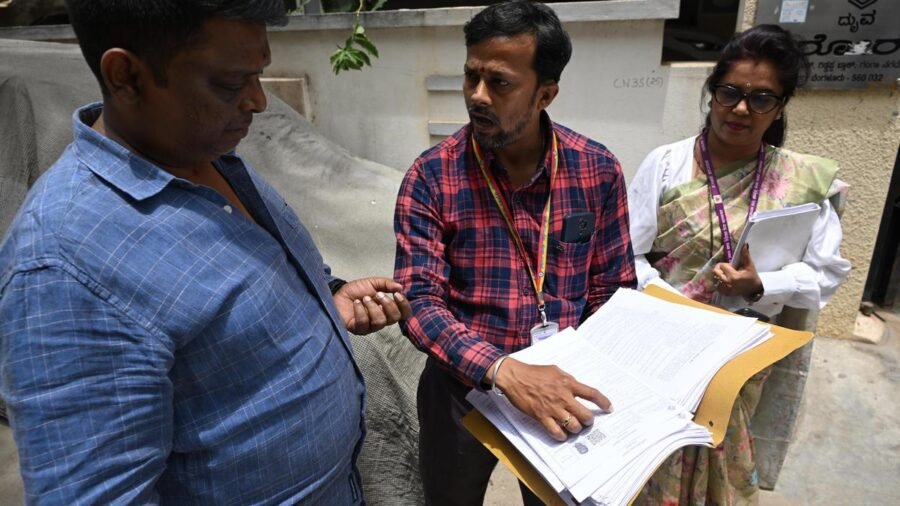
Over 1.08 crore voters — one of the highest such figures in the country — are set to be left out of Karnataka’s draft electoral rolls to be published on August 24 as part of the ongoing Special Intensive Revision (SIR).
In Delhi, the number of uncollected forms or voters placed under the ASDDO category so far stands at over 47.7 lakh, while Telangana, which published its draft electoral rolls on August 17, saw 73.39 lakh voters removed from the rolls.
The exercise was supposed to ensure that the electoral rolls are updated while keeping every eligible voter in the process. Instead, as the enumeration phase came to an end after two extensions, lakhs of voters found themselves navigating a process marked by confusing instructions, poor awareness and inconsistencies in implementation. Poor training, gaps in mobilisation and mismatches thrown up by the app were among the factors that contributed to the large number of voters being placed in the Absent, Shifted, Duplicate, Dead and Others (ASDDO) category. But the confusion was not confined to the final numbers. Right from the beginning, voters struggled to understand what they were expected to establish, which details they had to provide and, in several cases, whose details they were actually supposed to enter.
What was the confusion all about?
When the exercise began on June 30, one of the first hurdles for voters was understanding how to fill out the enumeration form, and why 2002 electoral roll being used as the base roll. Many were unaware about the historic and base roll, where they could find their details and how they were expected to trace their parents’ details if they were not part of 2002 electoral rolls.
For those who were part of the 2002 electoral roll — when the last intensive revision of this nature was conducted — many could not even remember where they had voted 24 years ago. The difficulty was compounded by the fact that the constituency boundaries used in the 2002 electoral rolls no longer corresponded to the present-day constituencies.
Following the 2008 delimitation, several Assembly constituencies were redrawn. The Kannada-only enumeration form added another layer of complication. While some voters were unable to read it, others struggled with similar-sounding terms such as “Bhaga Sankhye” (part number) and “Krama Sankhye” (serial number0.
What could have avoided or reduced this confusion?
The gaps in training and mobilisation stand out. From the beginning of the enumeration phase, voters were receiving different instructions from different BLOs. In several cases, those instructions did not match what was being conveyed by the EROs or even the CEO’s office.
The confusion over progeny mapping is one such example. A voter who was not part of the 2002 SIR because they were not yet 18 had to provide their parents’ or other eligible relatives’ details on the right-hand side of the enumeration form. The first column on both sides simply said “name”. But for a progeny voter, the name in that section was supposed to refer to the relative — such as a parent or grandparent — through whom the voter was establishing the link. However, voters were not conveyed this uniformly. Some BLOs instructed them to enter the voter’s own name, while others told them to enter the relative’s name. The same form was, therefore, being filled out in different ways depending on which BLO a voter happened to approach.
There was similar ambiguity over who could be used for mapping. Could voters establish the link only through their parents and grandparents, or could a “relative” mean any relative?
Here, too, the explanations varied. Even the CEO and Joint CEO offered different interpretations, with the latter saying that mapping through a relative would also be accepted while the formed maintained that only parents, spouse or grandparents could be named for mapping.
Why is Karnataka reporting one of the highest ASDDO figures?
Migration has been cited as the key reason for Karnataka’s high ASDDO figures, particularly in Bengaluru, which attracts large numbers of people from other districts for employment. A voter who has shifted but not updated their address can be marked “shifted”, while a voter who is not found at the address can be marked “absent”.
But the explanation does not end there.
Before August 4, when the CEO of Karnataka, under sustained pressure from civil society groups, agreed to make the ASDDO list public, there were repeated assurances that each ASDDO case was being accounted for. Yet, the number fell by nearly three lakh between August 5 and August 17, when the enumeration phase ended.
It remains unclear how the claim that every ASDDO case had been thoroughly accounted for can still hold when nearly three lakh voters subsequently moved out of the category between August 5 and August 17.
Furthermore, the CEO has maintained that every two hours, political parties were getting ASDDO lists, and therefore, these parties were meant to play a major role in preventing such errors. Together, political parties including BJP, Congress, and JD(S) had appointed more than one lakh booth-level agents (BLAs), whose job was to check and verify ASDDO cases that and ensure that eligible voters were not wrongly marked.
Yet, until the ASDDO list was made public, not a single correction was made by any party in any district. It was only after voters themselves could access the list that cases began to be identified and corrected.
Which parts of Karnataka are most affected by ASDDO?
Bengaluru, being the State’s capital and IT hub and a major destination for job-seekers, has reported the highest ASDDO figures. As of August 17, BBMP South had 49.61% of its voters under the ASDDO category, followed by BBMP North and BBMP Central, both at over 45%. Bengaluru Urban, meanwhile, had over 42% of its voters in the ASDDO category.
What happened to the corresponding voters in the districts they migrated from?
If voters marked as “shifted” have moved to Bengaluru, their absence should, at least to some extent, be reflected in the rolls of the districts they left behind. That pattern is not clearly visible in the figures released so far. At least 16 districts in Karnataka reported over 12% of voters marked under ASDDO list. Notably, most of these districts also rank lowest in Karnataka on the Human Development Index (HDI), as per multiple reports, including the Govind Rao Committee report on regional imbalances released earlier this year.
Even after the enumeration phase ended, there is no clear explanation from the CEO or the district election officials, for the ASDDO figures in several districts from which people are known to migrate. At the same time, several Assembly constituencies in Bengaluru continue to have more voters in the ASDDO category than the number of voters who remain on the rolls.
What happens to voters who are not mapped or have logical discrepancies?
After the draft rolls are published, at least 25 lakh (unmapped voters as of August 17) voters will receive notices from the ERO. These are voters categorised as “unmapped” because they could not establish a link between themselves or their family members and the 2002 electoral rolls. They will have to prove their eligibility before the ERO and produce one of the 11 indicative documents.
But being unmapped is not the only reason a voter could face scrutiny.
Mistakes, mismatches and inconsistencies between the 2002 reference roll and the details submitted during the current exercise can result in a “logical discrepancy”. The category became controversial in West Bengal, where SIR was conducted in the second phase, after similar discrepancies were used in the process that resulted in mass deletions.
In Karnataka, however, there has been no clarity on how voters categorised under logical discrepancies will be dealt with. The Karnataka CEO has largely deferred information on the category to the draft-roll stage, saying details will be provided later.
Before the enumeration phase began, the CEO said six categories of discrepancies that could be flagged have been identified. These included an implausibly large age gap between a parent and child, discrepancies in the ages of siblings, an implausible age difference between a voter and grandparent, and differences in names across documents.
With the enumeration phase now over, the burden of proving eligibility will shift to voters. But even at this stage, several practical questions remain unanswered by the CEO’s office.
Could the CEO help voters?
V Anbu Kumar, Chief Electoral Officer for Karnataka, addressing a press conference regarding the Karnataka SIR (Special Intensive Revision) on August 05, 2026.
MURALI KUMAR K
Apart from repeatedly stating that the exercise is being carried out as per procedure, Karnataka Chief Electoral Officer V. Anbu Kumar has remained largely silent on several of the practical nuances that voters will now have to navigate. With the enumeration phase over and the claims and objections period set to begin, voters flagged for mismatches will be required to establish their eligibility and produce documents. Yet there is still no clear indication of whether all 11 indicative documents will be accepted uniformly.
The uncertainty is particularly pronounced over the Permanent Residence Certificate (PRC), which figures among the 11 documents listed by the Election Commission. The CEO has declined to comment specifically on its acceptance. While the Congress-led State government announced a door-to-door issuance of PRCs and caste certificates drive to help eligible voters establish their claims, the CEO, however, has not given a categorical assurance that the PRC issued through this process will be accepted as a valid document during the claims and objections process.
Who are the ‘Others’?
Moreover, the enumeration was not only about verifying existing voters.
The stated objective of the SIR is to also identify and weed out suspected foreign nationals from the electoral rolls. Yet, with the enumeration phase now over and 100% of the forms digitised, the CEO’s office has released neither a count nor a clear explanation of who has been categorised as “Others” and how many suspected foreign nationals have actually been identified.
The CEO’s office has said the category comprises voters who are “mostly” refusing to sign the enumeration forms. But beyond those who refused to sign, there is still no clarity on who else falls under “Others”, how they are identified, or what process will be followed to establish their status. Even to begin with, it is unclear how those categorised as “Others” will be distinguished from voters who simply refused to sign the enumeration form.
Elephant habitats, corridors being systematically destroyed, will to preserve absent: Ramesh
By Sohail Khan · 18 Aug
Amendment to Taxation Act, Payment and Settlement Systems Act get President’s assent
By Sohail Khan · 18 Aug
Leave a Reply