Gen Z vs the khap panchayats: Old rules, new rebels
Anchal, an M.A. student and a resident of Igra village, Jind district, posted a video on social media satirising khap panchayats, the powerful but unelected community bodies dominated by elderly men from landowning communities in Haryana. Imagining what a “Gen Z panchayat” might look like, she suggests in the video that elderly men face restrictions on playing cards, smoking hookahs and bidis, and wasting time, while tobacco sellers be fined. The money collected through such fines, she jokes, could be used to replace phones damaged or confiscated from girls.
Anchal was responding to a controversy that exploded after a khap panchayat member, Virender Dhull, a resident of Ikkas village in Haryana, made a remark about young women at the Naugama khap meeting in Jind on August 1. The comment that went viral was about women riding pillion with their fathers on two-wheelers, their legs astride, while using mobile phones and wearing clothes the khap thought unsuitable. He said their phones should be smashed. Dhull, a director of physical education at Jat Senior Secondary School in Jind, was hit by social-media criticism.
Over the past few weeks, several khap panchayats across parts of north Haryana have unleashed a series of resolutions, many against women. The khaps have opposed marriages within the community and live-in and same-sex relationships, while also resolving to fight drug abuse, online betting, and obscene social-media content.
Khap leaders insist they are not issuing diktats. They describe themselves as community elders offering guidance to the youth, and argue that their goal is to preserve social cohesion and protect families. Except, ostracisation will be a penalty for those who disregard these social rules. And the rules are targeted primarily at young women.
To many, especially the social-media-vocal Gen Z, the khaps’ message sounded like an attempt to regulate their personal choices in the name of tradition.
“Why are concerns over culture and social behaviour directed primarily at girls? If these restrictions are genuinely meant to protect society and preserve our culture, they should apply equally to men,” Anchal says.
Young women see the controversy as an enduring culture of social control over female agency, and have posted videos against the diktats. Several men too, like rapper Rahul Fazilpuria and content creator Paras Yadav, too, took to social media to condemn the resolution.
Naugama khap president, Jaivir Lohan, however, says Dhull’s remarks have been misrepresented. He maintains that the khap has not banned mobile phones for girls or prescribed what women should or shouldn’t wear. Parents, he says, should decide what is appropriate for their children, and the khap will intervene only if parents seek its help.
“The views expressed during the panchayat on women’s clothing and use of mobile phones was an individual’s opinion,” Lohan says. The Naugama khap has 42 members, all male.
Haryana’s over 130 khap panchayats have long carried an image of being stuck in time. Their decisions have frequently been criticised for restricting women’s autonomy, particularly their freedom to choose whom to marry, who to associate with, and how to live. They have largely kept women away from decision-making roles.
Khap state of mind
On August 9, 24 khap panchayats met in Jind’s Kandela village. Here, they passed a resolution disallowing women and men from marrying within the same gotra (clan) or cluster that their khap panchayats oversee. This diktat is based on their belief that its members are one extended social family. However, people are free to choose who they marry beyond this boundary.
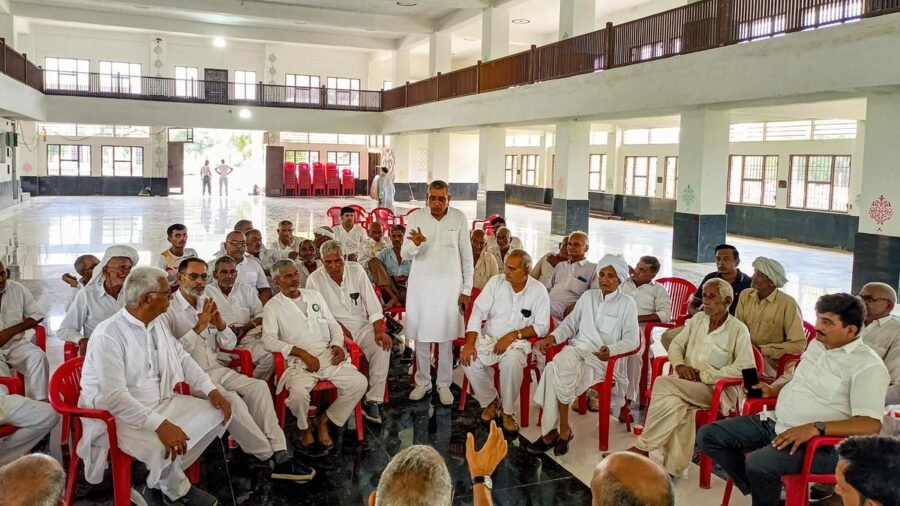
Chanderbhan Nambardar with other members of the Naugama khap panchayat in Ramrai village, which oversees 21 villages in Jind district.
Shashi Shekhar Kashyap
Chanderbhan Nambardar, a khap member, says people within this network are considered brothers and sisters, irrespective of caste differences and, in some cases, gotra distinctions. For the khap, therefore, a marriage within these prohibited social boundaries is seen as a relationship crossing what the community considers a kinship boundary. Lohan says that same-gotra marriages lead to genetic disorders and weak offspring, because of a common gene pool.
The consequences, if the khap panchayat is disobeyed, are severe. Nambardar says that if a woman and a man who come under the 24 khap panchayats disobey, they will not be allowed to enter the area under their community-appointed jurisdiction. He acknowledges that the khaps have no legal authority, though.
The khaps also passed a resolution banning live-in and same-sex relationships, and content they felt was obscene, while also urging the government to regulate marriage by choice, or love marriages, as they are called in India.
Raghubir Nain, president of the Sarvjatiya Binain khap, in Jind, says the panchayat did not oppose love marriages, but wanted them to take place with parental consent and within accepted social norms. He refers to live-in and same-sex relationships as a “nai beemari (new disease)” in society. The Naugama khap has made similar demands.
Naugama khap spokesperson Umed Jaglan says they want the government to examine the social consequences of live-in relationships, particularly where a married person leaves a spouse and children to live with another partner. The khap argues that such relationships can damage families and traditional social institutions.
Khap leaders also say women are being included more in decision-making now, through special assemblies and women’s wings aimed at addressing social issues.
On August 23 in Jind, the Naugama khap panchayat convened its first ever women-led mahapanchayat. They too passed resolutions against love marriages and live-in relationships, but also against dowry and gun culture. A 21-member committee will spread the word and ensure compliance.
At a mahapanchayat, held in July at the Meham Chaubisi Chabutra in Rohtak, participants adopted resolutions against drug abuse, online betting, obscene social-media content, and the glorification of guns online. The gathering also decided to eliminate the use of hookah at community functions — an especially striking move in a State where the hookah has long been a symbol of rural social interaction. The mahapanchayat was chaired by Chaubisi Khap president Subhash Goyat and attended by prominent local artists, including Ajay Hooda.
Khap leaders say these social issues they take up rarely receive the same attention as their positions on marriage and relationships. Nambardar argues the khaps are “guiding lights” for the youth.
Gen Z hits back
On her YouTube channel, Leena Sharma (leena_yuvan7240) criticises what she describes the khap diktats, questioning how restrictions on women’s clothing, mobility, and behaviour can be imposed in the 21st century. She points out that women sitting astride a motorcycle is a matter of safety. She also questions khap resolutions, such as not allowing DJ music at weddings, asking why community bodies should dictate personal choices. Her larger argument is generational: cities may be changing, she says, but villages need to change too.
On Instagram, Garima (@garima.sees) talks about how the khaps were claiming that this was done to save “culture”, but it was just to control women. In a Reel with the caption “One of the reasons why Haryana is developing backwards,” she says the State grapples with one of the highest youth unemployment ratios and one of the lowest sex ratios in India. “Meanwhile, Haryana’s male youth is involved in drugs and crime, but no such panchayat is held for the betterment of these people. Na unkay liye kuch ban kiya jaata hai, aur na unkay liye kuch rules banaye jaate hain (Nothing for them is banned, nor are there any rules made for them),” she says on the video.
It’s not just women speaking against the diktat. Aman Kashyap, who holds a master’s degree in journalism from a university in Jind, asks, “When the Constitution grants girls equal rights, how can a panchayat decide to smash their phones or restrict their movements?” He calls these diktats illegal and contrary to fundamental rights, including the freedom of movement, expression, and privacy. He stresses that the views of a few khap members should not be seen as those of all of Haryana, noting that many students and their parents too had opposed the decisions.
Krishan Dalal, a reel creator with nearly 27.8k followers on his Instagram account @iamkrishan7, clocked 747k views on his post on the subject. In the Reel with some mixed messaging, he says, “Actually, ye buddhay hain gay (Actually, these old men are gay),” adding that, “Before they die, they want to come out of the closet….” He also says, with some misunderstanding, “Ye low testosterone mard ki pehli pehchaan hoya kare, ki jab kahin uska bas nahi chalta toh aurat ne sanskar aur sabhyachaar sikhane nikileya kare wo. (The first sign of a low-testosterone man is that when he cannot assert his authority anywhere else, he sets out to teach women about values and civilisation).”
Critics, however, point out that societal relationships are governed through individual rights and the law, rather than through community sanctions. A YouTube channel FlicksUnpacked has uploaded a Short under the title “Huge Decision by Haryana Khap on Love Marriages”. It addresses Khap members as “so-called dadajis (paternal grandfathers)”, accusing them of seeking attention and social-media fame.
The clip reflects a wider generational tension in Haryana and elsewhere: traditional community-based institutions continue to assert authority over matters of relationships and social conduct, while the youth increasingly uses digital platforms to challenge those norms and demand greater autonomy, equality, and individual rights.
Customs versus law
As they sit in a circle in a building set on 5 acres of land in Ramrai village, some of the men feel India’s laws must be in tandem with Haryana’s social customs.
“Couples entering into these relationships, which are against our social customs, are given security by law-enforcing agencies,” Jaglan says, referring to safe houses set up by the government to protect couples who have been socially ostracised and whose lives are sometimes in danger.
Jaglan says the Naugama khap has actively approached political and legal authorities seeking changes to the law. According to him, more than two years ago, a delegation first met then Haryana Chief Minister Manohar Lal Khattar, and later, in January 2025, met Union Law Minister Arjun Ram Meghwal. Among its demands were changes to the Hindu Marriage Act, 1955, restrictions on same-gotra and same-village marriages, and legal action against live-in and same-sex relationships. Jaglan says the delegation was assured that its concerns would be placed before the Union Cabinet, but that no further action or response followed.
The khap also demanded changing the legal marriage age for women, with Jaglan recalling that some members had proposed reducing it from 18 to 16. He also points to its history of approaching political and judicial authorities, including earlier meetings with former Haryana Chief Ministers Devi Lal and Bansi Lal, as well as a representation before the Supreme Court.
The khap leaders see matters such as drugs, guns, and dowry as being interconnected with other parts of the social order, like marriage and relationships. Their critics see a dangerous blurring of the line between community advice and coercion.
Anti-women accusations
Nambardar rejects the accusation that khaps are anti-women. He points to the wider political system to explain why women remain under-represented in khap leadership. “Women became sarpanches in Haryana only in the 1980s,” he says, questioning the gap between political promises and reality. “Every political party talks about 33% reservation for women, but how many women are actually in the State Assemblies and Parliament?”
According to him, the problem runs deeper than the khaps themselves. Indian society, he says, continues to be patriarchal, with women still under-represented in politics, government, and employment. “So naturally, there are fewer women in khaps as well. But their representation is growing fast.”
Nambardar argues that several decisions taken by khaps have received support from women. For instance, during the wrestlers’ protest, when several women wrestlers from Haryana had accused BJP leader Brijbhushan Singh of sexual abuse, the khaps stood by the women.
The khap remains rooted in a Haryana where village identity, kinship, honour, and collective decision-making continue to carry enormous weight. But it operates alongside Gen Z that is increasingly connected to cities, smartphones, social media, new forms of work and relationships, and a legal system built around individual rights. That collision is producing uncomfortable questions on both sides.
In the first four months of 2026, Haryana’s Sex Ratio at Birth plummeted to 898 girls for every 1,000 boys.

Saif Ali Khan stabbing case: Jailed accused files plea, seeks to admit guilt
By Sohail Khan · 29 Aug


Leave a Reply