File ITR by Augsut 31, 2026 else risk late fee

Synopsis
ITR Deadline: The deadline for filing Income Tax Returns (ITR) for taxpayers with non-audit business or professional income is August 31, 2026. This due date was extended from July 31st to August 31st pursuant to an amendment in the Finance Act, 2026 in Budget 2026.
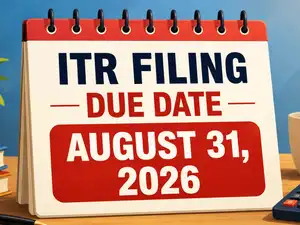
August 31, 2026 is the deadline for filing the ITR for those taxpayers who have business or professional income and who don’t need a tax audit. If you miss this date and still need to file, you’ll have to pay a late fee of up to Rs 5,000 and submit a belated ITR.
Shalini Jain, Tax Partner, EY India, said to ET Wealth Online that other taxpayers like partners of non-audit firms are also liable to file their ITR by the August 31, 2026 deadline.
Here’s a table showing the ITR filing deadlines:
| Category of taxpayer | AY 2026-27(FY 2025-26) | Tax Year 2026-27 |
| Salaried individuals; andOther non-audit taxpayers (not having business/ profession income; not being a company) | July 31, 2026 | July 31, 2027 |
| Taxpayers having business/ profession income whose accounts are not required to be audited(not being a company)* | August 31, 2026 | August 31, 2027 |
| Companies and taxpayers subject to tax audit* | October 31, 2026 | October 31, 2027 |
| Taxpayers requiring transfer pricing report under Section 92E* | November 30, 2026 | November 30, 2027 |
* Includes partners of firms whose accounts are not required to be audited and such other persons as specified under Section 263 of the Income-tax Act, 2025
Source: EY India
Also read: August 31 ITR filing deadline: ITR-3 or ITR-4? Which form you should choose while filing your income tax return
What happens if ITR filing deadline of August 31, 2026 is missed
Chartered Accountant Abhishek Soni, co-founder, Tax2Win says that if you miss the August 31, 2026 due date applicable to an eligible non-audit taxpayer filing ITR-3 or ITR-4, you can generally file a belated ITR up to December 31, 2026, subject to the applicable conditions.
A belated ITR may attract a late-filing fee under Section 234F of up to Rs 5,000. Where the taxpayer's total income does not exceed Rs 5 lakh, the late fee is restricted to Rs 1,000. Interest may also apply depending on the taxpayer's tax liability and circumstances. For example, interest under Sections 234A, 234B or 234C may apply where the respective conditions are satisfied.
Soni says: "However, missing the due date can also affect your choice of tax regime if you have business or professional income. For taxpayers having business or professional income, opting out of the new tax regime requires furnishing Form 10-IEA within the due date specified under Section 139(1). "
Therefore, if such a taxpayer misses the August 31, 2026 due date and files a belated ITR, they cannot newly opt for the old tax regime for AY 2026–27.
Also read: Filing ITR4 by August 31 deadline? Check these 6 major changes if opting for presumptive taxation for AY 2026-27
The ITR filing due date is extended due to Budget 2026 amendment
Shaily Gupta, partner, Khaitan & Co, said to ET Wealth Online that as per Section 263 (1)(c) of Income Tax Act, 2025 , the law prescribes different due dates for different categories of taxpayers.
Gupta says that recognising the practical compliance challenges faced by certain taxpayers, the extended August 31, 2026 ITR filing deadline is for:
(a) taxpayers engaged in business or profession not requiring audit [i.e., non-audit business cases],
(b) partners of non-audit firms [Partners of non-audit business cases]; and
(c) certain trusts;
Gupta says: “The Government has extended the due date for filing the above mentioned taxpayers’ ITRs from July 31 to August 31. The additional month is intended to provide taxpayers with adequate time to finalise their books of account and complete the ITR filing process.”
According to Gupta, although AY 2026-27 continues to be governed by the Income-tax Act, 1961, the due date for non-audit businesses and partners of non-audit firms has also been extended to August 31, 2026 through the Finance Act, 2026.
Separately, the time limit for filing a revised return has also been extended from nine months to twelve months from the end of the relevant tax year.
Gupta says: “Consequently, the deadline for revised ITR has shifted from December 31 to March 31 of the year succeeding the relevant tax year.”
(Join our ETWealth WhatsApp channel for all the latest updates)
Add 

(Catch all the Personal Finance News, Breaking News, Budget 2025 Events and Latest News Updates on The .)
…more

Check PM Modi’s agenda for 4-day Central Asia visit
By Sohail Khan · 29 Aug
AMFI re-elects Sundeep Sikka as Chairman, Vishal Kapoor as Vice Chairman
By Sohail Khan · 29 Aug
Is India prepared for a Glacial Outburst Flood?
By Sohail Khan · 29 Aug
Leave a Reply