‘Come out of Hindu-Muslim mindset’: Kangana tells Sharmila Tagore amid Vande Mataram row
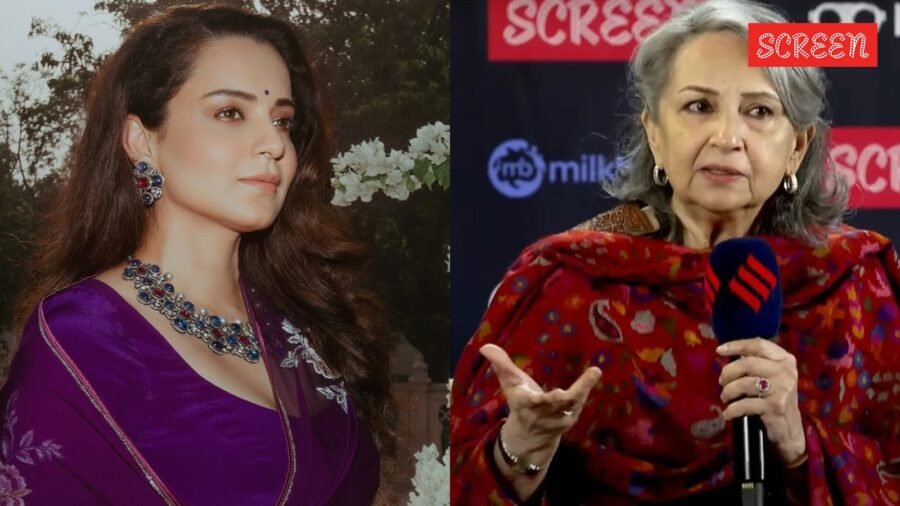
Amid the ongoing row about ‘Vande Mataram’, Kangana Ranaut has now commented on Sharmila Tagore’s remarks, suggesting that only the first two paras of the national song must be sung, as many religious people in India, coming from different faiths, might not be comfortable with singing ‘Vande Kali, Vande Durga’. Kangana took to her social media and said that she was “shocked” to hear the veteran actor’s take on the issue. She also said that Sharmila must “come out of Hindu-Muslim mindset.”
Kangana took to her Instagram Stories and wrote, “I appreciate that Sharmila ji has spoken about her reservation on Vande Mataram, but I am shocked as an artist how can her views on art/poetry be so limiting and contrived? In any poetry or song, words are metaphors. A poet or artist uses all kinds of imagination, draws unbelievable parallels to bring about the desired effect. Vande Mataram is the spirit of the freedom struggle. Bankim Chandra ji is compelling the nation to awaken the Shakti within. How can you reduce such a great piece of art to mere religious practice? Vivekananda famously said I need youth who are made of iron, bones of steel and veins in which runs thunderbolt. He was not giving a weather forecast. He was simply demanding Shakti to rise. Please come out of Hindu-Muslim mindset. Even if we believe in one god, doctors also call power Shakti. Let’s embrace each other like our own. I absolutely love you and don’t mind a crushing hug like you always give me. (sic).”
Kangana shared another post but here, she did not refer to Sharmila and wrote, “A very important aspect of art is interpretation. Shakti, Durga, Chandi can be a noun in a temple Aarti, but when it’s used as an adjective in a freedom anthem, it’s the unleashed ferocious spirit of volatile Shakti within. I am sorry if some religion is only restricted to one God and one expression, that too of male supremacy, huh, who cares!! Sorry to inform you, it’s a selective issue, not a collective issue #VandeMataram. (sic).”
What did Sharmila Tagore say?
Previously, Sharmila Tagore, in a chat with IANS, had said that the first two stanzas of ‘Vande Mataram’ could be sung by everyone, and the latter paragraphs have religious connotations that might not be well suited for people of different faiths. “My point of view is that there are many religious people who believe in one single God, not many Gods. In Vande Mataram, there is a stanza which says that many Gods are mentioned in Vande Mataram. It is difficult for those who believe in one religion to say, ‘Vande Kali, Vande Durga’. Therefore, if we take all the religious people in India together, the first two stanzas are very good”, she said.
About Vande Mataram row
The Vande Mataram row started when the BJP claimed Congress leader Sonia Gandhi allegedly signaled to stop the full rendition of the national song during the Independence Day function at the party headquarters and in Goa. The Congress Working Committee (CWC) decided that only the first two stanzas of Vande Mataram will be sung at party programmes. To back its decision, it cited a 1937 CWC resolution, saying that the leading lights of the freedom struggle, including Mahatma Gandhi and Rabindranath Tagore, were in favour of limiting the public rendition of Vande Mataram to only its first two stanzas.
During the recently concluded Monsoon Session of Parliament, the Narendra Modi government passed the Prevention of Insults to National Honour (Amendment) Act, 2026, which makes attempts to stop or prevent the singing or playing of Vande Mataram a criminal offence.
Story continues below this ad
‘Vande Mataram’ was written by Bankim Chandra Chatterjee in the 1870s. It was first published in 1882 in his Bengali novel Anandmath. The songs became an integral part of the freedom struggle during the Swadeshi movement. The poem was accepted as the national song in 1950, when Indian became a Republic. However, the Muslim League believed that “bowing to the mother” amounts to idolatry. It also had issues with some of the references.
Is Akshay Kumar joining Hanuman Ansh sequel? Producer breaks silence
By Sohail Khan · 29 Sep
Matthew Perry spent $7 million trying to get sober, sister reveals in Netflix documentary
By Sohail Khan · 29 Sep
‘He will slip only once’: Jailer 2 song ‘One Name’ celebrates 50 years of Rajinikanth
By Sohail Khan · 29 Sep