China robot makers seek to turn humanoid hype into useful work
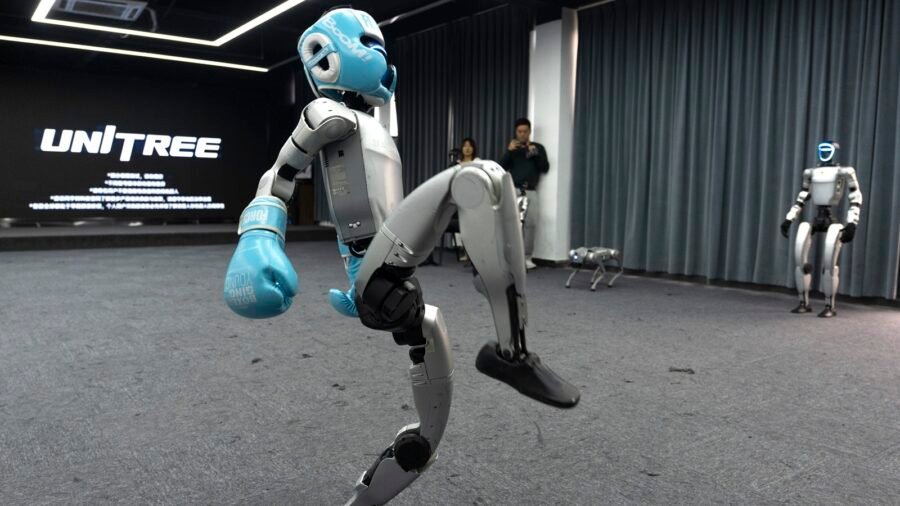
Chinese robot makers showed off humanoids sorting parcels, packing mobile phones and helping with household chores at a Beijing conference on Wednesday, seeking to demonstrate a shift from crowd-pleasing displays to broader commercial use.
More than 300 mostly domestic companies are attending the World Robot Conference, which runs through Sunday, displaying over 2,000 exhibits and launching more than 150 products, according to organizers.
The event comes amid a surge of investor interest in humanoids, a potential new source of industrial growth for China and an arena of technological competition with the United States.
Shares in Unitree, China’s best-known humanoid robot maker, soared nearly sixfold in their Shanghai trading debut on Wednesday, after Unitree’s initial public offering was more than 8,000 times oversubscribed by retail investors.
Following Unitree’s IPO, startup Lumos Robotics and the robotics division of China’s largest auto exporter Chery Automobile told Reuters they were also considering stock market listings.
Nvidia executive visits
Madison Huang, a senior Nvidia executive and daughter of the U.S. chipmaker’s CEO Jensen Huang, made an unannounced visit to the event, watching robots perform flying kicks and dance routines before stopping at a companion-robot booth to ask about its sensors.
Huang, who drew onlookers much as her father has on past visits to Beijing, oversees marketing for Nvidia’s Omniverse and robotics platforms, software used to simulate and test physical AI — systems that can perceive and act in the real world.
Story continues below this ad
Despite geopolitical tensions and U.S. restrictions on exports of Nvidia’s most advanced AI chips to China, her visit highlighted foreign suppliers’ role in China’s push to develop robots for its factories, warehouses and homes.
RealSense, a U.S.-based maker of vision systems for robots and one of the few foreign exhibitors at the conference, said it was building sales partnerships in China as the sector develops.
“We see China as a very strategic market for us,” said Mike Nielsen, the company’s chief marketing officer.
“It is becoming the center of humanoid technology.”
Robotics an ‘important force’
At the opening ceremony, Xin Guobin, vice minister of industry and information technology, said robotics had become “an important force” in China’s economic and social development, local media reported.
Story continues below this ad
Chinese robots are increasingly being tested in logistics, manufacturing and service settings.
“Our most common application scenarios are in logistics,” said Zhang Dapeng, assistant vice president at industrial humanoid robot firm Leju, as his company showed robots moving and sorting crates and small objects.
Zhang said European factories and Chinese auto plants were using Leju robots to move boxes and load components.
At Robotera’s booth, a humanoid torso on a wheeled tripod base sorted parcels. A company official said the robot had been deployed at China Post logistics sites since last year using Robotera’s AI software.
Story continues below this ad
A sales representative said Robotera had more than 100 parcel-sorting robots in 15 warehouses nationwide.
From demonstrations to deployment
Nearby, DexForce demonstrated humanoid robots packing mobile phones into boxes on an assembly line.
The robots have been deployed since early this year at a Lens Technology factory, a Chinese supplier of touchscreens and other components to Apple and Huawei, said DexForce official Nicole Yang.
Yang said the machines had millimetre-level operating accuracy and could detect and correct errors, such as a phone being placed at an angle.
Story continues below this ad
“In theory, human beings are the most dexterous,” Yang said. “But many workers in factories are unwilling to do this kind of boring work.”
Lumos Robotics is already using robots to automate the assembly of key modules at its factory and plans to introduce them into final assembly, Chief Executive Yu Chao said.
X Square Robot, known for its focus on household chores, is looking to move beyond short home-service trials.
Its longest deployment has lasted one month, and it is testing robots in hundreds of homes this year before gradual commercialisation next year, said co-founder Yang Qian.
Story continues below this ad
RealSense’s Nielsen said the companies most likely to succeed would be those able to put robots into active production environments, adding that China’s rapid development cycle was pushing suppliers to move more quickly.
“The product cycles for robots are more like six to eight months, not three to four years,” he said.

What is a kill switch, and why is it hard to build one for AI systems?
By Sohail Khan · 20 Sep
A smartwatch should fit your routine, not interrupt it. These five models go the extra mile
By Sohail Khan · 20 Sep
Nike Alphafly 4: 5 things (including the science) behind new marathon shoes
By Sohail Khan · 20 Sep