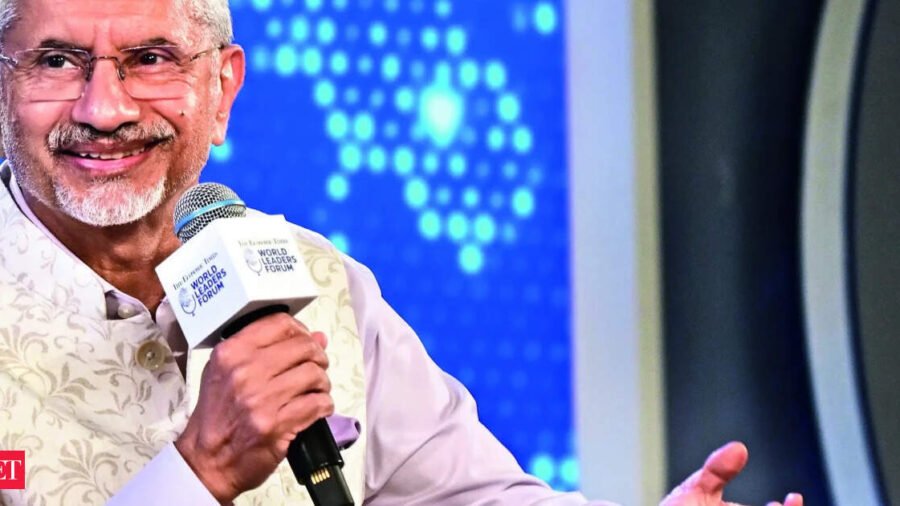
Always be ready for new risks: S Jaishankar
Benchmarks
Nifty24,252.0020.16
FEATURED FUNDS★★★★★
Motilal Oswal Midcap Fund Direct-Growth
5Y Return
24.08 %
Invest Now
Enter search text:
Business News›News›India›ET World Leaders Forum: We live in the just-in-case era, always be ready for new risks, says S Jaishankar
Read Today's Paper
ET World Leaders Forum: We live in the just-in-case era, always be ready for new risks, says S Jaishankar
Synopsis
Jaishankar said diversification should form a key part of how businesses respond to a more uncertain global environment and this strategy should be built into the plans. "We are finding a very distorted energy market, a very distorted fertiliser market, very distorted shipping. Because the choke points are creating distortions, I would say distrust and diversify, which is to assume that things may not go right, build it into your plans," he said.
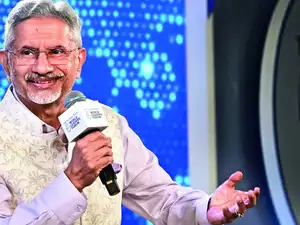
External Affairs Minister S Jaishankar outlined a set of mantras for businesses and policymakers in a world where geopolitical tensions are increasingly affecting trade and supply chains.
"De-risking would be my biggest mantra, as you called it. And the second would be to diversify," Jaishankar said at The World Leaders Forum.
Countries and businesses must assume that somewhere new risks will arise and be ready for that, the minister said. "The just in time era is over; and the just in case era is clearly in place," he said during a fireside chat with ET's Pranab Dhal Samanta.
Conflicts and Choke Points
Jaishankar said diversification should form a key part of how businesses respond to a more uncertain global environment and this strategy should be built into the plans. "We are finding a very distorted energy market, a very distorted fertiliser market, very distorted shipping. Because the choke points are creating distortions, I would say distrust and diversify, which is to assume that things may not go right, build it into your plans," he said.
Also Read: India has what the world longs for – stable leadership, says Satyan Gajwani, Chairman, Times Internet
On uncertainties created by geopolitical tensions, he said two major conflicts were now going on in the world. "One is in its fifth year, and the other, for all the ups and downs, there isn't really light at the end of that tunnel," he said.
"This is a world increasingly characterised by choke points, and choke points mean a country or a set of countries have established dominance or what they think is dominance in a particular field. They're willing to deploy that dominance partly because they think it's usable. It will inflict pain, and that they themselves are insulated from it, so they can handle the consequences of it," the minister said.

The government managed energy supply chain challenges due to the Hormuz crisis by diversifying supply sources to 40 from 25, he said, adding: "If you actually use the metrics of evaluation – energy trade, supply chains, fertilisers, food – I think we have actually risen to that challenge as a country."
China Relations
Peace and tranquillity in the border areas are a prerequisite for good relations, and "the state of the border, to a very large measure, naturally would determine the state of the relations", Jaishankar said.
Also Read: Our reform express will move forward at even greater speed, says PM Modi
There is an interest in maintaining a stable relationship at a political level and at a strategic level, he said, arguing for potential economic collaborations between India and China.
"Assuming things are stable, and the needle is more cooperative, we are both very big economies and in many ways we are markets to each other," he said, adding that "we have to do business with the entire world. That includes China too. But it is important we deal with them confidently."
On the US-China G2 concept, the minister said at its heart it was a fundamentally competitive relationship. He added, "But as is often the case, it can also be collaborative in certain matters… it is a relationship which we will monitor and assess from the manner in which it serves us best."
The government has raised with Beijing the difficulties faced by Indian entrepreneurs and executives in obtaining Chinese business visas, he said.
On Pakistan
On the current US-Pakistan equation, the minister said the two countries had a long history. "Now, to a large extent, we have developed our own relationship with the United States," he said.
But he said Pakistan was unique because there was currently no other country that used terrorism systematically and in a sustained manner to attack and pressurise another neighbour. This has an impact on public opinion in this country, he said. "We are a democratic society. I am a minister of a democratic polity. I cannot be impervious to what is the public opinion of my country. If the public opinion of my country feels that terrorism is an issue on which you know another country does not empathise with us, does not understand our point of view, or worse, then obviously it will have an impact," he said.
On the Mecca Defence Pact between Saudi Arabia, Pakistan and Turkey, Jaishankar said the three countries were not necessarily coming to each other's aid in a live war situation. India, having a big community in West Asia and a huge number of seafarers, has unique calculations in the region and this cannot be compared with Pakistan's approach to the region, he said. The minister noted that not many countries had equally good ties with both Iran and Israel.
Turbulent Neighbourhood
The priority is to secure the neighbourhood, Jaishankar said, noting that India's neighbourhood had been exceptionally volatile in recent years.
He mentioned the findings of a recent Pew poll that 79% of Sri Lankans viewed India favourably. "…that really touched me, because in my more youthful days, I served in Sri Lanka when the Indian peacekeeping force was there, saw the most difficult moments of that relationship, and for me, the idea that 79% of Sri Lankans would have a favourable view of India would be something beyond it," he said.
On Bangladesh's demand for former prime minister Sheikh Hasina's extradition, Jaishankar said for any relationship to work, it has to meet the test of mutual interest. "It has to work for them. It has to work for us…I'm not expecting neighbours to only do what's in my interest. There has to be a reasonable degree of you know my recognising and respecting what is their interest, just as I expect them also to do so," he said.
"It is when you get that landing point, that common ground that relationships work smoothly," the minister summed up.
Add 

(You can now subscribe to our WhatsApp channel)
(You can now subscribe to our WhatsApp channel)
Read More News on
ET World Leaders Forum 2026S JaishankarExternal Affairs MinisterChinese business visasMecca Defence Pact


Enter search text:
Stories you might be interested in
Iran: Sanctions impacting global food security
By Sohail Khan · 13 Sep
BRICS: Russia proposes new insurance mechanism
By Sohail Khan · 13 Sep
Hormuz attacks fan fears of oil supply threats
By Sohail Khan · 13 Sep