A younger BJP, but not a different BJP
By Aviral Pandey
The BJP’s new national team under Nitin Nabin is significant less for the scale of the reshuffle than for what its composition reveals about the political road ahead. Of the 65 national office-bearers, 51 are new. Yet the party has also brought back experienced leaders such as Ram Madhav and Smriti Irani, retained B L Santhosh, and made room for younger faces and wider regional and social representation. With the 2027 Uttar Pradesh election, the Presidential election and the 2029 Lok Sabha contest ahead, the BJP appears to be preparing for the next phase before electoral pressure peaks.
Advertisement
Nitin Nabin is the face of the change, but calling it simply “his team” would miss the larger picture. The composition of the new team suggests a broader organisational exercise. The emerging pattern is less a break with the past than a selective reconfiguration: Retaining an organisational architecture that has worked, bringing back experience where it is considered valuable, and making greater space for newer faces.
The most immediate political calculation is Uttar Pradesh. The 2027 Assembly election will matter far beyond the State because its 80 Lok Sabha seats remain central to the BJP’s 2029 arithmetic. The party has already reorganised its State unit, including its regional leadership, while the Samajwadi Party is seeking to strengthen its PDA coalition.
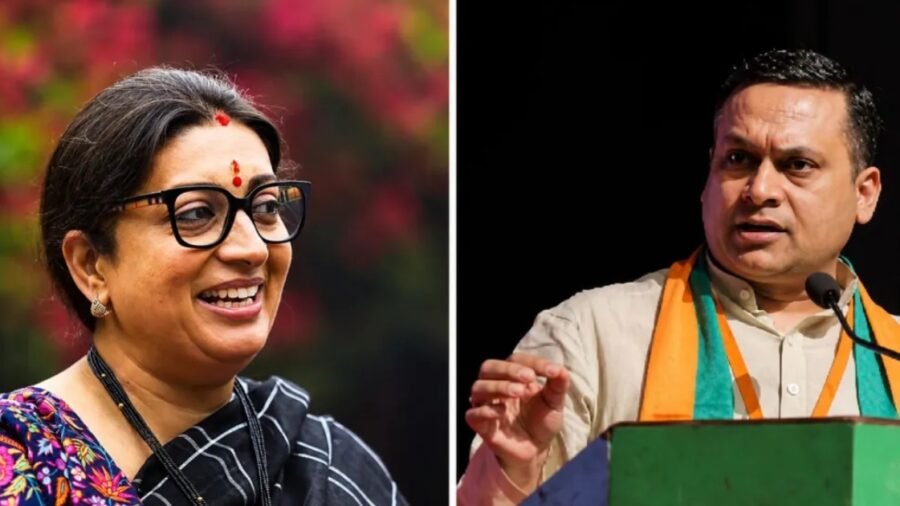
Smriti Irani’s return fits this calculation. Her 2019 victory over Rahul Gandhi in Amethi remains one of the BJP’s most memorable electoral moments. She brings national visibility and a strong UP association. But the contest extends beyond Congress. The BJP must not only win seats but also hold together the social and political coalition that has underpinned its dominance in the State.
Advertisement
The Presidential election is unlikely to have driven the reshuffle, but it reinforces another requirement: Managing allies and regional parties when political arithmetic matters.
The geographical spread of the team points to a longer-term calculation. The BJP is firmly established across much of the Hindi heartland and western India; its greater room for growth lies in regions where its electoral presence remains limited. Representation from Karnataka, Tamil Nadu, Kerala and Andhra Pradesh, along with the Northeast, suggests an effort to make the organisation more genuinely national. D Purandeswari’s elevation is particularly relevant to this southern push, while leaders such as K Surendran and Anil Antony bring experience from states where the BJP still has considerable room to grow.
This should not be read as a shift of the BJP’s centre of gravity to the South. Rather, it reflects an acknowledgement that future expansion cannot come only from regions where the party is already strong. The strategy is straightforward: Consolidate the base, repair weak spots and create new political space.
The social composition carries a similar message. Women, OBCs, Dalits, tribal leaders and members of minority communities have been given greater organisational visibility. This is more than symbolism. As the BJP’s electoral base has broadened, its organisation must increasingly reflect that social diversity.
The generational message is equally important, but this is not a wholesale replacement of the old guard. Nitin Nabin represents a younger leadership generation; Ram Madhav returns with organisational experience; Vasundhara Raje brings decades of electoral politics; and Santhosh continues to anchor the organisation. The message is better described as succession with continuity.
The BJP’s political core remains intact, but the social, geographical and generational environment in which it operates is changing. The reshuffle appears to recognise that distinction: The party does not need to abandon its established politics, but it does need an organisation capable of adapting to a changing electorate.
The changes in the digital and youth organisations suggest another adjustment. Amit Malviya has been replaced as the BJP’s IT cell chief, while Tejasvi Surya has been replaced as president of the youth wing. This should not automatically be read as a retreat from digital politics. The BJP was among the earliest major Indian parties to build an extensive political social-media machinery. A more plausible reading is that the party is adapting that machinery to a digital environment that has become faster, more fragmented and less predictable.
That matters because younger voters can now generate political narratives outside established party structures. Recent youth-led protests over examinations and employment are instructive — not because they demonstrate an anti-BJP wave, but because they show how quickly a specific grievance can enter the national political conversation.
For young Indians, competitive examinations are tied to family investment, social mobility and the hope of a secure future. When that pathway appears uncertain, questions of fairness and institutional credibility can quickly become political.
The challenge, therefore, is less ideological than political: How to connect the BJP’s established vocabulary of Hindutva, nationalism, welfare and leadership with voters whose expectations are becoming more diverse. A young person can strongly identify with religion, support the BJP, benefit from welfare and still expect the state to deliver greater economic opportunity and institutional credibility.
The Ram Mandir captures this transition. One of the BJP’s most enduring political promises has reached a historic milestone. Its significance will remain, but politics inevitably moves to the next question: What comes next?
For some, it may be employment; for others, economic security, institutional fairness or simply the expectation that the State should deliver.
The BJP therefore does not face a choice between Hindutva and development. Its harder task is to connect identity and welfare with the aspirations of a generation that expects the State not only to represent it, but also to deliver for it.
Seen in this light, the reshuffle is less about changing office-bearers than preparing the organisation for a more competitive and less predictable political environment. Uttar Pradesh, federal coalition management, southern expansion, social representation, leadership succession and digital politics are parts of the same calculation.
Nitin Nabin is the generational face of that adjustment. The real test will be whether the new team can detect political anxieties before they become electoral problems.
The reset, then, may not be about changing what the BJP stands for. It may be about ensuring that its organisation can understand — and respond to — a changing India before that change is reflected at the ballot box.
The writer teaches at Patna University

Sussanne Khan says she felt ‘more love’ for Hrithik Roshan’s mother after losing her own
By Sohail Khan · 28 Sep
COP31 hosts Australia and Türkiye face the fossil-fuel question
By Sohail Khan · 28 Sep