4 in 10 voters missed in 25 Maharashtra seats. Every one of them is a city seat
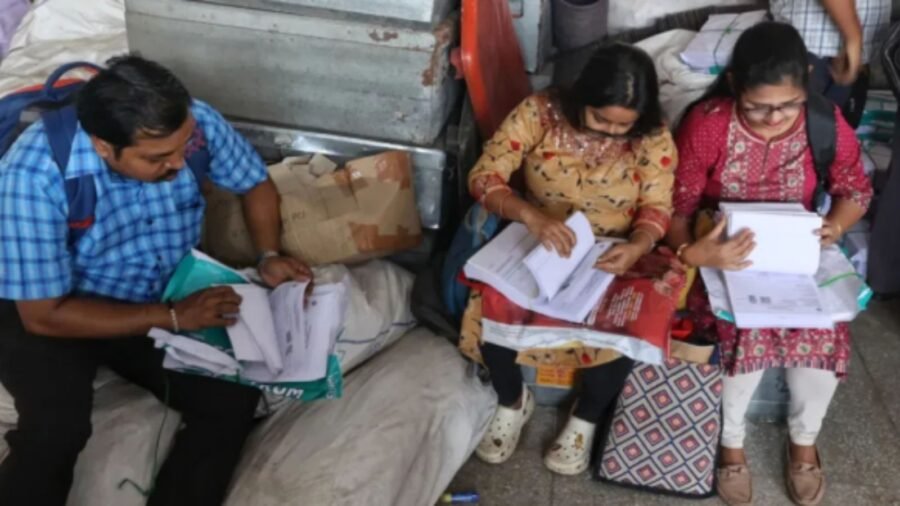
In Maharashtra’s 25 of 288 Assembly constituencies, all of which are urban, the Special Intensive Revision (SIR) forms of over 40 per cent voters could not be collected – their names would not find place in the draft roll that would be published on August 31.
These 25 constituencies have 1.10 crore electors, of whom 48.17 lakh, or 43.7 per cent, could not be traced.
This account for nearly a quarter of all uncollected forms in the state.
Statewide, forms of 2.07 crore of Maharashtra’s 9.78 crore electors, or 21.16 per cent, could not be collected. Those voters are liable to be left out of the draft roll and will then have to file a claim to get their names back on it.
Bhiwandi East seat recorded the highest rate, 49.11 per cent, nearly two-and-a-half times the state average.
Forms of almost half its electoral (1.84 lakh of its 3.76 lakh voters) could not be collected. Colaba seat follows at 46.98 per cent, Khadakwasla at 46.64, Nalasopara at 46.43 and Kothrud at 46.26. Kalyan Rural and Hadapsar complete the list of seven seats where forms of more than 45 per cent of voters went uncollected.
Rate and volume tell different stories.
Story continues below this ad
Nalasopara has the largest number of uncollected forms anywhere in the state – 3.07 lakh of 6.62 lakh voters – because its electorate is far bigger. Hadapsar follows with 2.98 lakh, Panvel 2.83 lakh, Khadakwasla 2.78 lakh and Kalyan Rural 2.52 lakh.
Many Booth Level Officers blame the urban concentration on the difficulty of reaching voters.
Dense housing clusters, high-rise buildings and a highly mobile population make door-to-door verification harder. In Mumbai, Thane and Pune, residents have reported BLOs not reaching individual homes, with forms left at building gates instead.
Maharashtra Chief Electoral Officer S Chockalingam said the high percentage of uncollectable forms in urban areas was also linked to population mobility. “People keep shifting from one place to another and their electoral records are not always updated. Another factor that needs to be considered is that this intensive revision is being undertaken after a gap of more than 24 years. The previous SIR was conducted in 2002 and the electoral rolls have not been comprehensively updated since then. We also have to take into account around 34 lakh names of deceased voters,” he said
Story continues below this ad
Chockalingam also said the draft roll was not the final voter list. Eligible voters can seek correction through Form 8 or apply for inclusion through Form 6 during the claims and objections period.
The worst-hit seats cut across party lines. Of the seven above 45 per cent, the BJP won Colaba, Khadakwasla, Nalasopara and Kothrud in the 2024 Assembly election, the Shiv Sena won Kalyan Rural and the Ajit Pawar-led NCP won Hadapsar. Bhiwandi East went to the Samajwadi Party.
Several of the worst-affected seats, including Bhiwandi East, Mankhurd Shivajinagar, Chandivali, Mumbadevi and parts of Malad, have large Muslim and Scheduled Caste populations and extensive informal settlements. Colaba, Sion Koliwada, Dharavi and Worli take in the city’s traditional fishing settlements.
The list is not uniform. Malabar Hill and Colaba, among the wealthiest constituencies in the state, record rates close to those in Mankhurd Shivajinagar. Kothrud and Khadakwasla, middle-class strongholds in Pune, are in the top five statewide.
Story continues below this ad
The pattern, therefore, cuts across income groups and neighbourhood types, from dense informal settlements to high-rise and middle-class areas.
Three SC-reserved seats are among the 25 above 40 per cent: Ambarnath at 44.21 per cent, Pimpri at 41.26 and Pune Cantonment at 40.47. Nagpur North (SC) is at 36.59 per cent, Dharavi (SC) at 34.55 and Boisar (ST) at 34.41.
The house-to-house exercise ran from June 30 to August 18. Claims and objections open once the draft roll is published on August 31, and the final roll is scheduled for October 19
Nepal Qualify For 2027 ODI Asia Cup After Beating UAE By 44 Runs In ACC Premier Cup Final
By Sohail Khan · 12 Sep