16 years to build a home? Experts explain what makes Suniel Shetty’s Jahaan different

It took 16 years for Suniel Shetty’s Khandala home, Jahaan, to evolve. What began as largely barren land with a few trees, cactus plants and rocks is now a property with more than 400 trees, a natural stream and a house designed around the contours of the site. But beyond the obvious greenery, what makes Jahaan interesting is the design philosophy behind it.
Experts studying the property point to something increasingly unusual in luxury homes: patience.
Rather than imposing a finished design on the site, the house appears to have evolved with it. That, architect Nitin Agarwal, Principal Architect at The Studio Synergy, says, is what makes Jahaan a good example of “slow architecture”.
“Homes are usually designed around deadlines. In this case, it looks like the design was done around the site,” Agarwal says.
For him, the 16-year timeline is not simply about how long construction took. The trees matured, the landscaping developed, and the natural topography remained part of the process. The placement of trees, differences in land levels, water flow, drainage and ventilation all appear to have influenced the design.
In fact, Agarwal says the house is an example of an “organic design rather than a design focused on transient trends.” Materials and spaces seem to fit the property rather than being forced into it.
Story continues below this ad
So what exactly is ‘slow architecture’?
Agarwal explains that slow architecture focuses on “the development of the site, and not on the speed of the market”. It considers the land, the people using it and the climate, allowing the design to respond to them over time.
That distinction is important in Jahaan’s case. The property was not treated like a blank canvas that needed to be levelled and perfected. Instead, its existing characteristics became part of the brief.
This also explains the idea that Shetty “let the hills define the design.”
According to Agarwal, that means the house and its construction were influenced by the site rather than the landscape being altered to fit a pre-decided house. The architecture also helps with practical aspects such as natural light, drainage and ventilation.
Story continues below this ad
His larger point is perhaps the most revealing: “The land was the main contributor to the design, rather than the construction itself.”
Gunjan Goel, Director at Goel Ganga Developments, sees the same principle from the interior-design side.
“What is most notable are the changes that dissolve from the interior to the natural landscape,” she says.
For Goel, the home does not need excessive decorative flourishes because the site already provides the visual richness. The texture of the earth, warm natural wood, soft hues and natural light do much of the work.
Story continues below this ad
And this is where the hills become more than a view.
Goel says Shetty’s use of windows, living spaces, verandahs and material selection allows the landscape to become the “primary design element”. The changing scenery, variations in daylight and seasonal shifts in foliage effectively keep changing the look of the home.
In other words, the house does not need to constantly change its décor because nature changes it for free.
Why the furniture matters
View this post on Instagram
A post shared by Kothi Club (@kothiclub)
While the architects focus on land and landscape, furniture expert Raghunandan Saraf, Founder and CEO of Saraf Furniture, sees another important part of Jahaan’s appeal: what has been put inside it.
“Furniture forms the nucleus of all interior designs and not decoration,” Saraf says.
Story continues below this ad
That is a useful distinction in a home where wood, earthy tones and natural textures carry so much of the visual language. Instead of treating furniture as something added after the architecture is complete, Saraf sees it as central to the way the interiors are experienced.
Shetty’s preference for brown and wooden shades also fits that philosophy. Saraf says such tones can create a sense of comfort, relaxation and strength.
But it is his argument about ageing that makes the furniture discussion particularly relevant to Jahaan.
“Natural wood will become more attractive with each year, as each grain and scratch becomes its history instead of a defect,” he says.
Story continues below this ad
That runs directly against the idea that a luxury home must always look new. In Saraf’s view, furniture built to last creates an enduring legacy because it can carry traces of the people and years that have passed through the house.
He draws a distinction between decorating and creating a home: the former can be about repeatedly refreshing a space, while the latter is about choosing things that endure.
What the 16-year wait actually adds
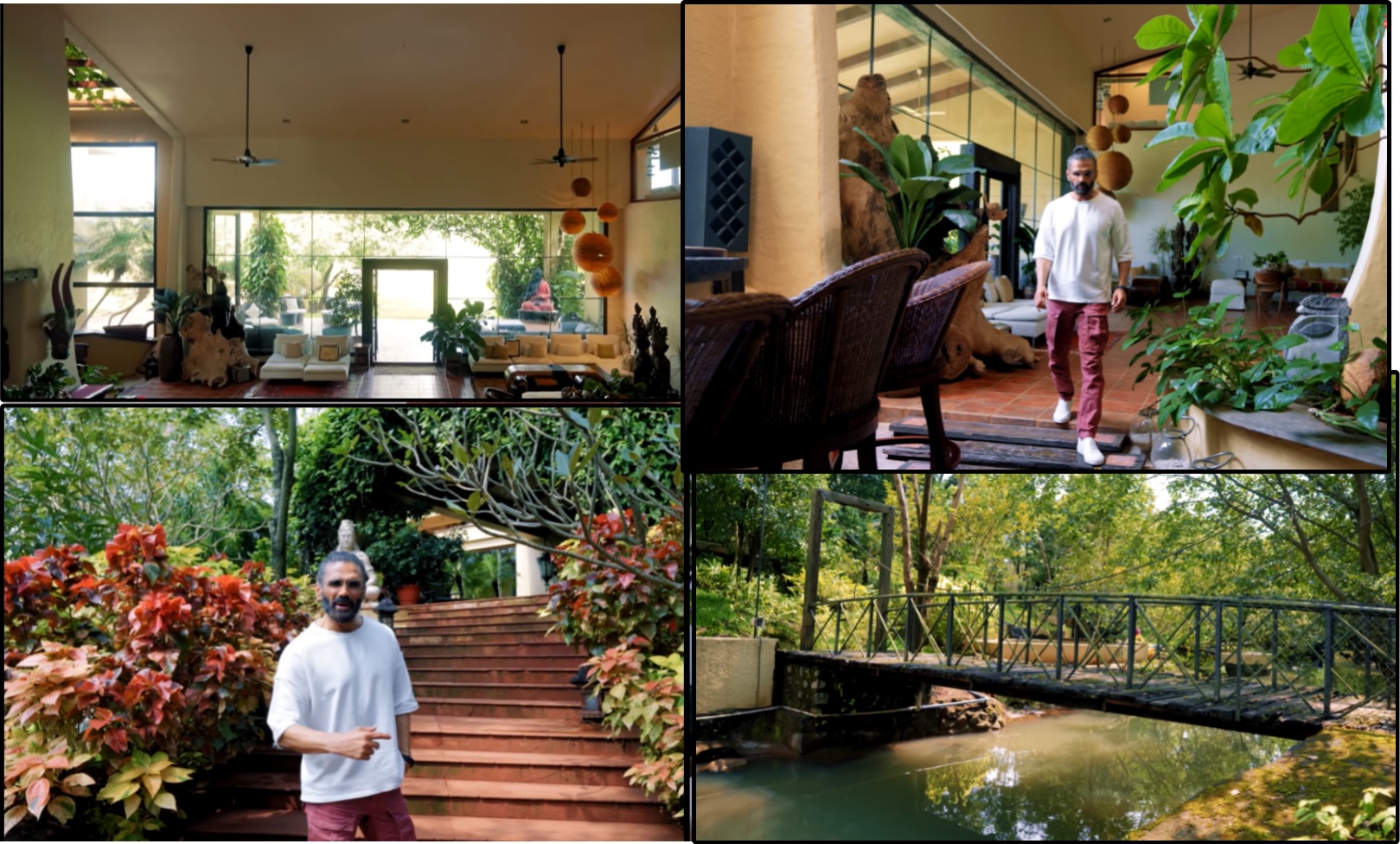 Glimpses of Shetty’s Jahaan (Screenshots from Asian Paints’ YT video)
There is a reason all three experts keep returning to time.
Agarwal points out that nature cannot simply be hurried into maturity. “Nature cannot be controlled in a timely manner,” he says.
Story continues below this ad
The growth of trees, the ageing of the landscape and thedevelopment of natural features all take time. In Jahaan’s case, the 16-year process allowed those changes to become architectural assets rather than problems to be concealed.
Goel similarly sees the home as the result of a design philosophy that “seeks to have permanence.” Preserving the landscape, allowing greenery to grow and incorporating existing water features meant the environment itself became part of the project.
That patience also helps explain why the house does not feel tied to one particular interior trend. The experts’ common thread is not that Jahaan is fashionable; it is that the design is less dependent on fashion in the first place.
Beyond luxury décor
Goel sees Jahaan as part of a broader shift in how luxury homes are being understood.
Story continues below this ad
The emphasis, she says, is moving away from luxury being purely about décor and towards features that improve residents’ everyday lives – natural light, fresh air, greenery and materials that gain character with age.
She describes the project as one focused on the “wellness of the residents”, rather than simply creating an impressive visual statement.
And that leads to perhaps her most important observation: “Real luxury is in developing an emotional bond with a space.”
For Goel, a home that mirrors memories, honours its surroundings and contains the natural world becomes more than a beautifully designed residence. It becomes a space that continues to interact with the people living in it.
That idea is particularly fitting for Jahaan. Shetty has spoken about “reliving my childhood in every possible way” there, while his children have created memories of their own. The property later became the setting for Athiya Shetty and K L Rahul’s wedding, adding another family chapter to a place originally built as a retreat for the Shetty family.
Ultimately, the experts see Jahaan’s appeal in different ways – through architecture, furniture, materials or wellbeing. But their conclusions meet at the same point.
The house works not because nature was made to fit the design, but because the design was willing to make room for nature – and wait for it.
Rishi Sunak, Ro Khanna, Dinesh D’Souza: united by colour; divided among white nationalists
By Sohail Khan · 28 Sep
From Nepal to India, how AI is improving disaster management
By Sohail Khan · 28 Sep
40 years ago September 28, 1986: Relief for Haryana farmers
By Sohail Khan · 28 Sep