Two captive-bred great Indian bustards released in Rajasthan national park
Union Environment Minister Bhupender Yadav and Wildlife Institute of India (WII) scientists released two male great Indian bustards (GIB) in Rajasthan’s Desert National Park on Sunday morning, marking the first step in rewilding captive-bred GIBs raised at two conservation breeding centres at Ramdevra and Sam, Jaisalmer, under Project GIB.
The project is being implemented for the long-term recovery of the critically endangered bird. Only about 150 GIBs remain in the wild.
Rajasthan Minister of Forest, Environment, and Climate Change Sanjay Sharma was also present on the occasion.
Story continues below.
Subscribe to see fewer ads.
“In a milestone move, released two male Great Indian Bustards in Sam, Desert National Park, Jaisalmer, today morning. This landmark success has been made possible by the nearly decade-long unwavering dedication of our scientists, researchers and ground staff who have spent years to ensure GIB reclaims the deserts of Rajasthan,” Yadav wrote on X.
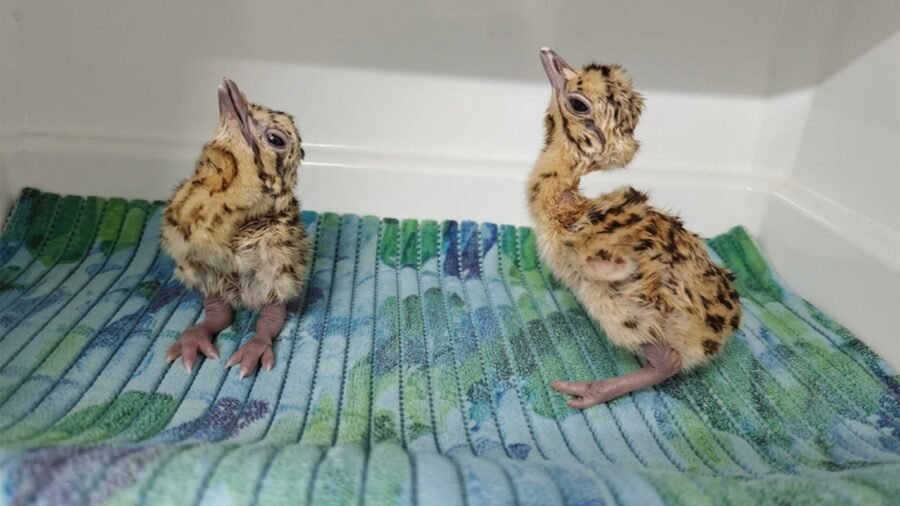
The conservation breeding centres were established to raise a founder population of GIBs that could be rewilded, a measure against the declining wild population. From 2019 onwards, wild-collected eggs were incubated artificially, and chicks were hand-reared. Later, these hand-reared birds mated in captivity.
At present, there are 98 such captive-bred birds in these facilities. Around 86 of them are being maintained for captive reproduction, and 11 have been earmarked for release into the wild. Of these 11, two birds were released into the wild at Desert National Park today. Captive reproduction has resulted in 24 live chicks in 2025 and 29 in 2026.
Species recovery programme
“The release of captive-bred GIBs represents the next critical step in the species recovery programme and will provide important scientific learnings for progressively developing and refining protocols for reintroduction of captive-bred birds into their natural habitat,” the environment ministry stated in a press release issued Saturday, after the initiation of the rewilding process.
Story continues below this ad
Yadav said Saturday that the GIB was important for grassland conservation, land degradation neutrality, and working as an important stopover for migratory birds that travel from the Central Asia flyway.
The Central Asian flyway is a large migratory corridor stretching across 30 countries from North to South Asia, connecting the Arctic and Indian Oceans.
Besides captive breeding, the project also includes habitat restoration by the Rajasthan forest department, including the establishment of around 200 square kilometres of fenced grassland enclosures inside the Desert National Park. Long-term telemetry studies by WII have identified these enclosures as prime breeding habitats for the species.

Why Odisha vs Chhattisgarh over Mahanadi row is back in spotlight
By Sohail Khan · 4 Oct
‘One last fight left in me’: Smit Machchhar details cockpit attack, fight to open door
By Sohail Khan · 4 Oct
Leave a Reply