Rajnath Singh stresses on self-reliance in aerospace sector as HAL delivers its 2,000th aero-engine
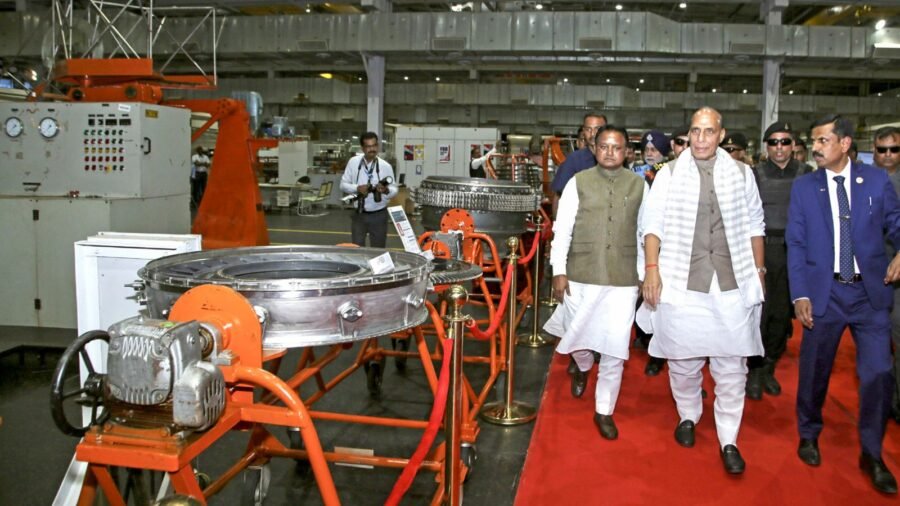
Union Defence Minister Rajnath Singh on Tuesday called for strengthening “indigenous capabilities” in the design, development, testing, manufacturing and maintenance of advanced aero-engines, stressing that mastery of propulsion technology is essential for self-reliance in the aerospace and defence sector.
Singh, who witnessed the delivery of the 2,000th aero-engine by Hindustan Aeronautics Limited (HAL), Koraput division at Sunabeda, noted that indigenisation of components and reduced turnaround time are contributing to operational readiness and extended service life of critical defence assets.
“Aerospace self-reliance must extend to indigenous aero-engine capability, particularly for the Advanced Medium Combat Aircraft (AMCA) programme. A sovereign aerospace ecosystem requires indigenous capabilities across materials, design, manufacturing, testing and Maintenance, Repair and Overhaul (MRO),” said Singh.
Story continues below.
Subscribe to see fewer ads.
He also highlighted proposed investment of around Rs 5,000 crore, indigenisation of raw materials in partnership with Mishra Dhatu Nigam Limited (MIDHANI), and establishment of India’s first indigenous high-thrust engine testing facility.
Urging the HAL Koraput division to raise standards in quality, productivity, indigenisation, innovation and delivery timelines, Singh described the 2,000th engine as a significant milestone and called for using it as a foundation to build an Indian aerospace industry capable of designing, developing, manufacturing and supporting advanced propulsion systems.
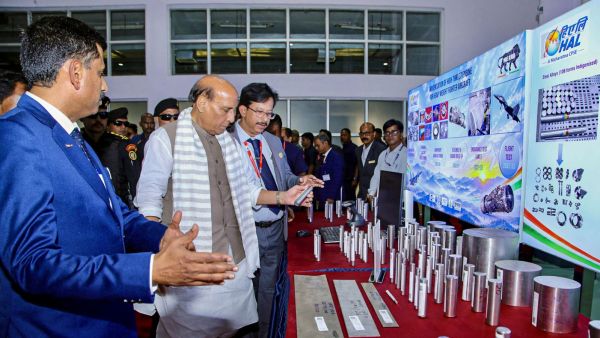 Defense Minister Rajnath Singh during the inauguration ceremony of second Shakti Engine Manufacturing line, in Koratput.
Emphasising the need for reliable indigenous propulsion for India’s helicopter ecosystem, the defence minister stated that forces require engines that are available when needed, supported throughout their lifecycle, and upgraded with evolving technology.
‘A long-term endeavour’
“Aero-engine development is a long-term endeavour requiring sustained investment, specialised testing, skilled manpower and a strong industrial ecosystem, with focus on repeatable, reliable and scalable production, design, critical materials and superalloys,” he added.
Story continues below this ad
Singh, on the occasion, hailed HAL’s contribution to military aviation, noting that its engines have powered frontline aircraft, including the MiG-21, MiG-27, MiG-29 and Su-30MKI since establishment of the unit in 1964.
The defence minister announced that HAL is enhancing annual AL-31FP engine production capacity from 30 to 50 engines annually with an investment of Rs 335 crore. He also announced a second Shakti engine production line with an investment of Rs 218 crore.
“The new line will manufacture up to 100 engines annually and is scheduled to be fully established by 2028-29, catering to indigenous helicopters including Dhruv Advanced Light Helicopter (ALH) and Prachand Light Combat Helicopter (LCH),” added Singh.
He also called for greater integration of MSMEs, start-ups, private industry, academia and research institutions into the propulsion ecosystem.

3 children suffer head injuries as ceiling collapses at government school in Udaipur
By Sohail Khan · 6 Oct

Stop daily drama, learn from Modi to win people’s support: BJP to Congress
By Sohail Khan · 6 Oct
Leave a Reply