India, Switzerland sign 5 pacts as PM Modi, President Guy Parmelin discuss trade, defence and nuclear energy
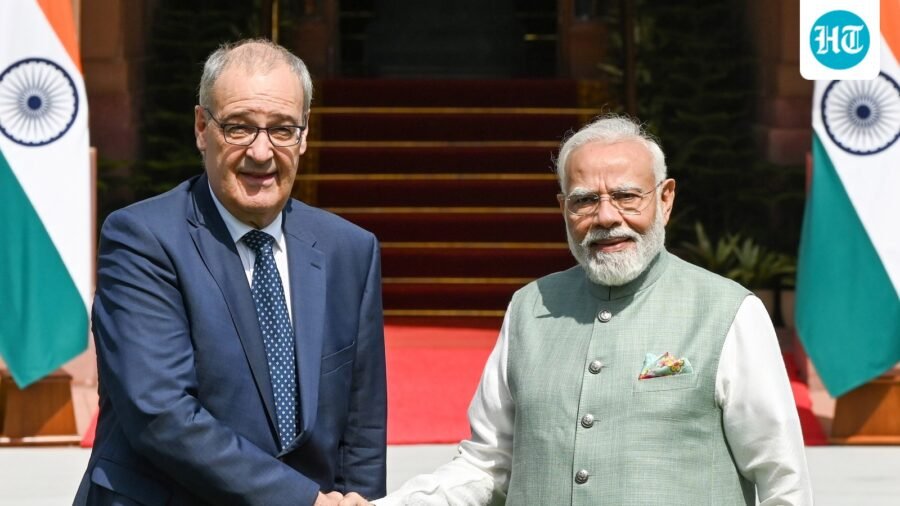
India and Switzerland signed agreements covering migration and mobility, young professionals, transportation, research, and innovation and technology transfer.
Updated on: Oct 5, 2026, 23:00:06 IST
Prefer HTon Google
Share via
Copy link
India and Switzerland on Monday concluded two agreements on the mobility of professionals and agreed to expand access for Indian exports to Swiss markets as Prime Minister Narendra Modi and President Guy Parmelin explored ways to enhance cooperation in defence and nuclear energy.
Parmelin is accompanied by a high-level business delegation and his visit coincides with the first anniversary of the coming into force of the Trade and Economic Partnership Agreement (TEPA) that India signed with the European Free Trade Association (EFTA), a bloc that includes Switzerland, Iceland, Norway and Liechtenstein.
Modi described TEPA, India's first trade deal with any European economic bloc, as an ambitious blueprint for investment, innovation, and jobs that envisages $100 billion in investments and the creation of one million jobs in India over 15 years by the four countries.
“We have taken several important decisions to expand market access for Indian exports to Switzerland and further facilitate investment between the two countries,” Modi said at a joint media interaction with Parmelin.
These measures will increase India's exports in agriculture, pharmaceuticals, textiles and engineering goods, and attract new Swiss investments in biotech, life sciences, banking, insurance, food processing and sustainability.
India, Switzerland sign mobility agreements
The two sides signed a memorandum of understanding (MoU) for a migration and mobility partnership, which will develop cooperation in this field “under equal treatment principles” and prevent irregular migration and human trafficking. It also provides for multiple-entry visas for up to five years, including stays of up to six months on each visit, and renewable one-year student permits.
A second agreement will govern the exchange of young professionals taking up temporary employment in the other country to enhance their professional and language skills within their field. This covers the exchange of 300 people annually per country, and the figure may be increased to 500, and a timeline of 30 to 90 days for verification of nationality and residency status.
Modi flags defence, nuclear energy cooperation
Modi said innovation, infrastructure and advanced technology are strong pillars of the bilateral partnership and the new initiatives will help the joint development of trusted supply chains and reliable solutions for the world.
“Today, we identified new possibilities for cooperation in military exchanges and defence production. We also agreed to further deepen cooperation in nuclear energy,” Modi said, speaking in Hindi.
Parmelin described the partnership as mutually beneficial. India will gain access to capital and technology transfers as well as easier access to markets for high-value-added goods, while Switzerland will benefit from trade “with a massive partner experiencing sustained growth, at a time when global trade has become more exposed and unpredictable”, he said, speaking in French.
Switzerland seeks investment protection pact
However, Parmelin emphasised the importance of quickly concluding an agreement on investment protection to stimulate investment.
“In this context, it is equally important to achieve results in discussions on the protection of intellectual property,” he said.
Modi also invited Swiss infrastructure companies to invest in India on a large scale and participate in capacity building, design and manufacturing. He said the two sides will launch new joint research projects in priority areas such as health, clean energy and space.
Parmelin added that both sides aim to promote an AI governance model that is innovative and equitable. “We are living through very difficult times. It is all the more essential to create win-win situations at the international level,” he said.
Five agreements signed
The two sides signed three more agreements – an MoU on collaboration in transportation technologies, mobility systems and infrastructure that will promote cooperation in sustainable infrastructure, electric vehicles, ropeways and tunnels, a letter of intent to promote long-term cooperation between the Indian and Swiss research communities, and an implementation arrangement for cooperation in innovation, technology transfer and entrepreneurship.
Ukraine, West Asia conflicts discussed
International and regional issues, including the conflicts in Ukraine and West Asia, figured in the talks between the two leaders. Modi said both sides believe in dialogue and diplomacy and work for global peace and stability. “Whether in Ukraine or West Asia, India has supported every meaningful effort towards peace,” he said.
Sibi George, secretary (West) in the external affairs ministry, told a media briefing that India and the EFTA bloc had agreed to set up a special group to discuss all issues related to trade and investment and to address constraints.
Switzerland is India's largest trading partner in EFTA and its 15th largest trade partner overall, with two-way trade worth $25 billion. About 340 Swiss companies have operations in India and have invested $11 billion in areas such as pharmaceuticals, chemicals, precision engineering and advanced technology
Switzerland is home to almost 30,000 Indians, including students and professionals actives in areas such as financial services, engineering, IT and pharmaceuticals.
See Less

Prisons DIG allegedly sexually exploited convict’s wife
By Sohail Khan · 6 Oct
Minister calls for efficient power use
By Sohail Khan · 6 Oct
Silver jewellery worth ₹5 lakh stolen from shop
By Sohail Khan · 6 Oct
Leave a Reply