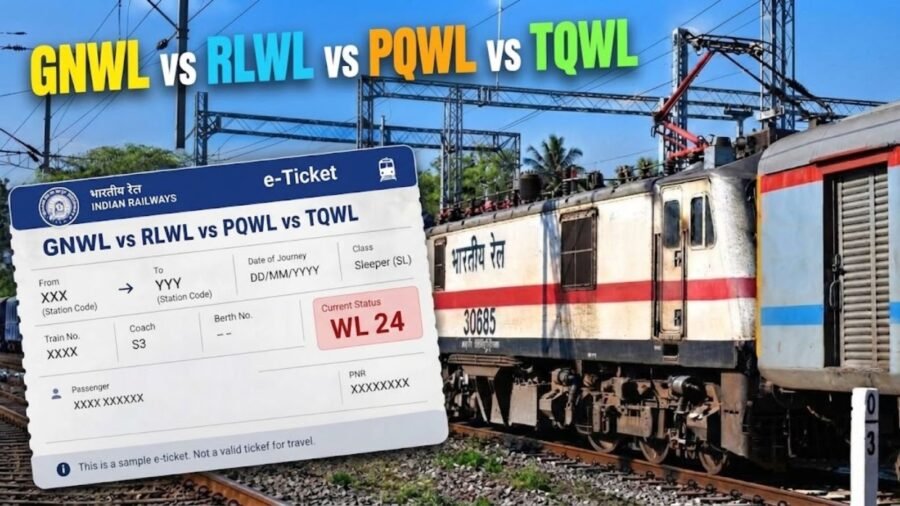
GNWL vs RLWL vs PQWL vs TQWL: Which railway waitlist has the best chance of confirmation?
Story continues below.
Subscribe to see fewer ads.
GNWL vs RLWL vs PQWL vs TQWL: Which waitlist has the best chance?
The train ticket confirmation depends on several factors. Speaking to Indianexpress.com, a senior railway official said the actual movement of a waiting list depends on factors such as cancellations and the release of unutilised quota.
“Indian Railways’ reservation rules shows that these are not merely different names for the same waiting list. They represent different reservation quotas and different pools of accommodation. Consequently, their movement towards confirmation can also be very different,” the official said.
- GNWL: Usually the strongest position
GNWL stands for General Waiting List and is associated with the general quota. Among the commonly seen waitlist categories, it generally offers the strongest position for confirmation. The official said that GNWL generally has an advantage because it draws from the main pool of accommodation and benefits from cancellations and release of certain unused quotas.
“Railway reservation material specifically states that RLWL and PQWL are confirmed after the General Waiting List, giving GNWL an important structural advantage over these smaller quota-based waiting lists,” the official noted. The official, however, added that this does not mean GNWL 100 is automatically better than RLWL 2.
Story continues below this ad
“The actual waiting-list number, train, class, journey sector, day of travel and expected cancellations still matter. But when comparable waiting-list numbers are being considered, GNWL is generally the more favourable category to hold,” the official told Indianexpress.com.
- RLWL stands for Remote Location Waiting List
When a passenger books a train from an important intermediate station rather than the originating station, the ticket may be placed under the RLWL quota. Indian Railways keeps a separate quota for certain remote or important stations on a route.
The key difference is that RLWL has a smaller, separate pool of seats. Its confirmation therefore depends largely on cancellations or the availability of accommodation in that particular quota. Railway reservation rules also place RLWL behind the General Waiting List in the confirmation order.
“Railway reservation instructions make the hierarchy clearer: RLWL is cleared after the General Waiting List. This explains why an apparently small RLWL number should not automatically be treated as equivalent to the same GNWL number,” the official explained.
Story continues below this ad
- PQWL stands for Pooled Quota Waiting List
This quota is meant for passengers travelling between certain intermediate stations on a route. The available seats are shared among these station combinations. Because the number of seats in this pool is limited, PQWL may move more slowly than the General Waiting List. Its confirmation depends on cancellations and the availability of seats in the pooled quota.
Railway reservation rules also place PQWL after the General Waiting List for confirmation. “Thus, a passenger comparing two otherwise similar booking options should not assume that “WL 10” means exactly the same thing under GNWL and PQWL,” the official said.
- TQWL means Tatkal Quota Waiting List
Tatkal Waitlist applies when the seats available under the Tatkal quota have already been booked and further Tatkal bookings are placed on the waiting list. It is a separate quota meant mainly for passengers making last-minute travel plans. This means TQWL follows a different confirmation pattern from the General Waiting List.
The chances of a TQWL ticket getting confirmed depend on factors such as cancellations and the availability of berths under the Tatkal quota.
Story continues below this ad
“For passengers, the practical lesson is straightforward: TQWL should not be treated as having the same confirmation dynamics as GNWL merely because its numerical waiting-list position is smaller,” the official added.
GNWL, RLWL, PQWL & TQWL – WHICH WAITLIST CONFIRMS FASTER?
GNWL
General Waiting List
Main/general quota – largest accommodation pool
Strongest position. Confirmed first, ahead of RLWL and PQWL; benefits most from cancellations and released quota.
RLWL
Remote Location Waiting List
Quota reserved for specific intermediate/remote stations
Confirmed only after GNWL. Smaller, restricted quota pool – movement is slower and depends on that station's own cancellations.
PQWL
Pooled Quota Waiting List
Shared quota for specific intermediate station-pairs (not full route)
Confirmed only after GNWL. Limited shared pool – a given WL number here is weaker than the same number in GNWL.
TQWL
Tatkal Quota Waiting List
Separate Tatkal quota, for last-minute bookings
Appears once Tatkal quota is exhausted. Confirmation tied strictly to Tatkal availability and cancellations – not comparable to GNWL dynamics.
KEY TAKEAWAYS
- No fixed confirmation percentages exist. Websites quoting fixed rates (e.g. "GNWL has 80–90% chance") are estimates, not official Railways figures.
- Hierarchy only, not a guarantee: GNWL clears before RLWL and PQWL, but a large GNWL number (e.g. GNWL 120) isn't automatically safer than a small RLWL number (e.g. RLWL 2).
- Confirmation depends on: train, class, route, day/season, cancellations, quota releases, extra coaches and time left before departure.
- AI prediction is now the better guide: Indian Railways' RailOne app gives an AI-based confirmation prediction, with accuracy improved from 53% to 94% (per Ministry of Railways). It remains an estimate, not a guarantee.
Indian Railways waiting ticket confirmation prediction
When asked about the actual confirmation percentages, the official said Indian Railways has previously informed Parliament that confirmation and cancellation trends vary depending on factors such as peak and lean travel periods, the type of train, journey details and passenger demand.
“A GNWL 25 on one train may therefore clear comfortably while GNWL 10 on another heavily booked service during a festival rush may remain uncertain. Other variables include the class of travel, day of the week, boarding and destination stations, cancellations by confirmed passengers, quota releases, additional coaches and the time remaining before departure,” the official replied.
The railway official also explained that GNWL generally has the strongest position for confirmation. RLWL and PQWL depend on smaller quota pools and are cleared after the General Waiting List, while TQWL follows the Tatkal quota and depends on available berths and cancellations.
Story continues below this ad
However, the waitlist number also matters. “A GNWL 120 cannot automatically be described as safer than RLWL 2 simply because GNWL has higher priority. There is no mathematically valid comparison without looking at that train’s historical and current booking pattern,” the official said.
Indian Railways waitlist prediction AI
Indian Railways’ RailOne application provides an AI-based prediction of whether a wait-listed ticket is likely to be confirmed or not. According to the national transporter, the accuracy of its waitlist confirmation prediction has increased from 53 per cent earlier to 94 per cent now.
“The concept itself is not entirely new. Indian Railways introduced a machine-learning-based confirmation prediction facility years ago, using historical PNR data to identify booking and cancellation patterns.
The prediction remains an estimate rather than a guarantee. Indian Railways’ own PNR enquiry system warns passengers that prediction is indicative and based on current and past trends, and that the actual status can differ,” the official said.

Why Odisha vs Chhattisgarh over Mahanadi row is back in spotlight
By Sohail Khan · 4 Oct
Two captive-bred great Indian bustards released in Rajasthan national park
By Sohail Khan · 4 Oct

Leave a Reply