From the edge of extinction, two captive-bred Great Indian Bustards released into wild in Rajasthan
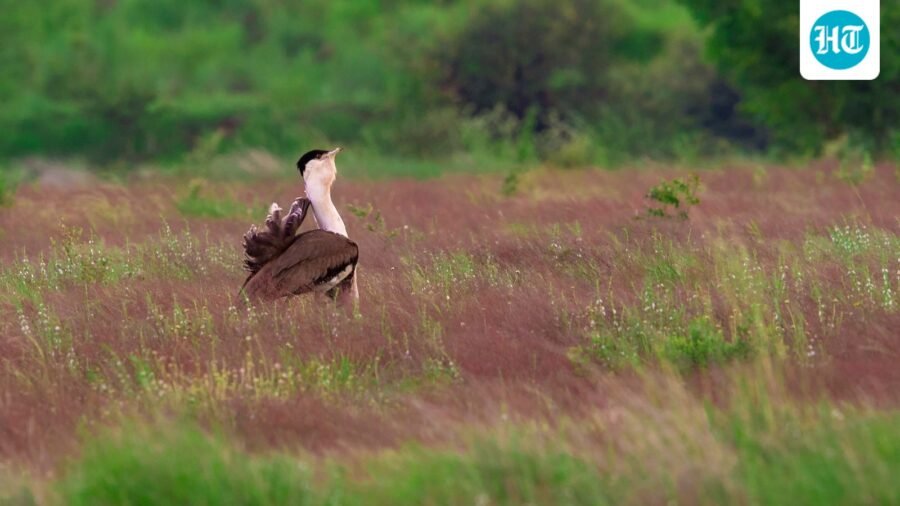
The release marks a new phase in the conservation programme, with experts set to track whether captive-raised birds can survive and reproduce without assistance
Published on: Oct 5, 2026, 06:29:29 IST
Prefer HTon Google
Share via
Copy link
Not very long ago, the Great Indian Bustard (GIB) ranged across a vast swathe of India, from Punjab in the north to Tamil Nadu in the south. Today, fewer than 150 remain in the wild, confined largely to pockets of Rajasthan’s Jaisalmer and Kutch in Gujarat.
The decline has been driven by two major threats.
Grassland loss emerges as a major threat
The first was the loss of its grassland habitat. Dry grasslands, the natural home of the bustard, were often classified as wasteland, leaving them vulnerable to takeover by government agencies and encroachment. The resulting neglect degraded the habitat, reducing the prey base and depleting water sources.
The second, and more recent, threat came with the rapid expansion of high-voltage transmission lines and windmills across the bustard’s remaining habitat. Unlike many other birds, bustards have excellent peripheral vision to detect predators but relatively poor front vision. When flying, they can fail to detect overhead power lines and collide with them, often fatally.
“Degradation of grasslands along with hunting contributed in a major way in decline of the GIB population. Their habitats have shrunk to less than 10% as compared to 1960s. In the last two decades, the high voltage lines connecting wind mills and solar farms to the grid in western Rajasthan and Gujarat overlap with Bustard traditional homes, and is a reason for death of large number of bustards,” said MK Ranjitsinh, former Union environment secretary.
Supreme Court relaxes restrictions on overhead power lines
In 2021, the Supreme Court banned laying of overhead new power transmission lines in 99,000 square km area of GIB habitat in Rajasthan and Gujarat to save them. Years later, the SC relaxed the guidelines by reducing the area to about 14,000 square kilometers and providing more time to lay the underground lines.
In 2016, the Government of India started a project to revive Rajasthan’s state bird, the Great Indian Bustard, through captive breeding in Jaisalmer. By June 2026, the captive population had reached 98, of which 38 were born through artificial insemination.
On Sunday, that effort entered a new phase when two captive-bred GIBs were released into the wild at the Desert National Park, at Sam in Jaisalmer.
“With this, we have entered a new era of GIB conservation,” said Ashok Singh, assistant conservator of forest at Jaisalmer.
Rewilding training prepares birds for life outside captivity
But releasing a bird is one thing. Making it survive in the wild is another. The birds underwent extensive rewilding training at a specially designed facility costing ₹9.25 crore at the GIB Conservation Breeding Centre at Ramdevra.
Inside the tunnel, captive-bred birds are exposed to natural sunlight, temperature variations and airflow and were made to hunt the prey — insects and other natural foods — and find water, Singh said.
If they survive, the experts from Wildlife Institute would monitor their reproduction in wild to revive the GIB population. “If that happens, we could say that the project was successful,” said an expert from the Wildlife Institute.
First release to guide future conservation efforts
The information gathered from the first release will be important in determining how future captive-bred GIBs should be trained and released. It will also help scientists assess whether birds raised in captivity are capable of establishing themselves in the wild without prolonged human assistance, said WII official Mahesh Gurjar.
He added that use of artificial insemination is considered an important development because it provides conservation scientists with an additional tool for breeding birds and managing genetic diversity in a species whose wild population has fallen to critically low levels.
If the experiment works, the officials said the next destination could be Kutch. Already, a first chick has hatched in March 2026 after a fertile egg was moved about 770 km from Rajasthan. The chick has survived beyond the critical first three months in the wild, a landmark for restarting breeding in Gujarat’s isolated population.
Gujarat steps up habitat restoration at Naliya
In Gujarat, officials said that the habitat restoration work at Naliya has started and about 11 sq km of invasive Prosopis juliflora, with 30 km of predator proof fencing covering 15 sq km, has been done. As per the Gujarat Action Plan for GIB Conservation, a target of release of 30 birds and 200 to 500 sq km of secure grassland has been set. In future, the GIB can be introduced in new habitats in states such as Maharashtra and Madhya Pradesh, officials said. “That will all depend on how the captive bred GIBs survive in the wild,” a senior environment ministry official said.
Sumer Singh Bhati, who has followed bustards in western Rajasthan for over a decade, said, “The real test is not just producing birds in captivity. That is easier than making them survive in the wild. There is a need to create a landscape where bustards can survive after release and flourish. Improving the habitat and putting all transmission lines below the ground would be key to revive the bustard population in the longer run,” he said.
See Less

Doctor assault: Sena corporator surrenders before Thane court; sent to jail
By Sohail Khan · 5 Oct
GST 2.0 may replace arrests with fines for tax defaulters
By Sohail Khan · 5 Oct

Leave a Reply