El Nino, rain deficit likely to add to Mumbai’s pollution and poor air
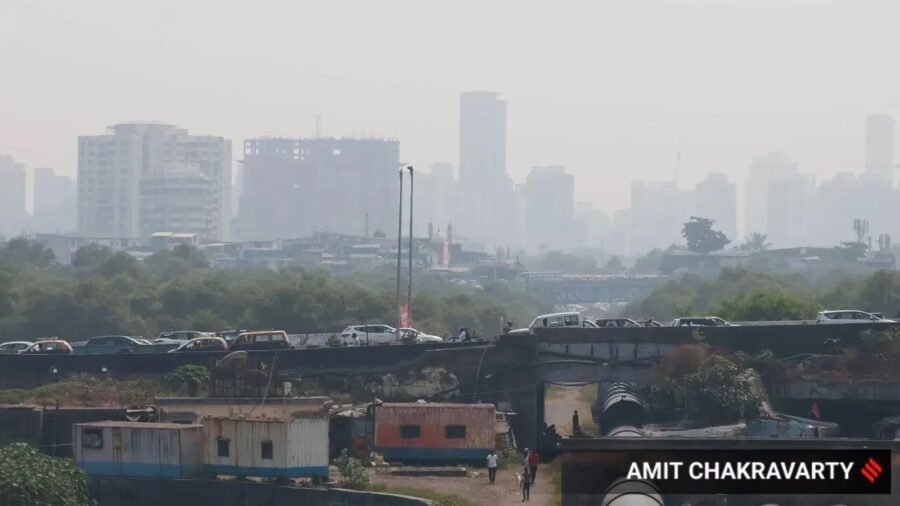
October has just begun, and Mumbai’s air quality has started to deteriorate, with certain pockets reeling under thick haze as the southwest monsoon marked an early withdrawal from Maharashtra. A strong El Niño phenomenon, which led to rainfall deficit and drought, is likely to add to Mumbai’s plummeting Air Quality Index (AQI) this winter.
As many as 21 districts in the state recorded deficit rainfall as the India Meteorological Department (IMD) declared the withdrawal of monsoon on Saturday — Mumbai’s earliest monsoon withdrawal since 2023.
El Niño — the warm phase of ENSO — refers to a phenomenon that is spurred by changes in sea-surface temperatures and atmospheric conditions in the eastern Pacific Ocean. The naturally occurring climate pattern can alter weather patterns globally and is most typically known to increase the likelihood of drier monsoons, drought, as well as extreme heat.
Story continues below.
Subscribe to see fewer ads.
While El Niño has been historically associated with below-average southwest monsoon in India, scientists and observers have said that strong El Niño patterns are also associated with worsening air pollution conditions owing to influx of dust-laden winds, extreme heat and below-normal post-monsoon rainfall.
For instance, Mumbai has been waking up to a thick blanket of haze and plummeting AQI levels since the onset of October. While the air quality index was in the “good” category of 0-50 until September 29, the AQI levels registered a sharp spike in October and finally went above 100 on October 2.
The deteriorating AQI coincides with the withdrawal of rain-bearing winds, which play a crucial role in settling down pollutants.
Speaking to , Raghu Murtugudde — Emeritus Professor at the University of Maryland and a visiting professor at IIT Kanpur’s Kotak School of Sustainability- said the spike in AQI was a result of the clockwise wind patterns that usher in dry and dusty winds from as far as the Middle East, while the conditions worsened owing to the favourable atmospheric conditions created by El Niño.
Story continues below this ad
“Over the past few days, the AQI worsened owing to the clockwise wind circulation that was pumping dry and dusty air from Rajasthan, Pakistan, and even the Middle East. When there is a clockwise circulation, the air tends to sink, trapping pollutants. The fact that PM10 pollutants were higher than PM2.5 was an indication of the fact that dusty and dry winds were blowing in from external regions. However, what worsened the pollution levels was the background of below-normal rainfall, high humidity, and dust influx caused by El Niño,” said Murtugudde.
“Pollution-inducing factors such as vehicular emissions and industries are always present in the atmosphere. While rain is good for washing away these pollutants, El Nino makes it harder for the pollution to be eliminated as the system is known to suppress rain activity,” he added.
Mahesh Palawat, vice-president of climate change and meteorology at Skymeg Weather Services, added that strong El Niño can indirectly trigger higher pollution levels owing to suspension of loose soil and dust particles.
“Since El Niño is known to disturb widespread rainfall, it triggers dryness. Since the surface is left dry due to insufficient monsoon, the loose soil and dust particles get suspended in the atmosphere and contribute to PM10 pollutants in the atmosphere,” Palawat told .
Story continues below this ad
In Maharashtra, an early withdrawal of monsoon winds means that the region now stares at a prolonged period of dry weather and a longer post-monsoon season.
“El Niño is also known to reduce the possibility of post-monsoon showers, which is responsible for bringing intermittent relief from high AQI levels,” experts said, pointing to the likelihood of higher pollution levels.
Last week, the state government of Maharashtra declared a drought in 265 of its 358 talukas.
Over the past five years, Mumbai has been reeling under air pollution during winter. While the city’s AQI showed improvement at monitoring stations in 2025, unhealthy air is becoming the new normal for Mumbai.
Story continues below this ad
Gearing up to tackle pollution, the BMC launched fresh standard operating procedures (SOPs) on October 2. Each civic ward is now set to identify at least 10 pollution hotspots, including major construction and redevelopment sites, infrastructure projects, open waste-burning locations, debris dumping points, and areas prone to traffic congestion. An officer will be assigned to each hotspot to monitor air quality and ensure corrective measures are taken.



Leave a Reply