British Airways London-Chicago flight plunged 28,000 feet before declaring emergency: What tracking data shows
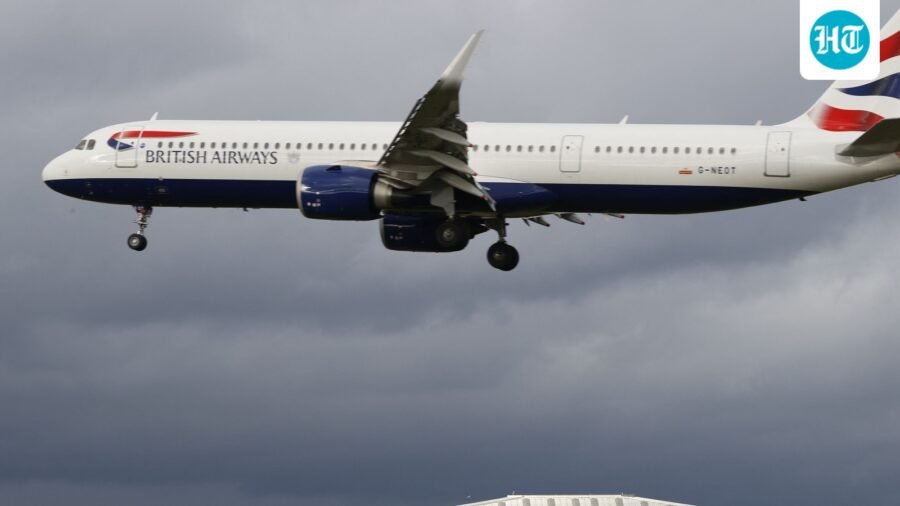
British Airways flight plunged 28,000 feet suddenly before declaring emergency: What tracking data shows
Updated on: Oct 5, 2026, 21:28:10 IST
Prefer HTon Google
Share via
Copy link
A transatlantic British Airways flight operating from London to Chicago on Monday suddenly plunged 28,000 feet after about an hour into its journey, a distance equivalent to almost 10 times the height of Dubai's Burj Khalifa, the world's tallest building.
The flight BA295 declared an emergency after squawking 7700 and descended from an altitude of 37,000 feet to an altitude of 9,000 feet within minutes. The flight then made a U-turn back to the United Kingdom, with tracking data revealing it had been diverted to London.
What does the flight-tracking data reveal?
The flight, which took off from London's Heathrow Airport at around 11.50 am local time, according to flight tracking data, and had a scheduled flight time of eight hours and 40 minutes to Chicago O'Hare International Airport (ORD).
After takeoff, it started its ascent and reached its cruising altitude of 37,000 feet. However, the flight, a Boeing 777-200ER, suddenly plunged to an altitude of 9,000 feet, registering a drop of 28,000 feet. The aircraft then issued a squawk 7700 code, shortly after beginning its rapid and steep descent. Following this, the flight took a U-turn while flying over Ireland's airspace.
It was diverted to London, flight-tracking data showed, and then circled multiple times in the airspace between Wales and Ireland. It then headed towards Heathrow, wherein it began to prepare for landing. It began its gradual descent thereafter.
Why was the flight flying in circles? What is squawk 7700?
The Boeing 777, after its diversion to London, kept flying in circles in an apparent effort to reduce its fuel weight as it prepared to return to Heathrow.
The aircraft was seen flying in circles, likely to burn off fuel before landing. Long-haul aircraft can carry a large amount of fuel for transatlantic journeys, and reducing the fuel load can help bring the aircraft closer to an appropriate landing weight during an early return.
The squawk code 7700 is used to declare a general emergency and acts as a signal to alert ground controllers that it needs immediate attention and priority landing.
Deep Dive
Powered ByAsk
After takeoff, it ascended to an altitude of
See Less

Leave a Reply