Born in Bihar, made in Bengal: Mukesh Kumar and Akash Deep behind RoI’s Irani Cup triumph
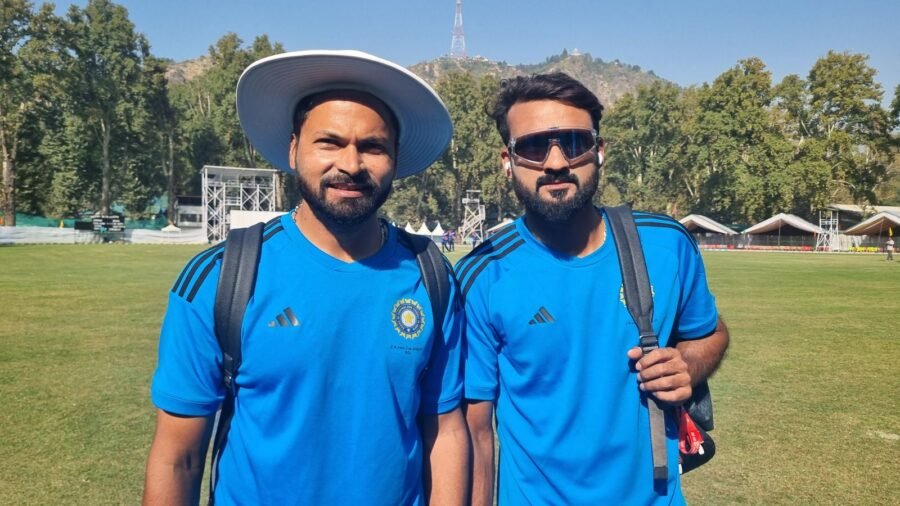
In the cold of Kolkata, Bengal had to settle for a draw. They would reach the final for the first time in 13 years, carried by the 67 wickets the two shared between them, but the silverware remained elusive.
In the cold of Srinagar, here at the Sher-I-Kashmir stadium, the silverware is theirs. Mukesh’s 6/33 and Akash’s 3/25 steered Rest of India to the Irani Cup, their first since 2024, with a 167-run defeat of the defending Ranji Trophy champions, Jammu & Kashmir.
“This was the first time we played together for Rest of India. Whenever we bowl together, it is so much fun. When something happens off the pitch from my end, I communicate it to him, and when the ball does something from his end, he comes and tells me ‘Bhaiya, aisa kar sakte hai’ (brother, we can do this). Saamne waale to pata chal jaata hai ki hum jab saath bowling karte hai, runs banana kitna mushkil hai (the batter knows how difficult it is to score when we bowl together),” says Mukesh.
Story continues below this ad
Akash, three years his junior, offers the quintessential younger brother’s nod of agreement.
“Our strength has been that we’ve played together for quite a while against great teams and top batters. We talk through things, which makes it simple whenever there’s any confusion about what to do. Sometimes conditions favour the batters, and discussing things between us makes handling those situations much easier,” he adds.
Their journeys run along parallel tracks. Akash, hailing from Bihar’s Sasaram, arrived in West Bengal in 2010 to live with his uncle. Mukesh, also from Bihar, relocated from Gopalganj a couple of years later, to help his father in his taxi business. Neither set of parents approved of their cricketing ambitions, yet both made the Bengal side, and then India.
“Our backstories are the same,” says Mukesh. He would have continued, if not for the interjection from Akash.
Story continues below this ad
“Our story is such that things for both of us seem to happen in parallel. Whatever happens, happens together. Don’t know if this is a stroke of destiny. Hum do alag jism hai, par ek hi kismat hai (we share separate bodies, but the same fortune). It is hard to explain. Even we don’t understand why everything turns out so similar for us,” he says.
For both men, the match carried a weight beyond a single trophy. For Mukesh, who has not played for India since July 2024, it was the opportunity to raise a case against his exile. For Akash, the challenge was to prove himself fit before the selectors — two of whom monitored him closely from the sidelines — pick the team for the New Zealand series. It was his first match in nearly eight months, having recently recovered from a lower-back stress fracture.
“What I felt during those six months was that my body needed a break. God perhaps gave that to me in the form of an injury, and I utilized that time really well. When I went into training and understood how my body was reacting, I made full use of that period. Diet, sleep, training, skill work—I did everything systematically. The outcome of that is showing now; it’s not like I am exerting extra strain right now just to hit 145 kmph. It is the cumulative result of what I did over those six to seven months. It’s not just about what I’m doing in this match today or the speed on the radar,” says Akash.
Mukesh arrived in rich form, having led the wicket-takers’ charts in the Duleep Trophy with 12 scalps. “I’m enjoying my bowling immensely because even in the Duleep Trophy, I was bowling with great rhythm. Things went well in the semi-final and final as well. Winning the trophy boosted morale, and in between, I took no time off. I played another fixture (in the English County Championship), bowled overs, and practiced in between. That momentum carried over here because the rhythm was never disrupted. Going forward, our goal is the upcoming Ranji Trophy. We will prepare for it, train for it, and do our best to help our team win.”
Story continues below this ad
For Rest of India, the wait for a title was a mere two years.The task ahead is much steeper. Bengal have not won the Ranji Trophy since 1990. Should the pair keep bowling as they did in the valley on Sunday, though, they are entitled to dream.

Surfeit of silver paints a picture of ‘what could have been’ for India at Asiad
By Sohail Khan · 4 Oct

Anshul Kamboj, Auqib Nabi going to be in India’s ODI mix a lot: Shubman Gill
By Sohail Khan · 4 Oct
Leave a Reply