Why teacher training reform is central to India’s foundational learning goals
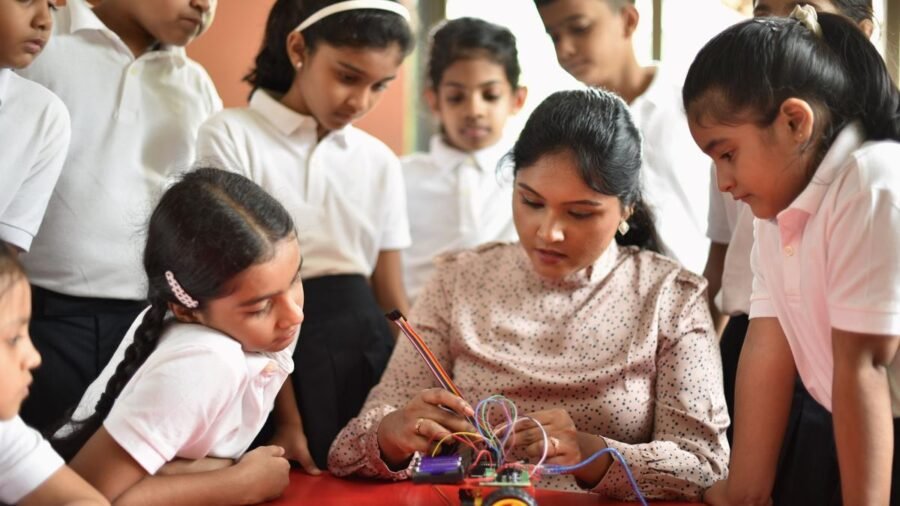
We are all creatures of education, and even after decades, many of us remember the names and idiosyncrasies of our childhood teachers because they set us on the path of lifelong learning. The catalyst was reading with comprehension in the local language and rejoicing in the magic of numbers. The outcome remained the same no matter how you juggled it. This is the significance of Foundational Learning and Numeracy- the Nipun Bharat Mission- and a tribute to our teachers who are making it possible.
(Sign up for THEdge, ’s weekly education newsletter.)
Every day, India’s teachers navigate multiple responsibilities, juggling instruction, administration, and mentorship. Despite the strain of multi-grade classrooms and limited support from parents and the community, they nurture young minds and stay committed to student learning outcomes. Shilpi Singh, a primary school teacher in Agra, is an exemplar of commitment, using a teacher guide to plan her lessons despite a visual impairment. Her story is only a glimpse of the quiet dedication that runs through India’s teaching community.
For 2047, India’s development will rest on the youth, farmers, women, and the underprivileged. Each element of this Amrit Peedhi (the generation of the nectar) is currently passing through a classroom. But for these groups to reach their potential and catalyse India’s development, they must have strong foundational skills, and our march towards Viksit Bharat must be led by our teachers. To support them, we must provide tools that reduce non-academic time, increase teaching time, and improve their competencies.
Join THEdge LinkedIn group
Currently, a number of tools help teachers improve students’ foundational skills. Specifically, structured teaching-learning materials (TLMs) enable teachers to plan lessons and optimise teaching time.
NCERT has developed toy-based pedagogy and has named it the Jadui Pitara (magic box).
Different States/Union Territories have customised it. Uttar Pradesh has built a grade-wise TLM ecosystem for Foundational Grades, with workbooks and play-based WonderBox kits reaching 52,000 pre-school children. Odisha devised the Ganitha Kalika Andolan as an activity-based maths-learning programme; they also introduced Jaadu Pedi, a classroom learning FLN kit for children till grade 5.
However, multi-grade, multi-level classrooms remain one of the toughest daily challenges, especially in rural schools. Madhya Pradesh offers a solution: its teacher guides place lesson plans for grades 1 and 2 side by side, letting a single teacher manage both more efficiently.
While these tools enable teaching to be optimised, pre-training of teachers is intrinsically linked to the quality of education imparted. Currently channeled either through the D.El.Ed, the diploma for elementary education, or the B.Ed, a Bachelor of Education, pre-training has been criticised for being overly theoretical, lacking practical classroom training, being rigid in routines and lesson plans, and for poor monitoring.
Data reveals that only a third of teachers find pre-training useful. Efforts are underway to improve pre-training through the NEP 2020, which envisions a four-year Integrated Teacher Education Programme focussing on ECE, FLN, and inclusive education. However, ensuring that teachers meet the benchmarks and competencies set out in the National Professional Standards for Teachers (NPST) through the four-year course will be critical in improving pre-training and, consequently, our children’s foundational skills for 2047.
A template for improving teacher training comes from Madhya Pradesh. The State reduced the number of training cascades from three to two; moving district-level training up to the State level. Now, with one fewer layer to pass through, the training is more consistent, and more academic content reaches the classroom.
Today, teaching and training is also linked to technology. 87% of teachers use some form of technology. More than 50% use it daily, and 37% use it more than once a week.
In Tamil Nadu, the Palli Paarvai app digitises classroom observations through standardised forms, sending results to multiple levels of administration.
Digital public platforms such as DIKSHA and the NISHTHA programme provide continuous upskilling opportunities for teachers. DIKSHA provides digital access to multiple curriculum-linked resources, such as NCERT and state-board textbooks, lesson plans, and teaching aids. NISHTHA provides certification courses for teachers at the elementary, secondary, and FLN levels. This is technology enabling continuous in-service professional development, and improving classroom interactions.
Integration of technology isn’t only a feature in the classroom. 90% of Indian households now have a smartphone. There is an pportunity to include parents, as active participants in their children’s learning.
Simple nudges through reimagined School Management Committees and parent-teacher meetings can turn mothers into co-pilots, utilising technology for home learning, easing the burden on teachers. Increased interactions between teachers and mothers can enhance the foundational skills of our Amrit Peedhi.
None of these suggestions diminishes what teachers already do; it is about optimising their time so more of it goes to the students. The building blocks exist: TLMs that structure lessons, platforms that ensure continuous upskilling, and systems that enable young mothers to become active teaching partners. What’s missing is the scale and intentionality to bring these together across the country.
While we pause to express gratitude for our teachers’ service and passion, we need to support all teachers and inspire many more like Shilpi Singh who go beyond the call of duty. Edward Gibbon wrote that “the power of instruction is seldom of much efficacy except in those happy dispositions where it is almost superfluous.” We must make it superfluous for all, and hence, structured support for teachers is not a detour on the route to a Viksit Bharat– it is the cement and concrete of the highway itself.
Sanjay Kumar (retd. IAS) is the former Secretary of the Department of School Education and Literacy (DoSEL), Government of India. Ishmeet Singh is CEO of Central Square Foundation. Views expressed are personal.

Silver lining: on the Samarkand Chess Olympiad and India
By Sohail Khan · 29 Sep
State of anticipation: on Jammu and Kashmir and Statehood
By Sohail Khan · 29 Sep