Through The Economic Lens: GDP — Dare We Reinvent The Formula?
Economies evolved from oil wells to algorithms. GDP endured. The time has come to reinvent how the world calculates economic progress.

Economies evolved from oil wells to algorithms. |
Mumbai: “Knowledge advances not by protecting old answers, but by daring to ask better questions.”
India’s latest 7.8 percent real has generated celebration, calculation and controversy. Yet beyond the arguments surrounding one quarter's number lies a question infinitely bigger than India: has the time come to reinvent the architecture of GDP calculation itself? My answer is yes.
Not because GDP is wrong. Nor because India’s number needs embellishment. GDP remains one of economics’ most useful statistical inventions. But no scientific instrument should acquire immunity from reinvention merely because generations have learnt to trust it.
The IMF broadly defines GDP as the monetary value of final goods and services produced within a country during a specified period. The World Bank’s framework approaches the same economic territory through gross value added by resident producers, adjusted for product taxes and subsidies. Both are sound measures of domestic production. But is domestic production alone sufficient to illuminate the economic anatomy of tomorrow?
`;
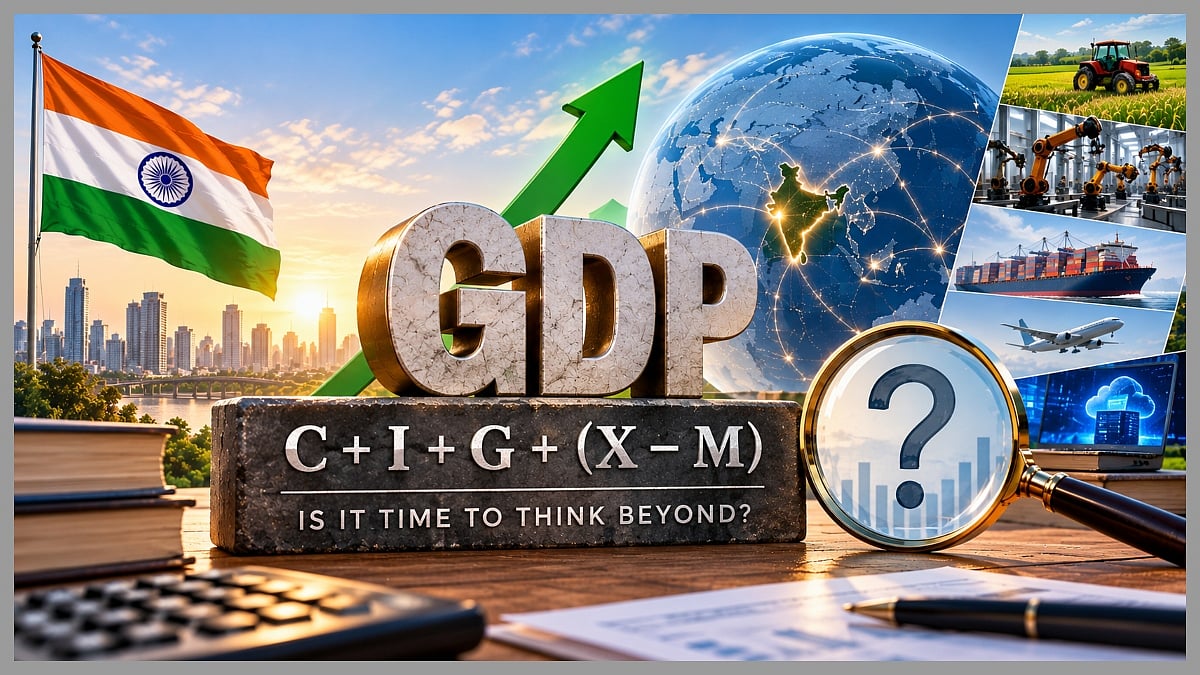
The familiar expenditure equation is C + I + G + (X − M): C for household consumption, I for investment, G for government spending, X for exports and M for imports. The IMF and World Bank anchor GDP in domestic production and value added. But no instrument deserves immunity from improvement.
Strip away the jargon. Imagine India’s inflation-adjusted was ₹100 last year. At 7.8 percent real growth, it becomes ₹107.80 this year: India has actually produced more goods and services, not merely experienced higher prices.
Suppose instead 100 cups of tea costing ₹1 each still number 100, but each now costs ₹1.078. Their value becomes ₹107.80, yet real growth is zero because production has not increased. Real GDP separates greater production from inflation.
India presents another challenge. Millions of farmers, vendors, domestic workers and tiny enterprises operate informally. Their output is not ignored; statisticians estimate it. Yet cash transactions, under-reporting and difficult-to-observe activity complicate precision. GST, UPI and digitalisation illuminate this landscape.
The Courage To Question
Every science evolves. Physics did not stop with Newton. Chemistry, medicine and astronomy repeatedly revised theories and instruments as evidence and human understanding advanced. Many pioneering minds encountered scepticism, ridicule or institutional resistance because accepted knowledge inevitably creates comfortable boundaries. Economics cannot claim exemption.
Bureaucracies understandably prefer continuity. Stable definitions permit comparisons across countries and decades and protect official statistics from political manipulation. Those safeguards are invaluable. But bureaucratic caution must never become intellectual reluctance. The economy itself has escaped every comfort zone.
Agriculture and factories have been joined by petroleum kingdoms, multinational supply chains, global finance, intellectual property, digital platforms, remote workers, data, algorithms and artificial intelligence. Capital crosses continents in seconds. A worker can live in one country, support a household in another and work for an enterprise headquartered in a third.
Production, income, ownership and prosperity no longer necessarily share the same passport.
Money Crosses Borders
Consider an Indian working in Dubai. His production principally contributes to UAE GDP. Yet the money he sends home may educate children in India, repay debt, finance consumption, build a house, become a bank deposit or seed an enterprise.
India received $135.4 billion in remittances in FY25.
That $135.4 billion cannot simply be added to GDP. If remitted money subsequently buys domestically produced goods and services, that production is already captured by GDP; mechanically adding the original transfer could double count economic activity.
FDI presents another puzzle. A billion dollars entering India is not automatically a billion dollars of GDP. But when foreign capital builds a factory, employs workers, transfers technology, develops infrastructure and produces goods, it can reshape productive capacity for years.
Hence India's 7.8 percent poses an irresistible hypothetical. If economists could scientifically measure the broader economic impulse generated by remittances, FDI, overseas economic linkages and cross-border digital value — while rigorously eliminating double counting — might India's wider economic expansion appear much higher than headline GDP suggests?
Today’s GDP formula cannot responsibly answer that question. That is precisely why economists should invent a framework that can.
One World, Different Economic Engines
Consider petroleum economies. Oil production can dominate national output, exports and government revenue, while depletion steadily reduces a finite natural asset. Oil GDP and non-oil GDP may consequently tell markedly different stories.
India has another economic anatomy: services, manufacturing, agriculture, digital activity, domestic consumption, foreign investment and enormous overseas linkages. Singapore is disproportionately shaped by trade and finance. Other economies rely heavily on tourism, minerals or migrant earnings.
Why expect one headline number to illuminate every economic organism equally?
The answer cannot be statistical nationalism. Allow governments to invent their own convenient GDP formulas and international comparability — and credibility — would collapse. Instead, build GDP 2.0.
Preserve universally comparable Core GDP, but surround it with internationally standardised structural accounts revealing petroleum and non-petroleum activity, remittance-linked economic power, FDI-generated domestic value, digital and AI activity, tourism, informal production and natural-resource depletion.
The world's statisticians are not standing still. The 2025 System of National Accounts already updates economic measurement for globalisation, digitalisation and other emerging realities. But why stop evolving?
Stop Arguing, Start Inventing
Debate is the oxygen of economics. Endless argument without methodological progress is not.
Every GDP release need not become another battlefield over what a number captures, misses or supposedly conceals. Economists, statisticians, universities, governments, the IMF, World Bank and United Nations should channel more of that intellectual energy towards designing the next generation of economic measurement.
For a developing economy with developed-economy ambitions such as India, time itself is economic capital. Avoidable statistical quarrels, bureaucratic resistance and institutional comfort zones carry an opportunity cost.
The objective is emphatically not to turn 7.8 percent magically into 10 percent. It is to ask whether tomorrow's economy deserves tomorrow's ruler.
An AI system may soon be owned in America, trained partly in India, hosted elsewhere and provide services everywhere.
Where exactly was its economic value created?
GDP need not die. Newton survived Einstein. Science does not advance by endlessly defending yesterday’s ruler. Sometimes humanity simply invents a better one. The world has reinvented how it works, produces, invests and creates wealth. Now economics must have the courage to reinvent how it measures that world.

Add As a
Trusted Source