The rise against data centres
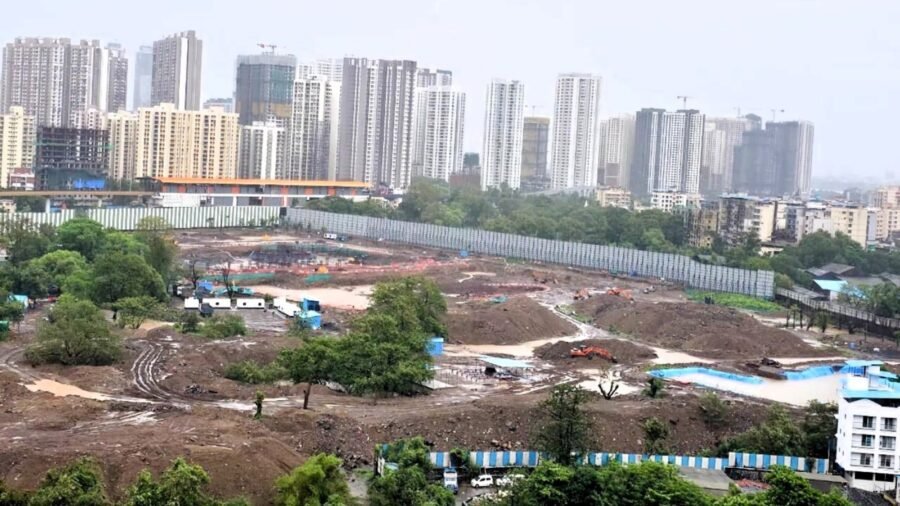
When the areas of Balkum, Majiwada and Dhokali in Thane first heard that Amazon was coming to their neighbourhood, they thought of jobs.
For some, the land beside their homes, once occupied by a chemical company, had been lying vacant. An Amazon facility sounded like an opportunity for a community that had already lost livelihoods when the factory shut. It was only later that residents learnt what was actually being built: a 53-acre hyperscale data centre expected to consume 422 MW of power, 125 kilolitres of treated water daily and have 193 diesel generators on standby.
That discovery has turned excitement into resistance. For villagers and residents of sprawling apartment complexes living next to the site, the question is no longer what Amazon might bring to Thane, but what the city may have to give up for it: water, power, quiet and, they fear, a little more room to breathe.
Data centres have entered public consciousness alongside the rise of AI and have faced protests in countries such as the US. Now, that backlash has reached the Mumbai Metropolitan Region, even as it races to establish itself as one of India’s biggest data centre hubs.
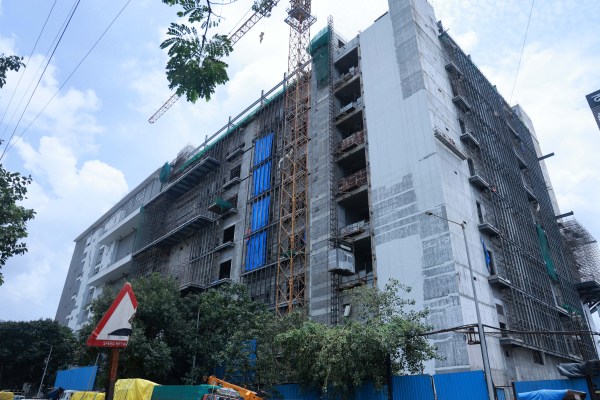 Data centres have entered public consciousness alongside the rise of AI and have faced protests in countries such as the US.
The Thane protests
Sprawled across 53 acres, the Amazon Web Services facility is set to come up in Thane’s Balkum area, surrounded by highrises, small padas and at least eight schools and hospitals. AWS purchased the land from developer Kalpataru Buildings during the Covid period to establish the hyperscale facility.
“Earlier, this land housed a chemical company which employed the local villagers. After it was closed over health concerns, thousands had lost their source of income. So, when we first heard that there was an Amazon centre coming up, we were hoping it would create jobs,” said Rohidas Patil, a native farmer of Balkum whose home is next to the facility’s boundary wall.
Story continues below this ad
“But last year, we found out that this was no ordinary facility, it was a hyperscale data centre,” he said.
Residents subsequently began looking into data centres and the protests they have triggered elsewhere. The #WakeupThanekar movement took shape around a central question: how could a hyperscale facility be permitted in the middle of a city?
On July 18, hundreds of residents formed a human chain in a silent protest against the proposed centre. Shiv Sena MP Naresh Mhaske has also backed the residents.
A bureaucrat from the MMR region said the Thane project differed from several other data centres in Mumbai and Navi Mumbai, which have largely come up in existing industrial complexes such as the Airoli Mahape belt and Chandivali Powai.
Story continues below this ad
“The one difference when it comes to Thane as against most data centres in MMR like Navi Mumbai and Mumbai is that data centres in these cities are slated to come up in already existing industrial complexes … and are hardly surrounded by any residential accommodation,” the bureaucrat said. “The proposed data centre in Thane is near a residential area, which means extra precautions will have to be put in place,” the bureaucrat added.
Water is one of the residents’ biggest concerns. Thane currently faces a shortage of 31 MLD of potable water every day, while the Thane Municipal Corporation has twice this year written to the BMC seeking additional supply.
According to public information furnished by Amazon, the facility will draw 125 kilolitres (KLD) water each day of 115 MLD supplied by the TMC for landscaping and irrigation.
TMC officials said the proposed data centre would be supplied with treated water from sewage treatment plants at Kolshet and Majiwada. “No potable water supply will be impeded as water from two separate STPs at Kolshet and Majiwada are proposed to cater to the data centre’s demands,” an official, on condition of anonymity, told .
Story continues below this ad
Responding to queries, Amazon spokesperson told , “We are committed to being a responsible neighbour in Thane and our environmental clearances are publicly available on the Indian Government portal. Our data centre will not use water for cooling. We will use closed-loop cooling technology that recirculates coolant through sealed pipes without consuming water. It won’t draw power from the local network but will connect to the high-voltage transmission grid through its own dedicated industrial substation. Amazon has been building and operating data centres responsibly for nearly two decades. We are continuously innovating the design and engineering, and we’re always focused on creating a positive impact in the community.”
The assurance has done little to assuage residents’ concerns.
“People in Thane are already facing an immense water crisis and depend heavily on tankers as Thane barely has its own source of water supply. In such circumstances, the supply of any water to this data centre facility is bound to impact us directly,” said Dayanand Nene, a resident of Thane’s Saket complex who has spearheaded the protests.
MMR’s data centre boom
The Thane controversy comes as Maharashtra aggressively positions itself as a major data centre destination. Last month, Chief Minister Devendra Fadnavis announced that the state had signed MoUs worth more than $300 billion to develop data centres.
The Mumbai Metropolitan Region is at the heart of this expansion. According to a July 2026 report by Rubix Data Sciences, the MMR accounts for 49 per cent of India’s operational data centre capacity.
Story continues below this ad
The region has more than 14 international submarine cable landings, extensive fibre connectivity, established business districts and government designated data centre zones.
It has at least 76 data centres, with the highest concentration in Navi Mumbai, where open land parcels and dedicated business parks have attracted operators.
An official said at least 10 data centres are already active in Navi Mumbai’s Dighe Airoli Ghansoli Mahape stretch, generating more than 500 MW of power demand, which is expected to rise further.
Navi Mumbai Municipal Commissioner Dr Kailash Shinde said the city’s data centres had largely come up in industrial complexes that previously housed factories.
Story continues below this ad
“We will be providing reused water given secondary treatment which would otherwise go in the creek,” he said.
On electricity, Shinde said companies were preparing to use solar power and generators would operate only when there was no electricity supply.
In Mumbai, the second highest concentration of data centres is in the Chandivali Powai zone, followed by South Mumbai, according to Rubix Data Sciences. A BMC official said industrial water, procured from Mumbai’s potable lakes, is supplied to data centres in the city.
The resource question
The rapid expansion of data centres has intensified debate over their resource requirements. Their servers operate round the clock, requiring uninterrupted electricity and generating substantial heat that has to be managed through cooling systems.
Story continues below this ad
Prof Pradip Kalbar of IIT Bombay’s Environmental Science and Engineering Department (ESED) said the scale of these requirements could create conflicts in resource-stressed urban areas. “When these servers generate heat, they have to be cooled down. This requires massive water,” Kalbar said, adding that the servers demand clean water. “This is where the conflict emerges. First, the centres demand massive energy and second, they consume huge amounts of water which, if not managed sustainably, can disturb the regional water table,” he said.
The AWS centre’s environmental impact assessment states that the facility, when operational, will collectively consume 422 MW of power, sourced from MSEDCL, with a backup of 193 diesel generator sets.
For its part, the Amazon spokespersons maintained that the electricity will not be drawn from the local distribution network that supplies homes, shops and businesses. “Instead, we are on an industrial connection to the high-voltage transmission grid, and have established our very own dedicated high-voltage substation, planned in coordination with the utility,” an Amazon statement to says.
Yet, the scale of the proposed facility has heightened concerns among residents.
Story continues below this ad
“Thane already faces frequent power outages, particularly during summers. The massive energy drawn by this facility will only aggravate our problem further,” Nene said.
For Anuradha Rode, secretary of the Lodha Luxuria building complex, which has around 3,000 flats and shares a boundary wall with the proposed Amazon facility, the bigger concerns are heat and noise.
“The heat generated from 422 MW of power consumption will significantly increase the temperatures in the area. According to their own reports, the centre is expected to rise as high as 42 metres. Since our homes are situated right next to the compound, the smoke and heat from these centres will directly impact our homes and the homes of villagers,” Rode said.
She said residents were also worried about the generators. “Our second biggest concern lies in the constant buzzing sound that will be generated when the centre operates. In case of a power outage, 193 generators are expected to run simultaneously. Imagine the extent of pollution and noise generated through these sets,” Rode said.
When contacted, Amazon said that the Thane facility will be built and operated in compliance with legal noise limits under the Noise Pollution (Regulation and Control) Rules, 2000.
Jatin Kothare, a social worker and local resident associated with the #WakeupThanekar movement, said the protest was not against data centres themselves but their location.
“We are not against development of AI centres. What we are opposing is its construction right in the middle of a thriving residential belt. When we called in the protest, we were surprised by the overwhelming response. Kids and parents from the padas as well as highrises joined in, highlighting that everyone is concerned about this facility,” Kothare said.
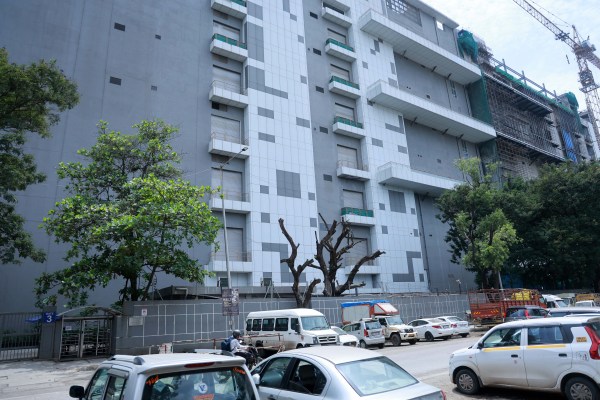 The rapid expansion of data centres has intensified debate over their resource requirements. Their servers operate round the clock, requiring uninterrupted electricity and generating substantial heat that has to be managed through cooling systems.
The way forward
As data centre development becomes a growing point of contention, experts and bureaucrats say the industry cannot simply be kept out of cities. Instead, they argue, facilities must be planned with adequate safeguards and clear separation from residential areas.
BMC Commissioner Ashwini Bhide said data centres would have to coexist with residential areas, with clear boundaries between habitable and industrial zones. “You cannot say that data centres should not be there, because where will they go? We have to co exist, we have to draw boundaries between the habitable areas and the industrial areas,” she said.
A bureaucrat said, “There is also a security angle involved in this. Thus far sensitive security information including those of banks is stored in servers outside the country, sometimes in countries that may not share good ties with India leaving it vulnerable to foreign legal overreach.”
Prof Kalbar said the growth of data centres was ultimately being driven by the people’s own rising demand for databased-services ranging from online shopping, entertainment needs, digital transactions to increased artificial intelligence (AI) usage.
“Now everything is becoming digital and that requires data transactions. Once you press the Google search button on your laptop, that query could go far away, sometimes as far as a different continent. This will take a lot of time, effort as well as energy. Now, as each country’s data demand is increasing, there can’t simply be one centre in a single location. We need to decentralise the storage and computation facilities by building regional data centres, in order to improve efficiency,” explained Prof Kalbar.
Thane facility
* Amazon’s hyperscale data centre
* 53 acre Total area
Balkum and Majiwada, Thane location
422 MW Total power demand
125 kilolitres per day water demand
75 during operational phase; 1,200 during construction phase: Employment scope (manpower required)
Mumbai Metropolitan Region: India‘s leading data centre market
Areas with largest data centre clusters
* Navi Mumbai
* Chandivali and Powai-Andheri East corridor
* Bandra-Kurla Complex (BKC) and South Mumbai (SoBo)
* 76 Total number of data centres in MMR
(Source: Rubix Data Sciences)
Know your data centre
* Enterprise data centres: The ones that have been around the longest where a company put the servers in one room, earlier called server rooms, which were later expanded. Mostly used by companies or its own use and where it all began.
* Colocation data centres: Companies that rent out space to other companies that can use their servers mainly used by small enterprise startups.
* Cloud data centres: These data centres use virtual versions of physical resources like servers which provide them elasticity to grow and shrink its capacity. For example, a streaming platform may use this to account for particular high-demand days and also low-demand days. AWS and Microsoft Azure are examples.
* Hyperscale data centres: Usually cloud data centres present on huge compounds used by big giants like Google, Meta which are taking off because of the AI boom.
* Edge data centres: Small footprint closer to where people use their services faster with less latency

Dhule: Guardian Minister Rawal Inspects Drought-Hit Farms, Assures Farmers Of Aid
By Sohail Khan · 30 Sep