Takaichi Sanae’s big-spending plans are unnerving markets
Takaichi Sanae's big-spending plans are unnerving markets
She is putting the state at the centre of Japan’s economy
Published on: Sep 10, 2026, 20:33:45 IST
Prefer HTon Google
Share via
Copy link
IN 1999 a little-known second-term parliamentarian contributed an essay brimming with ambition to a volume about Japan’s future. Takaichi Sanae imagined that in October 2010 she would be elected prime minister and create a regular Sunday morning TV programme to reach the public directly. Ms Takaichi was off only on the timing and the medium: she became prime minister in October 2025; instead of TV, she posts on X. The essay collection gathered graduates of the Matsushita Institute of Government and Management, where Ms Takaichi learned from Panasonic’s well-regarded founder to see politics as the art of “national management”.
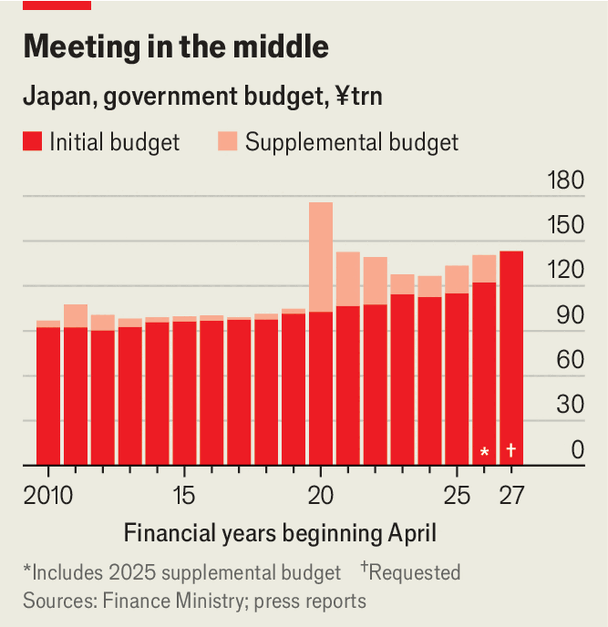
Ms Takaichi has applied that lesson as prime minister. “She thinks like the CEO of Japan,” says Wakatabe Masazumi, a former Bank of Japan (BoJ) deputy governor and one of her closest economic advisers. And the CEO believes it is time for big investments. As Ms Takaichi’s first full budget comes together, the scope of her turnaround plan is coming clear. Her growth strategy foresees ¥370trn ($2.3trn, or 55% of GDP) in public and private investment across 17 sectors between next year and early 2041. To facilitate this, she has changed the budgeting process to allow all ministries to make multi-year requests. The initial asks for next year’s budget, announced on September 4th, sum to a record ¥143trn, up from ¥122.5trn . Markets are antsy: fiscal concerns briefly sent yields on ten-year Japanese bonds over 3% for the first time in three decades.
For years Ms Takaichi presented her economic policy as an extension of Abenomics, the market-friendly programme of one of her mentors, the late Abe Shinzo. As prime minister from 2012-2020, Abe unleashed monetary stimulus to fight deflation; he also saw corporate-governance reform as a useful tool to discipline the torpid leaders of Japan Inc. At the end of his premiership, Morgan Stanley, an investment bank, compared his legacy to that of Margaret Thatcher.
Ms Takaichi shares Abe’s drive for a national revival and the Iron Lady’s strong will. Yet Sanaenomics, as Ms Takaichi calls her agenda, has neither the same ring nor the same ethos as Abenomics (not to mention Thatcherism). “Takaichi has no inbred conviction that markets are the best way to do things,” says Jesper Koll, an economist. Instead, she often looks to the state. Where Abe’s brain trust plotted how to help companies improve their returns, Ms Takaichi’s advisers debate which industries to direct investment towards.
The aim is to use government seed funding to catalyse private investment across a swathe of critical industries. Ms Takaichi has empowered bureaucrats from the Ministry of Economy, Trade and Industry (METI), which helped direct the Japanese economy during its post-war boom, and clipped the wings of fiscal hawks at the Ministry of Finance. Rapidus, a government-backed cutting-edge semiconductor firm, is a model. “They want to do a Rapidus for everything,” says Tobias Harris of Japan Foresight, a consultancy.
Ms Takaichi’s allies say global trends justify the approach. “The world has changed since Abenomics,” says one official. “She’s not against the market, but in today’s world it’s not enough.” Under Joe Biden, America embraced industrial policy. China’s state-backed firms compete ever further up the value chain.
Takaichites also reckon Japan’s fiscal trajectory affords a window of opportunity. Thanks to inflation and growing tax receipts, Japan’s gross public debt has fallen from a peak of 230% of GDP to less than 210%; taking into account the government’s substantial financial assets, its net debt now stands at around 130%. As long as the government’s debt-to-GDP ratio remains on a downward trajectory in the long term, her administration argues it should not matter if the government fails to achieve a primary budget surplus in the short term, a goal previous governments thought important. The initial budget requests are expansionary, but not drastically so: they amount to ¥2.4trn more than the cumulative total of the past year’s main budget and supplemental budgets, which Ms Takaichi wants to phase out (see chart).
Yet scepticism abounds. In one recent survey of 48 prominent Japanese economists, 35 of them did not believe the government’s investment plans would produce sufficient growth to maintain the decline in the debt-to-GDP ratio. The new budget could easily balloon. Though the administration promises to scrap supplementary budgets, these tend to come in response to unexpected shocks. The budget also includes an uncapped category for investment in a “Strong and Prosperous Japan”, financed with “bridging bonds” that will not count against the official debt-to-GDP ratio. Ministries have already requested ¥12trn through it, mostly for AI and space-related projects. The Ministry of Defence has yet to specify its bid. A consumption-tax cut promised by Ms Takaichi also takes effect next April and will further strain government finances.
Debt-servicing costs, meanwhile, are already on the rise. Next year’s budget includes a record ¥36.6trn for them, up 17% from the previous year. Ms Takaichi would prefer that the BoJ keep interest rates lower for longer; her first two appointments to its policy board were die-hard doves. But it already raised rates from 0.75% to 1% in June; persistent inflation and a weak yen strengthen the case for more hikes. American officials have also bristled at Ms Takaichi’s expansionary policies, which they believe have unsettled Treasury markets, and chastised the BoJ for not raising rates faster. Markets expect another hike at the next meeting on September 17th and 18th; the yen, in turn, has reached its strongest level against the dollar since February.
Even if Ms Takaichi manages to push Japan’s fiscal limits, it is unclear the spending will deliver the promised growth. METI’s record of picking champions is disappointing. Even Rapidus, despite much progress, has yet to deliver on its promise. Structural reforms have fallen by the wayside. While Ms Takaichi has been expanding state investment channels, she has been narrowing paths for migrant workers to come to Japan, as is necessary to prevent Japan’s population shrinking faster still. Her main deregulation effort has been rolling back restrictions on overtime.
Yet Japan’s executive-in-chief is undeterred. After the initial budget requests, Ms Takaichi posted on X to defend her approach. “Spending ceilings should not prevent good ideas from receiving the necessary funding,” she wrote. “This does not mean all such requests will be approved…We will carefully evaluate whether the policy is genuinely effective.” Much depends on the CEO’s judgment.
See Less


Australia launches probe into FlyDubai co-pilot’s past, and other Mideast news
By Sohail Khan · 6 Oct
Clashes erupt outside Kosovo parliament over war crimes court
By Sohail Khan · 6 Oct