SC draws line on panel’s powers, says only court can order FIRs in protest cases
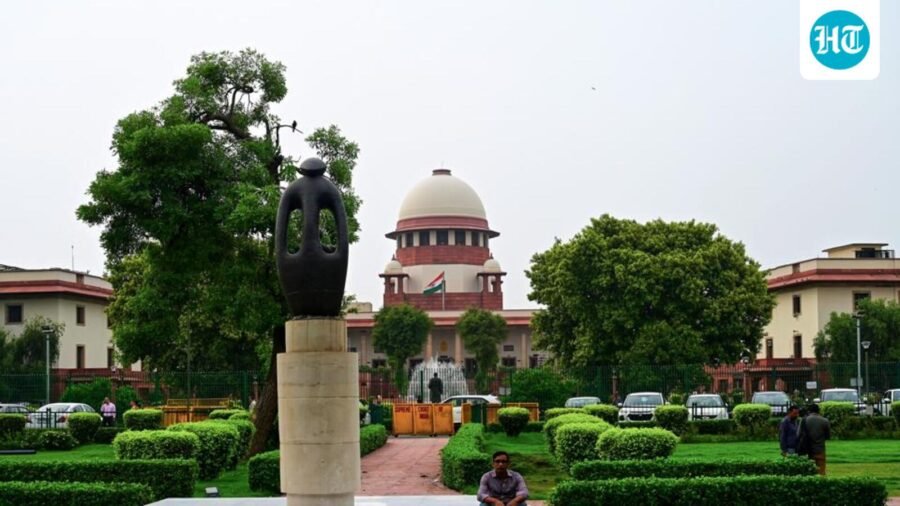
The court agreed to expedite the proceedings before the committee and said it would “iron out” any creases that emerge
Updated on: Sep 10, 2026, 16:17:22 IST
Prefer HTon Google
Share via
Copy link
The Supreme Court on Thursday made it clear that its five-member high-powered enquiry committee (HPEC) cannot order registration of FIRs in connection with the July protests led by the Cockroach Janta Party (CJP), saying the power to direct criminal investigations rests exclusively with the court.
A bench, comprising Chief Justice of India (CJI) Surya Kant and justices Joymalya Bagchi and V Mohana, said the committee would examine the allegations, identify victims and make recommendations, but any decision to order a criminal investigation would have to be taken by the Supreme Court.
The clarification came as the bench agreed to expedite the proceedings before the committee and said it would “iron out” any creases that emerge in the course of its functioning. “The committee has to work under the direct supervision of this court,” said the bench, adding that the HPEC could appoint its own amicus or lawyer to assist it before the Supreme Court.
It also permitted the committee to give wide publicity to its proceedings, invite suggestions and objections, and create a dedicated mechanism, including a helpline, for vulnerable witnesses who may be unable to approach it directly.
Solicitor General Tushar Mehta, appearing for the Centre and Delhi Police, told the court that the committee’s first meeting had been scheduled for September 15.
The court’s clarification assumes significance because it had, on September 1, used its extraordinary powers under Article 142 to bring to an end criminal proceedings arising from the protests. It ordered that FIRs registered between July 20 and 25 in connection with the protests would not be pursued or investigated and would be treated as closed, while directing that no fresh FIRs be registered in relation to those incidents.
The HPEC, headed by former Supreme Court judge Justice R Subhash Reddy, was constituted to independently examine competing allegations arising from the July 20 student protest, including allegations of excessive use of force by police as well as violence against security personnel and damage to public property.
The committee has been authorised to receive documentary evidence, representations and even anonymous complaints to protect witnesses. The court on Thursday rejected suggestions that its composition be changed, saying it had constituted the panel and would not reconstitute it even before it had begun its work.
“We cannot reconstitute a committee like this,” said the bench, while making it clear that concerns about its functioning could be raised before the court.
The court was particularly concerned about criminal cases already registered in relation to alleged intimidation, assault and violence against minors and other victims.
It directed Delhi Police to urgently act on an FIR registered at Parliament Street police station concerning allegations that a 14-year-old girl was threatened, harassed and intimidated in connection with the protests. The girl is now residing in Uttar Pradesh.
“We would like immediate action to be taken on that FIR and a report to be filed,” said the bench, directing that police protection and appropriate safeguards be provided to the girl and her family by Uttar Pradesh Police.
The bench stressed that allegations of intimidation of a child could not be allowed to await the outcome of the HPEC inquiry if those accused were roaming free and attempting to browbeat the victim or her family. “If there are anti-social elements roaming free and trying to browbeat a child and their family so that they do not pursue criminal proceedings, they have to be acted upon…a child is a child,” it added.
The court said the sanctity of a 14-year-old’s statement required independent verification and, if found correct, the allegations must be investigated and taken to their logical conclusion.
The intervention came amid a criminal case against right-wing influencer Swatantra Bhardwaj, who was arrested after allegedly claiming in an interview that he had “cracked the skull” of the father of a student activist, the minor referred to by the bench on Thursday, during the CJP protest. Delhi Police subsequently invoked provisions of the SC/ST (Prevention of Atrocities) Act and criminal intimidation in the case relating to the alleged assault on the 38-year-old man.
A separate POCSO case was also registered against Bhardwaj following allegations by the student that she was subjected to rape threats, abuse and circulation of morphed images after she complained about the alleged assault on her father.
Senior advocates AM Singhvi, N Hariharan, Gopal Sankaranarayanan, and Menaka Guruswamy, besides advocates Prashant Bhushan and Vrinda Grover, raised concerns over the committee’s composition, access for vulnerable witnesses, interim compensation, use of pellet guns and the alleged collection and storage of protesters’ data by private entities engaged by Delhi Police.
The bench said parties remained free to place material and suggestions before the committee and approach the Supreme Court with concerns as its inquiry progresses. “We will consider the complaints, iron out these issues and, if necessary, further clarify our directions. We are not in doubt,” it said.
See Less
Can States change ward boundaries during Census freeze? SC to hear plea
By Sohail Khan · 5 Oct
Panel on simultaneous elections Bills meets media personalities and economists
By Sohail Khan · 5 Oct