Questions for Bhagwat, and how he can easily lay debate over his remarks to rest
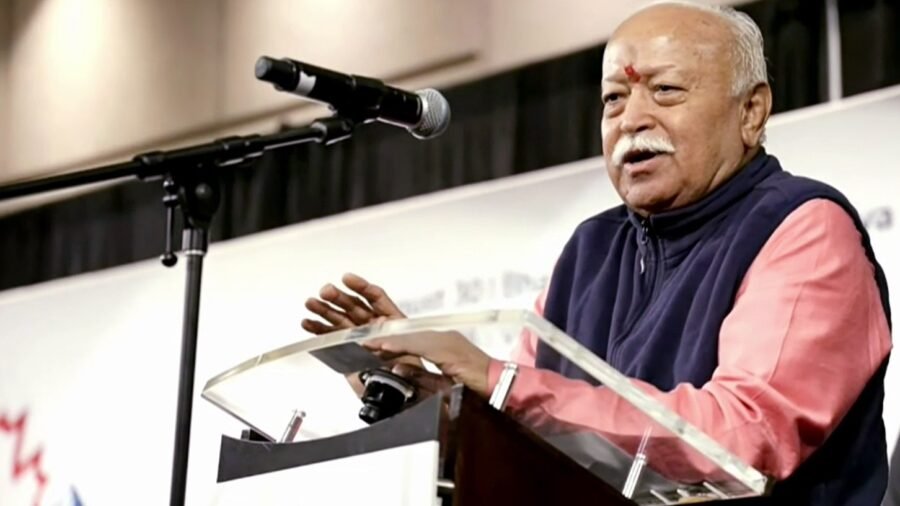
Mohan Bhagwat’s western outreach has elicited a variety of reactions. To his critics, his apparent inclusiveness and the claim that “any Hindu who believes Muslims should not live in India ceases to be a Hindu” are window dressing or worse. His own supporters have two reactions. Some are tempted to say, “We are not as intolerant as we have been made out to be. We have always been misunderstood.” Others on the Right are wondering if he might be sounding a bit too much like a liberal who has walked into the wrong shakha. Others still are welcoming this as a sign of RSS evolution, a transition from hate to humanism.
It is worth reiterating that there is nothing new in Bhagwat’s remarks in New York. He has been saying the same things for years. He used the identical sentence in a speech to the Muslim Rashtriya Manch in 2021. The mystery is why both critics and friends are astonished by it. Such is our state of colonisation, even the RSS chief has to go to New York for his words to be noticed. Even more amazing is that many erstwhile critics think this is the perfect excuse to make peace with the RSS. They were looking for a pretext to make peace. The RSS chief’s reiteration provided it.
Advertisement
History is full of ironies. Well-intentioned and moral actors can sometimes produce catastrophic consequences. Narrow or opportunistic agents can sometimes produce good. Organisations can overcome the traces of their origin. The RSS faces two challenges. First, it has to think of a future beyond Narendra Modi. Modi’s rise facilitated its growth, and it has to ensure it does not sink with it. Second, internally, the RSS’s authority rested on being a special organisation. It was built on cadres, a discourse of sacrifice and discipline. But it is no secret that the more power it has acquired, the pathologies of normal organisations have begun to afflict it, including careerism and corruption. It may have to reinvent its self-image. This context may provide some room for ideological contention within the RSS.
But Bhagwat can easily lay to rest the debate over his remarks by acting institutionally and publicly. There is lots of low-hanging fruit. Just take recent events. Bhagwat once chided Hindus for looking for Shiv Lingas everywhere. Yogi Adityanath recently announced the goal of building temples in Mathura and Vrindavan. Can Bhagwat say he will oppose any moves that violate the spirit of the Places of Worship Act, 1991, and oppose communal triumphalism? Will Bhagwat ask for a repeal of anti-conversion legislation in Maharashtra that is shifting the burden of innocence even in ordinary acts of worship by minorities? Will he display his moral leadership and the might of his organisation by, on the ground, opposing and resisting attacks on Christian prayer meetings and burial grounds in West Bengal (both the Maharashtra and Bengal stories were reported by this newspaper)? Will he ensure that the law will not be weaponised to target minorities, whether the filing of an FIR against an MLA offering namaz, or the alacrity with which bulldozers are being used against a mosque in Saharanpur, without the possibility of an appeal? Will he use the RSS’s power to sanction a minister or even the prime minister for hate speech? Will he perhaps share his anguish: Why, despite his apparently inclusive remarks over the last decade, has the communal atmosphere become more poisonous?
Perhaps Bhagwat’s inclusiveness is sincere. But most of us Hindus have little idea what it means. The mission statement on the RSS website says that, even as the struggle for political independence was being pursued, there were “few or no sustained efforts for restoration of the Hindu psyche to its pristine form. Indeed, it is the latter which should constitute the content or core of freedom”
For those Hindus who are neither pristine nor even particularly sure what a “Hindu psyche” is, should we worry? I doubt even deep readers of the Yoga Vasistha or Abhinavagupta can decode what the pristine Hindu psyche means. This alignment for freedom and identity is hardly reassuring for the safety of Hindus, let alone minorities. Rather than constantly searching for benchmarks of civilisational identity, would it not be simpler to say one’s religious, cultural, or even civilisational identity is irrelevant to one’s standing as a free and equal citizen?
Advertisement
The RSS apparently values education. Delhi University is India’s most important public university. It’s a low-hanging fruit for the RSS to display its evolution. Apart from its abysmal lack of infrastructure that forms the backdrop to the horrific deaths in Satya Niketan, the University is becoming a poster child for the RSS. Bhagwat’s critics allege that VCs and teachers have to flaunt their relationship with the RSS to get appointments; the threat of disruption by the ABVP leads to seminars being cancelled. Decolonisation has become, to put it mildly, a pretext for anti-intellectualism and destruction of the university. Perhaps Bhagwat could inspire us by reminding everyone that knowledge should keep political power away. Indian traditions were so radical that they made even the conditions of knowing an object of sceptical inquiry. Subordinating knowledge to civilisational identity is to betray its essence.
Bhagwat rightly sensed that at the Jantar Mantar protest, students were agitated. They should not be termed anti-national. Yet the prime minister used an ever-expansive understanding of “dimagi Naxal”. The RSS, perhaps of the old variety, believed in German-style ideological solutions to the nationalism problem. But the prime minister has discovered a German remedy of another sort: Homeopathy. It can cure a pathology called criticism and freedom. But this is not just a joke. The irony seems to be that while people are welcoming Bhagwat’s apparent turn to inclusiveness, his party has not got the message. So, either Bhagwat does not mean what he says. Or he is ineffective. Either way, those applauding Bhagwat are revealing something about themselves: Their own complicity, delusion, or fear.
The writer is contributing editor,

At Nagoya, promises kept, a winning arc
By Sohail Khan · 1 Oct
With Central Vista, a library without a home and a larger absence
By Sohail Khan · 1 Oct
40 years ago, October 1, 1986: First-ever Asiad gold for Usha
By Sohail Khan · 1 Oct