Nepal’s post-flood reconstruction must become part of the global fight against climate change
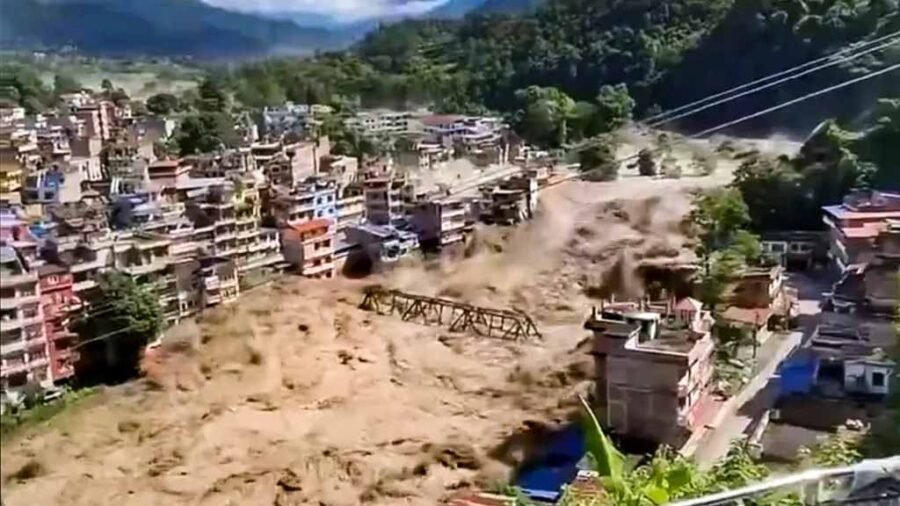
In the past, Nepal has faced multiple mega crises — natural and man-made — that have had long-term impacts on public and social security, economic growth, governance, diplomacy, and politics. But the trail of devastation caused by the ice-and-rock avalanche-precipitated flood in the Bhotekoshi-Trishuli river system on August 26 is unprecedented in the country’s history.
Flowing at 180 km/hour, the river swept through two contiguous districts — Rasuwa and Nuwakot — with unimaginable fury. Most of the damage was caused in the first two hours, after the flood began around 9.15 in the morning. Rasuwa and Nuwakot, the districts closest to Kyirong in Tibet, were the worst hit, followed by four other districts downstream — Dhading, Chitwan, Gorkha, and Nawalparasi.
Advertisement
Official figures show more than 1,350 dead, over 5,000 missing, with about a tenth of them tourists, from 38 countries. The loss to commercial and public property amounted to nearly $6.5 billion. Fourteen hydro-projects on the two rivers were damaged, stalling the generation of around 431 MW – about a tenth of what is generated in the country. Eighty bridges have been damaged, hampering movement of victims to safer places as well as the supply of relief materials.
People in uniform were among the most visible rescuers. Nepal Police and the Armed Police Force under the command of the Nepal Army took control of the search and rescue operation, rescuing 12,000 people, including those trapped in the tunnels of most of the hydro projects. At least 80 of them, more than half from the Nepal Army, lost their lives in trying to save lives. Experts from India, China and South Korea joined the Nepali rescue group in the hydro tunnels, three days after the flood began.
The aftermath of the disaster, however, looks even more challenging for the Prime Minister, known to be a silent and elusive person. He appeared in parliament on the eighth day of the disaster to assure that the government will do everything for the affected and displaced. Despite his earlier unwillingness, he has decided to go to New York and address the General Assembly later in September to attract world attention and seek support for much-needed reconstruction and rehabilitation.
Advertisement
Public opinion in the country is divided on the stance Nepal should take when he interacts with global institutions. The international community, including the United Nations and philanthropists, have come forward pledging donations and assistance generously. A strong lobby in the country is advocating for compensation from those responsible for GHG emissions, especially because Nepal’s emissions amount to less than 0.1 per cent of the global total.
The August 26 catastrophe came closer to the anniversary of last year’s political tsunami on September 8. Also known as the Gen Z protest, it resulted in the exit of K P Sharma Oli as prime minister, its succession by an interim government under former Chief Justice Sushila Karki, and then the coming into office of Balendra Shah and his Rastriya Swatantra Party. By all accounts, these operations were conducted under the supervision of the Army and they enhanced its image. However, the major political parties, the Nepali Congress, the Maoists, and the Communist Party of Nepal (Unified Marxist–Leninist) and a few Tarai-based groups fear that the Army is a pro-monarchy outfit inching for a larger political role.
PM Shah, in contrast, has been appreciative of the Nepal Army’s role. By and large, the people in the country are with the PM on this.
Shah’s handling of the divided domestic polity will be crucial, especially when he lobbies to increase international support on Nepal’s leadership role on behalf of climate-vulnerable countries. Some in the country are in favour of the catastrophe being internationalised — this implies presenting Nepal as a “victim” and holding industrialised countries, including its immediate neighbours, responsible for its suffering.
On its part, Nepal has failed to check deforestation and the extraction and trading of sand and stones, which have resulted in continued floods and caused damage in recent years. Official figures state that the loss of life from such climate-induced events in the past 14 years amounts to more than 4,200.
US Secretary of State Marco Rubio preferred to speak to the more accessible RSP Chief Rabi Lamichhane, a former American citizen, instead of the Prime Minister, a day after a bipartisan group of US Congress representatives wrote to Rubio requesting him to do everything to support the country in crisis.
Nepal’s former King Gyanendra Shah has suggested a three-country — China, Nepal and India — mechanism in the aftermath of August 26. But it’s not known how seriously the PM will take this suggestion.
Nepal is home to over 3,000 glaciers, 21 of them deemed vulnerable and part of the Hindu Kush Himalayan system extending across Afghanistan, Bhutan, China, India, and Pakistan. If these countries do not come together, the impact of any future catastrophe could be bigger.
Climate activists, including Greta Thunberg, have raised the issue of justice and compensation to Nepal – reparations, instead of “charity”. But Shah’s challenge lies in consolidating the support of the sympathetic global community.
The writer is Kathmandu-based contributing editor for
Gandhi taught us: Dissent and disagreement are essential to the health of democracy
By Sohail Khan · 2 Oct
From Gram Swaraj to SVAMITVA: unlocking the mystery of capital in Madhya Pradesh
By Sohail Khan · 2 Oct