How US share in India’s LPG imports surged to over 50% in 6 months
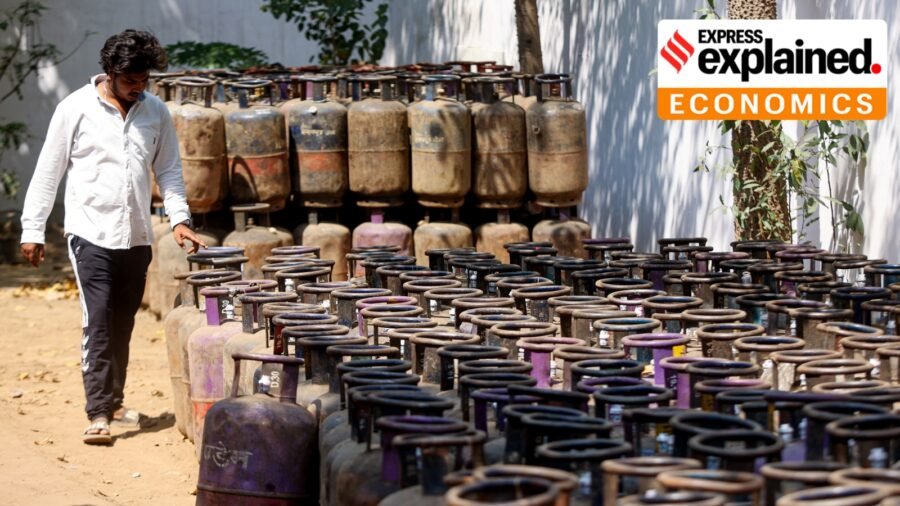
The stifled supply of liquified petroleum gas (LPG) from West Asia owing to the regional conflict there has led to a surge in the US’s share in India’s LPG imports to over 50% in the six months since the conflict began, up from less than 10% in the preceding six months, as per an analysis of LPG shipping data of the past 12 months.
The West Asia war, which started with the US and Israel striking Iran late February, has upended India’s LPG import pie, which was traditionally dominated by Gulf suppliers like the United Arab Emirates (UAE), Qatar, Kuwait, and Saudi Arabia. Amid the supply crunch, India’s overall LPG imports fell over 40% sequentially in the March-August period, while imports from the US nearly quadrupled as India scrambled to find alternative supply sources not constrained by geopolitical conflict.
The West Asia war led to an effective halt in vessel movements through the critical chokepoint of the Strait of Hormuz, which accounted for a fifth of global oil and liquefied natural gas (LNG) flows. The strait is a narrow waterway that connects the Persian Gulf with the Gulf of Oman and the Arabian Sea, and is the primary route to evacuate energy supplies from the broader Gulf region.
The disruption in energy supplies through the strait has caused a headache for various energy importing countries, including India. While the country’s crude oil and LNG supplies have also been impacted, LPG supplies have been impacted the most.
Around 40% of India’s crude oil imports, 60% of its LNG imports, and a whopping 90% of its LPG imports regularly came from West Asia through the Strait of Hormuz. The country’s dependence on imports stands at over 88% for oil, 60% for LPG, and about 50% for natural gas. This means that the Strait of Hormuz effectively saw the movement of around 54% of India’s LPG consumption.
In data: US dominates as West Asia falters
An analysis of tanker data from commodity market analytics firm Kpler shows that India’s overall LPG imports in the six months to August declined 43.1% from the previous six months (September-February) to 7.14 million tonnes. Supplies from the US surged 281.1% to 3.78 million tonnes, accounting for 53% of India’s LPG imports for March-August. In September-February, Washington supplied about 993,000 tonnes of LPG, making up 7.9% of New Delhi’s LPG imports.
Share of the UAE, which was the biggest source of LPG for India before the war, contracted to 13.4% in the six months to August from 37.8% in September-February. Import volumes crashed 79.8% to about 958,000 tonnes. Similarly, import volumes from Qatar plummeted by 84.7% to about 405,000 tonnes in March-August; its share in India’s LPG import pie shrunk to 5.7% from 21.1% in the previous six months.
Story continues below this ad
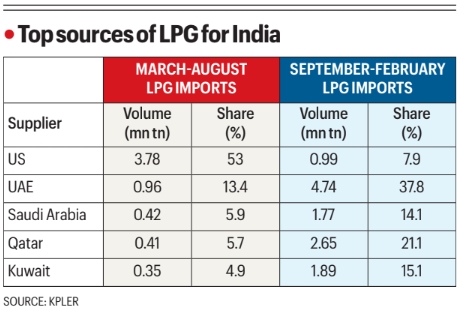 Top sources of LPG for India. Source: Kpler
Kuwait, which had a 15.1% share in India’s LPG imports in September-February, saw it contract to 4.9% in March-August as volumes were down 81.7% to about 346,300 tonnes. LPG import volumes from Saudi Arabia in the six months to August were down 76.1% sequentially to about 423,700 tonnes. In September-February, Riyadh had a share of 14.1% in New Delhi’s LPG import basket, which shrunk to a mere 5.9% in the following six months.
“This growth (in LPG imports from the US) is particularly due to the constrained supply from the Middle East. US is a major LPG supplier globally and became a readily available option for India. This LPG is accessible in this constrained supply environment. This is similar to Russian (oil) barrels flocking to India (amid the West Asia supply disruption),” Nikhil Dubey, lead analyst-refining at Kpler, told .
Hormuz factor remains critical
According to experts, American LPG flows to India are expected to remain strong till the time West Asian supply normalises, on which there is no clarity at present.
“Washington has been the biggest LPG exporter worldwide even before the crisis, and US propane was already cheaper than Asian supplies before the war. Once the shortage hit, and with no other option nearby, India was willing to pay more to bring it from further away because keeping cooking gas available was the priority,” Abu Dhabi-based energy analyst Natalia Katona told .
Story continues below this ad
She expects the share of the US could come down if supplies from West Asia recover meaningfully, even as security around the Strait of Hormuz remains the “big uncertainty”.
“What’s interesting now is the discussion around 2027 contracts. The government has reportedly asked Indian Oil, Bharat Petroleum, and Hindustan petroleum to secure at least 15% of next year’s LPG imports through annual US deals. Nothing has been finalised yet, but that tells me India wants diversification built into its purchasing plans. There’s also a trade-talks angle: buying more American energy could help negotiations with Washington on the US-India trade deal,” she added.
The disruption in LPG supplies from West Asia forced India to ration LPG supplies to industrial and commercial consumers in a bid to prioritise crores of households that depend on the fuel to run their kitchens. There are over 33 crore households in India with LPG connections. As a demand management tool, the minimum gap between LPG refill bookings by households was also increased.
Moreover, domestic refineries have been maximising domestic LPG production to partly offset the loss in imports, and refiners scrambling for LPG cargoes from alternative geographies.
Story continues below this ad
Some of the emergency measures have since been withdrawn as domestic production increased and imports from the alternative geographies picked up, predominantly from the US. The supply gap, however, is still too wide to be fully bridged.
India’s annual LPG consumption stood at a little over 33 million tonnes, or about 90,000 tonnes a day, with an import dependency level of 60%. But with the disruption in flows through the Strait of Hormuz, the country’s LPG consumption declined to about 80,000 tonnes a day, according to estimates shared by the Ministry of Petroleum and Natural Gas in May.

40 years ago, October 1, 1986: First-ever Asiad gold for Usha
By Sohail Khan · 1 Oct
India’s elderly women need better social security cover
By Sohail Khan · 1 Oct