Health insurance in your 20s: Worth buying early?
Synopsis
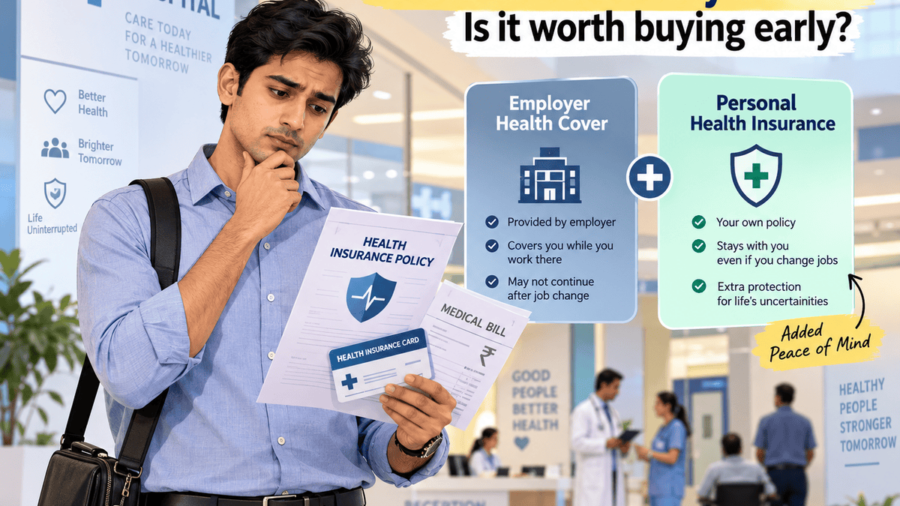
Employer health insurance offers peace of mind, but what happens when you change jobs? This article explores the benefits of securing your own health cover in your 20s, even with existing employer protection. Discover how buying early can lead to lower premiums, faster waiting period completion, and long-term financial advantages, ensuring your health security.
Being young, healthy and covered by your employer can make buying a separate health insurance policy seem unnecessary.
But employer cover can stop if you leave the organisation. A job change, layoff, sabbatical or move into entrepreneurship could therefore leave you without the same level of health protection. An unexpected accident, hospitalisation or illness can also result in a hefty medical bill that may not be fully covered by your corporate medical insurance.
So, does it make sense to buy a separate health insurance in your 20s, even when you already have employer cover?
Why buying health insurance while you are young can be beneficial
Health risks can arise at any age, which is one reason young professionals may want to consider securing their own health cover early.
“Many early-onset conditions have a stronger genetic link or inherited risk factors. Further, one can also meet with serious accidents causing injuries which require surgery and hospitalisation,” says Hari Radhakrishnan, Expert, Insurance Brokers Association of India (IBAI).
There is also a financial advantage to buying a policy when you are relatively young and healthy.
“Buying your own policy at 25 or 27, while you're healthy, can mean lower entry premiums and allows you to complete applicable waiting periods before you may need the cover. It's really a decision made with your 35-year-old self in mind, not your 25-year-old self,” says Sarita Joshi – Head of Health and Life Insurance, Probus.
Buying early can offer several benefits:
| Advantage | Why it matters |
| Lower premiums | Age is one of the factors insurers base premiums on. Buying young can generally mean a lower entry premium compared with buying at an older age. |
| Longer waiting periods get used up early | Pre-existing disease waiting periods and specific ailment waiting periods can be completed while you're still healthy and unlikely to need a claim, subject to the policy terms. |
| Simpler medical underwriting | Younger, healthier applicants may have simpler medical underwriting, although medical tests can still be required depending on the insurer and product. |
| Continuity benefit builds early | No Claim Bonus (NCB) and cumulative sum insured benefits can build over time, depending on the policy, so your effective cover may grow over the years. |
| Employer independent | Cover stays with you across job changes, sabbaticals, or a shift to entrepreneurship |
| Tax benefit | Premiums may qualify for tax deduction under the applicable provisions and tax regime, subject to prevailing tax rules and eligibility. |
Source: Probus
The benefit of buying early, therefore, is not necessarily that you expect to make a claim immediately. It is about having secure cover while you are healthy and allowing the policy's applicable waiting periods and benefits to run over time.
But should you buy a large health insurance policy in your 20s?
Not necessarily. For someone in their 20s, affordability and opportunity cost are important considerations.
Early-career professionals may be balancing rent, education loans, building an emergency fund and starting investments. Allocating a significant portion of their income towards insurance may therefore not always be practical.
“A useful approach is to follow the 50–30–20 rule of income utilisation, 50% towards basic needs, 30% towards wants and 20% towards savings and financial goals. If an individual’s income is not yet sufficient to comfortably meet essential needs such as food, rent and necessary insurance, they should avoid stretching their finances to purchase excessive health coverage,” says Abhishek Bansal, CEO, Insurance Business at InsuranceDekho.
The objective should therefore be adequate and sustainable protection, rather than buying the largest possible policy simply because you are young.
It is also important to remember that health insurance does not cover every healthcare expense. Policies can have waiting periods, exclusions, deductibles, co-payments, room-rent restrictions and disease-specific sub-limits, which can affect the amount payable by the insurer.
The key question is therefore not whether the policy will be used immediately, but whether the individual has adequate protection to absorb an unexpected hospitalisation without significantly disrupting their savings and other financial goals, explains Bansal.
As income and responsibilities increase, the health cover can also be increased.
“A reasonably basic plan bought at 26, with a sum insured that is affordable for you, later topped up with a super top-up plan as income rises, can be a practical way to build cover over time rather than waiting to buy a larger policy later,” says Joshi.
In other words, build the base when you can afford it and increase the protection as your income and responsibilities grow.
What should young professionals check before buying a separate policy?
Before buying an individual health insurance policy, young professionals should look beyond the premium and check the actual terms of the cover.
Some of the key factors to evaluate include:
- Sum insured: Is it adequate for the healthcare costs in the city where you live?
- Waiting periods: Check pre-existing disease and specific-ailment waiting periods.
- Room-rent restrictions: These can affect the amount payable for hospitalisation.
- Co-payment and deductibles: Understand how much of a claim you may have to pay yourself.
- Exclusions and sub-limits: Check which treatments and expenses are not covered or have limits.
- Portability and continuity: Check whether the policy can continue as your circumstances change.
A young professional does not necessarily need to buy a very large policy immediately. The priority should be to secure meaningful cover that fits comfortably within the budget and can be maintained over the long term.
(Join our ETWealth WhatsApp channel for all the latest updates)
Add 

(Catch all the Personal Finance News, Breaking News, Budget 2025 Events and Latest News Updates on The .)
…more

AI clones turn celeb likeness into a new business
By Sohail Khan · 2 Oct
Pakistan took full advantage of IWT, Saxena says
By Sohail Khan · 2 Oct
Gadkari dares critics over ethanol blending
By Sohail Khan · 2 Oct