Haldwani turns into fortress ahead of Supreme Court verdict on railway land dispute
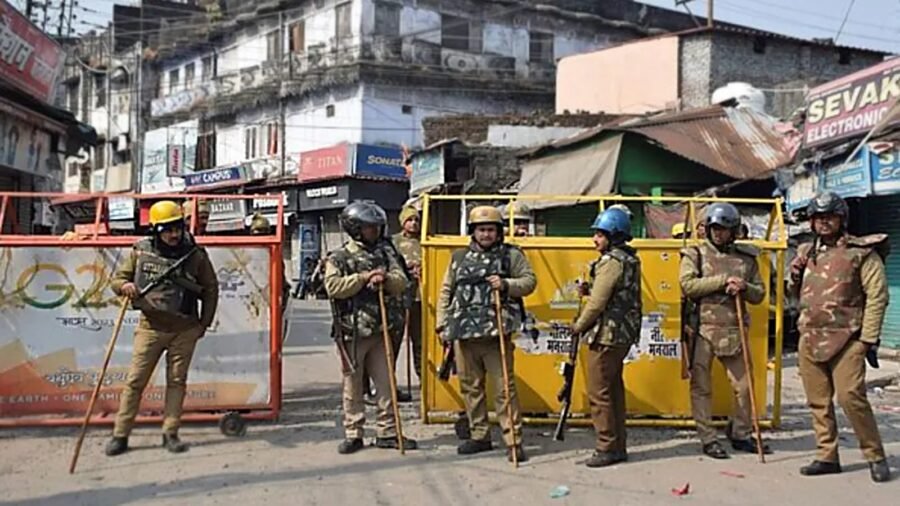
Haldwani’s Banbhoolpura area will be placed under specialised police deployment, divided into sectors, zones and super zones, ahead of the Supreme Court hearing on the railway land dispute on Wednesday, with additional forces being brought in from across Uttarakhand.
Senior Superintendent of Police (SSP) Manjunath TC told that the state police headquarters and Kumaon Range have provided additional forces to Haldwani.
“General alert has been sounded and specialised police deployment has been made,” Manjunath said.
Heavy police force and multiple companies of the Provincial Armed Constabulary (PAC) have been deployed in Banbhoolpura.
The police are also deploying tear-gas squads, anti-riot squads and armed units, along with drone surveillance teams, Manjunath said. Personnel from the Fire Department, traffic police and other specialised teams will also be deployed.
The Local Intelligence Unit (LIU) will also be deployed, along with wireless teams to maintain communication between police units. “Entire Banphoolpura will be divided into sectors, zones and super zones,” Manjunath said.
The exact number of personnel being deployed would be provided by the police later, he said.
Story continues below this ad
What is the case all about
The case in the top court concerns the land around Haldwani railway station, covering the localities of Gafoor Basti, Dholak Basti and Indira Nagar. The Railways claims ownership of the disputed land and says structures have been built there without authorisation. A joint survey conducted by the Railways and the district administration in 2016-17 identified 4,365 structures as encroachments.
The scale of the settlement has made the case particularly sensitive. More than 50,000 people live in the disputed area, according to figures placed before the Supreme Court. The area is also not limited to residential structures. It has three government schools, 11 accredited private schools, 10 mosques, 12 madrassas, a government public health centre and a temple.
The dispute has its roots in proceedings before the Uttarakhand High Court relating to illegal sand mining in the Gaula river, which flows alongside Haldwani railway station. The issue of alleged encroachment on railway land subsequently became part of the litigation.
In December 2022, the Uttarakhand High Court directed residents to vacate the disputed land within a week and authorised the use of force, if necessary, to remove unauthorised occupants. The order triggered protests in Haldwani and led to widespread concern among residents who faced the possibility of losing their homes. In January 2023, the Supreme Court stayed the eviction order.
Story continues below this ad
The court raised concerns over the prospect of around 50,000 people being uprooted and said a workable arrangement would have to take into account both the Railways’ requirements and the rehabilitation of affected residents.
The Railways has relied on a 1959 notification, revenue records from 1971 and the findings of the 2016-17 joint survey to support its claim over the land. Residents of Gafoor Basti, Dholak Basti and Indira Nagar, meanwhile, have maintained that many families have lived in the area for decades, in some cases for generations. They have relied on various documents relating to occupation and property transactions to contest the Railways’ claim.
Point of contention
A key point of contention has been a 1907 government record, which residents have cited to argue that the land was nazul land — government land historically made available for private use or settlement under specified conditions. The Uttarakhand High Court did not accept the residents’ interpretation of the document and held that it did not establish the legal status claimed by them.
The Railways has said the land is required for the expansion and realignment of infrastructure around Haldwani railway station. Its requirements include additional railway lines and platforms, a washing pit for cleaning and servicing coaches, a sick line shed for coaches requiring repairs, and stabling lines where railway coaches can be parked when they are not in service. The Railways has also raised concerns about the vulnerability of railway infrastructure close to the Gaula river.
Story continues below this ad
In July 2024, the SC directed authorities to identify the land actually required for railway purposes, determine the families likely to be affected, and work out a rehabilitation plan.
In February 2026, the Supreme Court passed a substantive order in the matter, holding that occupants could not claim a legal right to remain indefinitely on the disputed railway land. At the same time, it directed the authorities to assess affected families for rehabilitation and facilitate applications.
The court also made it clear that residents could not insist on being rehabilitated on the same site.

CEC Gyanesh Kumar postpones 2-day Chhattisgarh visit
By Sohail Khan · 7 Oct
Rahul, Priyanka Gandhi detained after hours-long anti-CEC protest, released later
By Sohail Khan · 6 Oct
4.9 Magnitude earthquake hits Uttarakhand, tremors felt in Delhi-NCR
By Sohail Khan · 6 Oct