Grandson has no right in grandfather’s land
Synopsis
Grandson claims share in late grandfather’s 75-bigha land, challenges sale by father; Rajasthan HC says it is father’s inherited land and rejects grandson’s appeal.
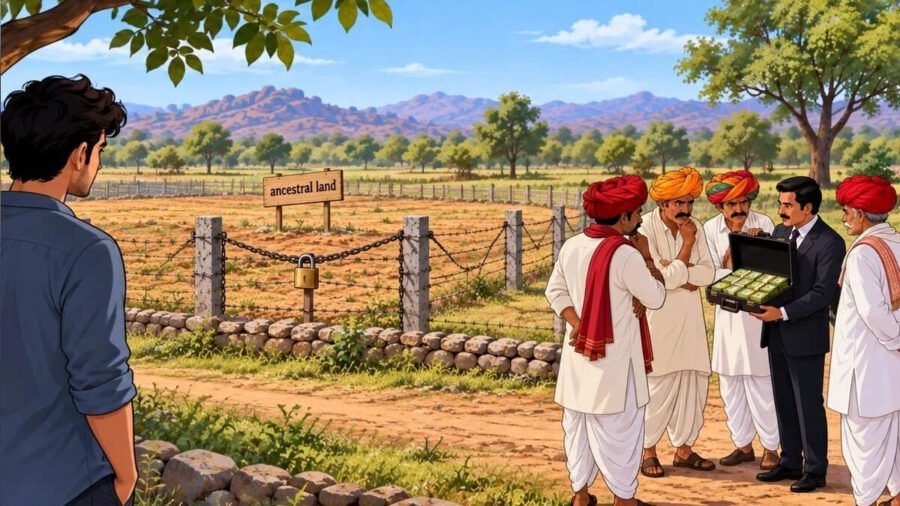
The Rajasthan High Court, in a recent judgement, has ruled that a grandson has no right to oppose the sale of his late grandfather’s land under the Hindu Succession Act, since his father inherited the land and is still alive. In simple terms, it means that when the grandfather died, the land went to his three sons under the Hindu Succession Act. So this land is not ancestral land, as it has now become the son’s respective self-acquired inherited land. Thus, the grandson can’t oppose the sale of this land since he has no birthright over his father’s inherited self-acquired land.
To get the full picture of this case, it’s important to know the history of the land. The government had given Late Chutra Ram 75 bigha land in Jaisalmer under Section 101 of the Rajasthan Land Revenue Act, 1956.
On April 24, 2004, Chutra Ram died intestate (without a Will) and the land went to his three sons, Khetaram, Ramaram and Lachchuram, since they were Class-I heirs, in accordance with the Hindu Succession Act, 1956.
On April 17, 2025, Khetaram, in collusion with his brothers (Ramaram and Lachchuram), sold this land to a buyer from Madhya Pradesh. But, Khetaram’s son (Devaram) opposed this sale and filed a court case on the ground that he wasn’t consulted before the land was sold and that his 1/9th share in the land is now at risk.
On August 20, 2026, Devaram lost the case in the Rajasthan High Court.
Advocates H.R. Soni, Harish Joshi, Tripti Soni, Narootam Soni and Jitendra Soni represented Devaram’s father and his brothers and the buyer. Advocate D.K. Godara represented Devaram.
Also read: Daughter can claim late father’s share in HUF property even after widowed mother's remarriage, rules Madras HC
Why did Devaram lose the case?
Devaram lost mainly because the Rajasthan High Court found that he could not prove an existing legal share in the land that would allow him to challenge its sale. Jahnavi Kohli, Partner and Head of Private Client Practice at ANB Legal explained to ET Wealth Online the legal reasons behind why Devaram lost the case:
Reason 1: No established coparcenary right
The Rajasthan High Court observed that this land was originally allotted to Devaram's grandfather (Chutra Ram) under the Rajasthan Land Revenue Act. So due to this reason the land was not inherited by Chutra Ram therefore cannot be termed as ancestral. However, Devaram's plaint and pleadings contained no averment that this land allotment was made to a Hindu Undivided Family, or that Chutra Ram held it as "karta" of a joint family.
So when Devaram himself did not claim that this land was alloted on HUF's basis, the high court expressly deduced that a coparcenary claim cannot rest merely on the fact that the parties are related by blood, or that the land once belonged to a grandfather. Ancestry alone doesn't convert property into coparcenary property as it has to be specifically pleaded and shown that the property carried that character.
Also read: Not all family properties are ancestral: Son has no birthright in father’s self-acquired assets
The Rajasthan High Court explained that when Chutra Ram died intestate in 2004 his estate went to his Class-I heirs i.e. his three sons in equal one-third shares, later reflected in mutation records. This mutation entry was consequential i.e., it merely recorded a succession that had already legally happened, it didn't create new rights.
Moreover, Chutra Ram's son (Khetaram) was a direct heir as Devaram was a grandson only. So on this ground, Devaram could have claimed a share in this land only if the property inherited by Khetaram had remained coparcenary property, in which case Devaram could have got a birthright interest in it. But this did not happen in this case.
Mainly, Sections 4 and 8 of the Hindu Succession Act formed the statutory basis of the Court’s reasoning. Section 4 gives the Act overriding effect over earlier Hindu law and customs, while Section 8 determines how a Hindu male’s property devolves on intestacy. Since there was no pleading of any pre-existing HUF, Chutra Ram’s property passed under Section 8 to his three sons individually, rather than continuing as coparcenary property.
Also read: Wife, son can’t object to sale of 1.7 hectare land inherited by husband as it is not a joint family property, rules Bombay High Court
Siddhi Dama also from ANB Legal says that the Rajasthan High Court also relied on Uttam v. Saubhag Singh (2016), which confirms that property inherited by Class I heirs under Section 8 becomes their individual property. Thus, Khetaram’s one-third share became his individual property, and Devaram could not claim a birthright in it while his father was alive.
It is pertinent to point out that Devaram argued he was a minor when his grandfather died, so perhaps his rights were somehow preserved or delayed. The Court rejected this outright saying that minority doesn't change who counts as an heir, and doesn't postpone how an estate vests.
Also read: Uncle sold their grandfather’s 2 acre land without giving them a share, sister’s children files case, loses in Kerala High Court because of Hindu Law of Succession
Reason 2: No declaration from the revenue court
Even setting aside the coparcenary issue, the Rajasthan High Court held that Devaram’s suit could not succeed because his claim to cancel the sale deeds depended on first establishing his own khatedari right in the land. Relying on Pyarelal v. Shubhendra Pilania (2019) 3 SCC 692, the Court held that such a foundational right had to be determined by the competent revenue court before any consequential relief could be sought in a civil court.
Under Sections 88 and 207 of the Rajasthan Tenancy Act, 1955, declaration of khatedari rights falls within the exclusive jurisdiction of the revenue courts. Since Devaram had never obtained such a declaration, the civil court could not assume that he had a share and then examine the validity of the sale deeds. His suit was therefore not maintainable, regardless of how he framed the reliefs.
Rajasthan High Court discussion
Devaram failed to establish that the land was HUF/coparcenary property
In brief, the Rajasthan High Court said that under Section 8 of Hindu Succession Act, the law says that once succession opened upon the death of Chutra Ram, his estate passed on to his Class I heirs (his three sons, Khetaram, Ramaram and Lachchuram) in accordance with that provision and the Schedule.
Thus the high court observed that Devaram now cannot displace this statutory devolution merely by invoking the general expression "ancestral property" or by asserting that, as a grandson, he acquired a right by birth.
Property was Khetaram’s self-acquired inherited property
The Rajasthan High Court said that the distinction between a property inherited by a person under Section 8 and property in which a person is already a coparcener is of considerable importance.
The high court explained that when the property devolves upon a son under Section 8, he succeeds to it in his individual capacity unless some independent legal foundation exists for treating the property as part of a subsisting joint family estate. The mere fact that the property came to him from his father does not, in itself, confer a birthright to his son (since a son has no birthright in father’s self-acquired inherited property).
The Rajasthan High Court said: “The property so inherited by the appellant's (Devaram) father devolved upon him in his individual capacity and, consequently, acquired the character of his self-acquired property.”
Case law cited: Uttam Vs. Saubhag Singh & Ors. (2016) 160 AIC 1
The Rajasthan High Court observed that the above mentioned Supreme Court case’s principal is relevant in Devaram’s case since his grandfather Chutra Ram died intestate (without a Will) and Devaram is the son of the legal heir of Chutra Ram
The high court said that consequently, Devaram cannot claim that a coparcenary interest accrued in his favour by birth in the share which had already devolved upon his father under the statutory scheme.
Moreover, since Devaram could not prove this property was held as HUF/coparcenary property, he does not get a right to seek partition or to challenge an alienation made by his father on the footing of an alleged pre-existing coparcenary interest.
Jurisdiction problems
There was also a jurisdictional problem. Devaram was claiming a khatedari/share in agricultural land, but he had not obtained the necessary declaration of that right from the competent revenue court.
So the Rajasthan High Court held that they could not use a civil suit to challenge the sale deeds without first establishing that foundational right before the revenue court.
Thus, on these grounds, Devaram lost the appeal.
(Join our ETWealth WhatsApp channel for all the latest updates)
Add 

(Catch all the Personal Finance News, Breaking News, Budget 2025 Events and Latest News Updates on The .)
…more

Next-gen GST to boost growth, ease compliance
By Sohail Khan · 5 Oct
Consumer brands are betting big on small-town India
By Sohail Khan · 5 Oct
India growth fundamentals face external shock risk
By Sohail Khan · 4 Oct