From paper leaks to policy failures: the academic cost of NTA’s bureaucracy
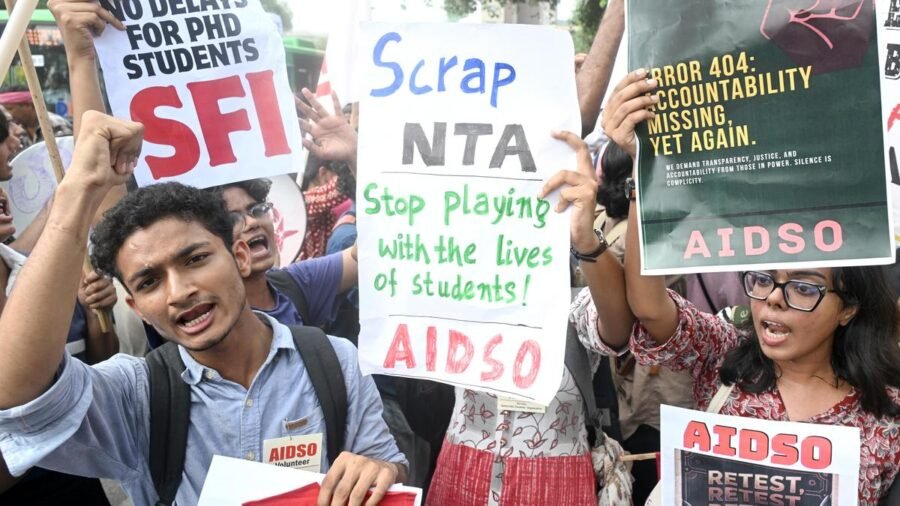
Despite successive committees, reforms, tougher laws, security measures, and increasing use of technology, breaches and irregularities continue to haunt India’s high-stakes examinations. The recurring failures suggest that the problem lies deeper than security or technology: does the examination system have the academic competence, process integrity, and institutional accountability needed to protect the examination from question setting to results? The issue is not merely how to secure an examination, but how to make the entire examination ecosystem trustworthy.
(Sign up for THEdge, ’s weekly education newsletter.)
The National Testing Agency (NTA) has an unusual institutional character: it combines traditional bureaucracy with academic expertise, with both playing major roles in the examination process. Its administrative machinery comprises its own officers, officers on deputation, and personnel engaged on tenure or contractual terms. Much of its academic work — including question setting and related functions — is entrusted to external academics, largely on a per-project or per-assignment basis, rather than through a permanent salaried academic structure.
Join THEdge LinkedIn group
Bureaucracy provides continuity, scale, hierarchy, and procedural control. Its natural emphasis is on compliance with prescribed SOPs and rules. Academia, in contrast, rests on professional competence, autonomy, and individual integrity, with relatively less emphasis on hierarchy. Genuine academics are expected to exercise independent judgment and not compromise professional standards merely to satisfy a procedure.
The distinction is fundamental: bureaucracy derives authority largely from office, hierarchy, and procedure; academia derives it from individual competence, professional standing, and intellectual judgment. Both are necessary. But applying one’s own norms to the other’s functions can produce serious anomalies. A bureaucratically compliant system can still be academically deficient; an academically autonomous system can still lack institutional controls.
This is particularly important in selecting academic experts. A bureaucratic approach may invite applications from experts, while an academic approach may invite recognized experts based on demonstrated competence and professional standing. The former may enlarge the pool but can also admit sub-standard individuals whose suitability is difficult to establish; the latter relies on established academic standing. For a high-stakes examination, the distinction is not cosmetic.
The same issue appears in the NTA Board’s constitution. Most members are ex officio, by virtue of positions such as Director or Vice-Chancellor. Their membership derives from the office they hold, not necessarily from demonstrated expertise in examination functions. They usually nominate juniors to attend meetings, potentially weakening substantive deliberation.
The concern becomes acute when an office-holder’s own record—including an indictment for examination-related irregularities—calls their suitability into question. Such members may also shield compromised experts, yet ex officio status continues to confer eligibility for governance of examinations. Institutional status should never substitute for individual suitability.
Academic expert bodies generally follow a different principle: membership is based on the individual’s demonstrated expertise and suitability, not merely the office held, and members are ordinarily expected to participate personally in important deliberations. If externally engaged academic experts are subject to individual scrutiny and professional criteria, while ex officio members enter NTA governance automatically by virtue of their positions, the same examination ecosystem ends up applying different standards of suitability to different participants.
NTA’s hybrid structure can work only when the right person performs the right function through the right process—and remains accountable for the outcome. Otherwise, bureaucracy and academia may cease to complement each other and instead amplify each other’s weaknesses: bureaucratic complacency, academic mediocrity, and, ultimately, compromised examinations.
Emphasis on security
NTA’s response to examination vulnerabilities has increasingly focused on security—secure transportation, surveillance, technology-enabled monitoring, and protection of printed question papers. These measures are necessary, but securing examination material does not necessarily secure the examination process.
A question paper may be transported under extraordinary security even though its contents were compromised much earlier during question setting, moderation, translation, digitization, or compilation. Likewise, intensive surveillance at examination centres cannot address vulnerabilities in candidate allocation, OMR handling, or result processing.
Following the alleged insider compromise of NEET questions, NTA announced a four-layer security system for question setting, moderation, and translation. But more layers do not necessarily mean greater security. The more people handle confidential questions, the larger the potential insider risk surface.
This points to the insider risk at the source. Once confidential questions enter the examination ecosystem, the people who create, moderate, translate, digitise, and compile them become as critical to security as the systems designed to protect them. Qualification or reputation cannot substitute for verification. Those entrusted with such access require appropriate selection, conflict-of-interest checks, limited disclosure, separation of duties, and auditable records of critical actions.
The same discipline must extend across moderation, translation, digitization, compilation, printing, logistics, OMR processing, and results. The objective should be fewer points of vulnerability. Securing the last mile cannot compensate for vulnerabilities at the source. A secure question paper does not make a secure examination; examination integrity begins at the source—not at the last mile.
Can technology repair institutional weakness?
NTA has increasingly relied on biometrics, CCTV, encrypted communication, GPS tracking, digital authentication, and AI-enabled surveillance to secure examinations. These technologies can strengthen controls, but they cannot repair weaknesses in the institutional processes they are meant to protect. Every technology-based safeguard should answer three questions: What risk does it address? Who independently verifies that it works? What happens when it fails?
NEET-2026 illustrates the limitation. Examination operations were placed under AI-enabled CCTV surveillance nationwide, with senior NTA officials overseeing the central control room. Yet this extensive surveillance could not detect the alleged leakage of questions before the examination, or, subsequently, the tell-tale signs among candidates who allegedly had access to the material and could recognize and rapidly answer the compromised questions.
The same limitation applies to the high-security environment for question setting, moderation and translation. Entry was reportedly CCTV-monitored and accompanied by extensive frisking to prevent the carrying of electronic devices inside. Yet such controls did not prevent a compromise originating within the very process they were meant to secure. A CCTV system can record an event; GPS can track movement; and biometrics can authenticate identity. None can establish the academic integrity of a question or detect every form of insider compromise. Technology is therefore a control within the examination process—not a substitute for sound processes or institutional accountability.
A complex examination may have clearly assigned responsibilities at every stage, yet still lack accountability for the examination as a whole. The critical question is therefore not simply who performs each task, but who owns the integrity of the entire examination.
This is where NTA needs a stronger institutional mechanism. Police investigations, CBI inquiries, tougher anti-leak laws, and judicial proceedings are primarily post-facto mechanisms, invoked when something goes wrong. They cannot establish whether the examination was being conducted correctly before a breach occurred.
NTA should therefore have an independent examination-integrity function with a mandate to continuously audit compliance with critical SOPs and report deviations before they become failures. Such oversight should cover the complete examination cycle and test not merely whether procedures exist, but whether they are actually followed, properly recorded, and independently verified.
The way forward
NTA needs not merely more security or technology, but stronger professionalism and institutional governance. Its hybrid bureaucracy–academia structure requires uniform, auditable SOPs across the examination lifecycle. Academic expertise must be demonstrable, bureaucratic compliance verifiable, and technology a control, not a substitute for institutional responsibility.
The Nandan Nilekani Committee provides an opportunity to move beyond yet another round of recommendations and focus on implementation, measurable compliance, and independent verification of standardized SOPs.
The objective should be to eliminate academic mediocrity, minimize arbitrary discretion, make every critical process auditable, and place no person, position, or technology beyond scrutiny. A credible public examination should prove—process by process, audit by audit—that zero tolerance is actually practiced.
(Rajeev Kumar is a former Computer Science Professor at IIT Kharagpur, IIT Kanpur, BITS Pilani, and JNU, and a former scientist at DRDO and DST. Views are personal)

‘Sham’ contracts, inflated revenues: Charges against Man City, penalties it could face
By Sohail Khan · 1 Oct
Amitabh Bachchan, 83, suffers knee injury after fall: ‘I had trouble standing up’
By Sohail Khan · 1 Oct