Durga Puja under BJP rule in West Bengal: a push for vegetarianism and tradition
Offering and consuming non-vegetarian food during Durga Puja has long been a tradition in West Bengal. Before it became a community event, or Sarbojanin, many Bonedi Bari (aristocratic households) practised goat sacrifice on Nabami, with the meat used to prepare prasad (holy offering) for Goddess Durga. Meat consumption during the Pujas has persisted since, rooted in the Shakta tradition of worship.
On September 6, the chief priest of Madhya Pradesh’s Bageshwar Dham, Dhirendra Krishna Shastri, while participating in an event in West Bengal, appealed to the Hindus in the State not to sell non-vegetarian food near Durga Puja pandals.
“I want to appeal to Hindus of Bengal that during Navratri, even if you don’t keep the idols of the Goddess, do not sell non-veg [food] near the idols,” the self-styled godman Shastri said while addressing his devotees.
The remark triggered a huge controversy because a debate has already been raging over what should be the dietary preferences of the people of the State during the festival. On August 26, Vishwa Hindu Parishad office bearers in West Bengal issued a similar advisory that non-vegetarian food should be kept away from Durga Puja pandals to maintain the sanctity of the religious festival.
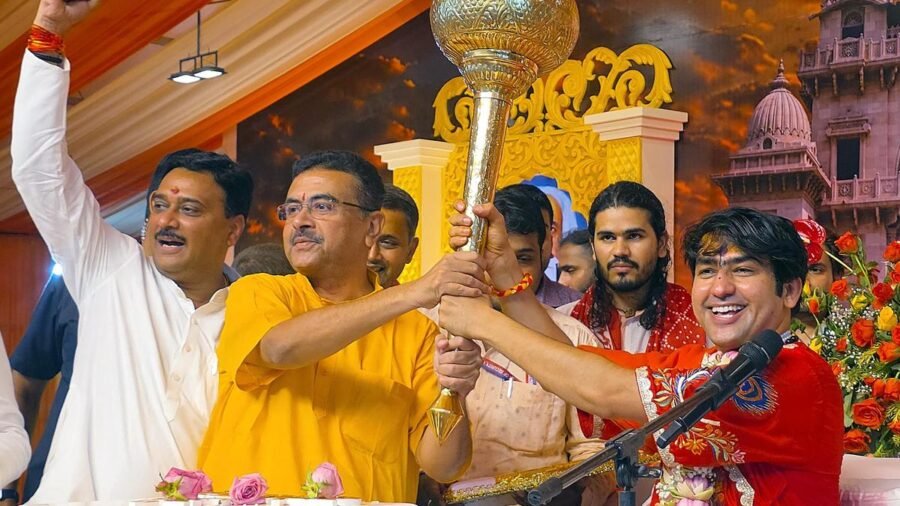
While the people of Bengal were grappling with the VHP advisory, the appeal by a religious preacher little known in political and social circles of the State, triggered a huge backlash. The controversy also took a political turn as the visit of Dhirendra Krishna Shastri to West Bengal was endorsed by the Bharatiya Janata Party government. Chief Minister Suvendu Adhikari not only met the religious preacher but also hosted him over dinner and urged him to set up a centre of Bageshwar Dham in Bengal.
“During Durga Puja, the government will work to protect the culture of West Bengal and India. Baba Maharaj Ji, please come and have a centre here. There should also be a centre of Bageshwar Dham here,” the Chief Minister said with Mr. Shastri by his side.
After a storm of criticism raged in political circles and on social media, West Bengal BJP president Samik Bhattacharya sought to contain the damage by stating that Bengalis would eat whatever they want.
“How can Bengalis not have fish and meat? Even Swami Vivekananda said Ma Kali will have mutton [as an offering]. It is dangerous if someone tries to rise above Vivekananda. This is his [Mr. Shastri’s] personal opinion,” Mr. Bhattacharya said. The BJP leader, however, added that there was no sin in advocating vegetarianism.
The poll promise of not changing dietary preferences
One of the criticisms levelled by the current Opposition parties towards the BJP before the 2026 Assembly election was that the party would try to impose vegetarianism if it came to power. The BJP leaders campaigned during the election holding fish and even had fish and meat in public to ward off scepticism.
Even after coming to power, there have been no attempts by the government to regulate or control food habits. However, Durga Puja is a sensitive issue for the people of the State, and the anger over Shastri’s remarks stems from the fact that people of West Bengal do not want ‘outsiders’ to tell them what to eat and not to eat.
Durga Puja, more than a religious festival
For people of West Bengal and the Bengali diaspora, Durga Puja is not only a religious festival but also a cultural and community celebration that gives uniqueness to Bengali identity. There have been several instances when the so-called ‘outsiders’ have confused the Durga Puja festival, which is a religious carnival, with Navratri, where the Goddess is worshipped. The festival in West Bengal is a community celebration, a space for artistic expression and one of the drivers of the State’s economy.
Durga Puja in Kolkata was inscribed in UNESCO’s Representative List of the Intangible Cultural Heritage of Humanity in December 2021. The State witnesses over 40,000 community Durga Pujas, with 3,000 such pujas in Kolkata alone. By including Durga Puja in Kolkata in the Intangible Cultural Heritage of Humanity, UNESCO has highlighted the community aspect of the festival, where “the divides of class, religion and ethnicities collapse as crowds of spectators walk around to admire the installations”.
Push for tradition
While the BJP leadership in West Bengal has made it clear that there is no push towards vegetarianism, the State government is making changes in the manner in which the festival should be observed. In a departure from how Durga Puja used to be observed during the previous Trinamool Congress regime, Chief Minister Suvendu Adhikari has issued a set of do’s and don’ts for the festival.
No Durga Puja inauguration will be allowed before Mahalaya, marking the beginning of the Devi Paksha and unlike the previous regime, the State government will not organise the Durga Puja carnival this year.
The restrictions imposed include not allowing cranes at immersion ghats to extricate structures of idols after immersion and a ban on the use of DJ music during the festival. The State government had declared that Ashtami, the eighth day of the festival, will be a dry day when liquor shops would remain shut. Theme-based pujas would be allowed, the Chief Minister said on September 7, adding that Durga Puja committees must ensure that themes do not hurt Sanatani traditions and heritage and culture of the State.
As far as giving cash doles to Durga Puja organisers, Mr. Adhikari appealed to the organisers of big-ticket pujas to forgo the State government’s support. Other organisers seeking the ₹1 lakh assistance promised by the State will have to apply through the local authorities.

Search operations launched after suspected terrorist movement in Rajouri, Udhampur
By Sohail Khan · 4 Oct