Draft SIR list shows statistical absurdities. Audit by an independent agency is needed
It varied from an indulgent smile to a wry smirk. We remember the reactions both of us received to our initial estimates of the cumulative damage of the Special Intensive Revision of electoral rolls, if it was carried out across the country. The SIR had led to a deletion of 65 lakh names from the voters’ list in Bihar. We calculated that a nationwide SIR could lead to a deletion of up to 10 crore names. No one believed us. We hoped that raising the alarm would act as a check and bring the eventual numbers down, as it did in Bihar. Now that we have nearly the final figures, the total deletions have surpassed our worst fears.
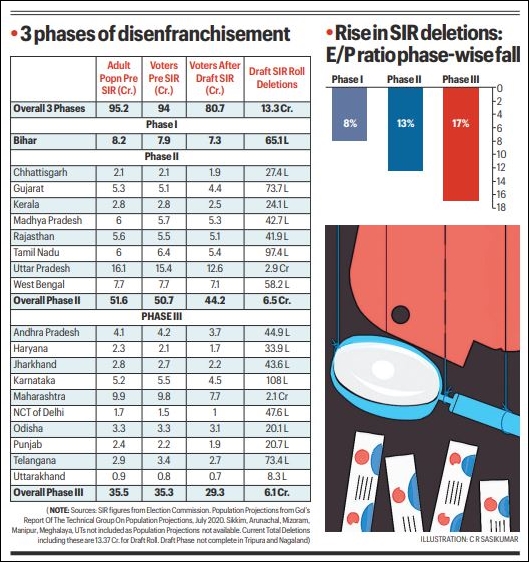
Last week, the Election Commission of India completed the release of the draft SIR voters’ list in all the major states. The draft rolls are yet to be released for Nagaland and Tripura. And the SIR is yet to start in Himachal Pradesh and J&K. Yet, the overall trends are now clear (see accompanying table). The actual number of deletions at the draft stage stood at 13 crore 37 lakh. The final impact will be a little lower, as the publication of the draft SIR list is usually followed by more additions than deletions. Taking the likely additions and the remaining states into account, we estimate that eventually the SIR will lead to over 11.5 crore deletions in India’s voters’ list.
Advertisement
Here is the big picture. At the time of the 2024 Lok Sabha elections, India’s electorate was about 98 crore, almost the same as the adult voting-age population of 99 crore at that point. By the time the SIR is formally concluded, the total count of the electorate will drop to around 88 crore against the projected adult population of 103 crore.
This huge discrepancy between the projected census figure of the adult population and the ECI’s figure of the electorate leaves only two possibilities. Either the population is massively overestimated: It is under 125 crore rather than over 145 crore as in the official projections. Or we have nearly 15 crore-voting age Indians missing from the voters’ list. Either way, we are looking at a scandal.
This is not to assume that all the deletions are wrongful. The existing voters’ list carried accumulated errors and spurious names. So, a majority of the deletions may be correct. Yet, even if one-third are wrongful, we are looking at an unacceptable level of voters’ list manipulation. Add to this a large-scale under-enfranchisement that the SIR has done nothing to rectify. These are crores of eligible voters who did not feature on the pre-SIR list, those who did but whose names were removed before the SIR, and those young voters whose names should have been added during the SIR but were not. These could explain the difference between the adult population and the electorate.
Advertisement
Instead of improving, the extent and the nature of voter deletions has taken a negative turn with each SIR phase. The accompanying chart shows this trend. The first pilot phase was limited to Bihar. A deletion of 65 lakh names — a fall of less than 8 per cent in the elector-population ratio — was enough to cause nationwide outrage. Judicial oversight and bureaucratic cover-up reduced the final deletions to 45 lakh. Everyone’s guard was already down by the second phase of 13 states. Bihar elections had taken place. The SIR was here to stay. So a drop of nearly 13 per cent did not raise eyebrows. The national attention, if any, was focused on the brazen and targeted deletion of Muslims in West Bengal. The third phase, nearing completion, comprises the rest of the country, barring Himachal and J&K. Held after the Supreme Court’s carte blanche to the ECI, this phase was marked by impunity. The deletions in the draft SIR have shot up over 17 per cent. No one seems to blink an eye.
This phase has witnessed abnormally high deletions in Haryana, Maharashtra, Karnataka, Telangana and, of course, Delhi. Across the three phases, the proportion of voters marked “dead” has stayed constant at around 3 per cent of the total deletions. Most of the deletions are on account of the voter being “absent” or “shifted” — categories that remain undefined so far and have been used arbitrarily by the local electoral officials. Besides those deleted from the draft rolls, another one-fifth are likely to face further scrutiny on account of being “unmapped” or due to “logical discrepancy” (LD). The unusually high proportion of LD in Odisha, Jharkhand and Telangana suggests that there is more to it than just a computer algorithm. Nor is there a standard operating procedure for how such discrepancies are to be treated. Clearly, “logical discrepancy” is not a method. It is arbitrariness by design.
The third phase has also opened a new malpractice: Many states have witnessed abnormal large-scale deletions just before the SIR officially began. This is crucial, because those deleted before the SIR do not even receive an enumeration form. Their deletion stays below the radar and does not count as SIR deletion. Between May 12 when the SIR schedule was announced for the third phase and the day the SIR officially began, there were over 14 lakh such suspicious deletions, of which over 8 lakh took place in Maharashtra. If we look at the entire period since the assembly elections held in February last year, Delhi has witnessed an inexplicable decline of more than 11 lakh voters before the launch of the SIR. So, Delhi’s voter list has shrunk from 1.56 crore last year to just 98 lakh after the release of the SIR draft list.
We are not dealing with data anomaly or even absurdity. We are looking at an attempt to remodel the foundations of electoral democracy. Therefore, we need nothing short of a full public audit of the entire SIR operation — design, execution and aftermath. We need an agency independent of the ECI to carry this out. We need it sooner than later. The nation wants to know.
Shastri is a researcher associated with Bharat Jodo Abhiyaan. Yadav is member, Swaraj India, and national convenor, Bharat Jodo Abhiyaan

40 years ago, October 1, 1986: First-ever Asiad gold for Usha
By Sohail Khan · 1 Oct
India’s elderly women need better social security cover
By Sohail Khan · 1 Oct