Devastating flash floods and 25,000 livelihoods: How the world’s highest marathon was born in the mountains of Ladakh
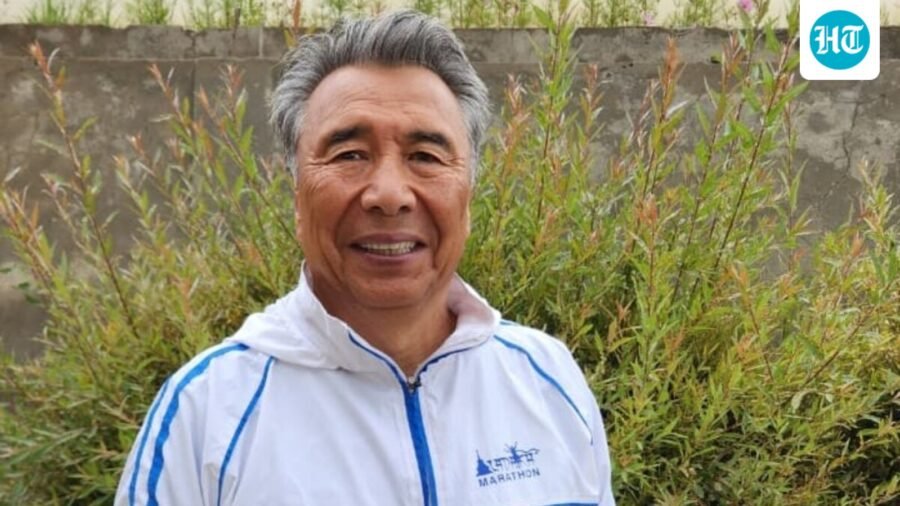
Two years after devastating floods hit Ladakh, Chewang Motup Goba turned his love for the mountains into a marathon that now brings an entire region together.
Updated on: Sep 10, 2026, 10:14:38 IST
Prefer HTon Google
Share via
Copy link
The Ladakh Marathon is unlike any other marathon in India. The way people have embraced it over the years has ensured that it is no longer just another run. The fitness culture has given a boost to marathons in recent times, but Ladakh brought its own marathon way back in 2012 – at a place and altitude where running isn’t everyone’s cup of tea.
The man behind the vision of bringing a marathon to Ladakh was Chewang Motup Goba, for whom the mountains have always been home. He brings the whole of Ladakh together to ensure the marathon works for everyone – the locals, the athletes and everyone associated with it. The wider outdoor and adventure ecosystem is estimated to support 25,000-30,000 local livelihoods, both directly and indirectly.
A 122 km marathon isn’t a bed of roses, and staging one at the altitude of Ladakh makes it even more challenging, not only for the runners, but for the organisers as well. Yet, Chewang’s motivation has kept it going, with the event entering its sixth edition this year.
In an exclusive interview with on the sidelines of the Ladakh Marathon, Chewang Motup Goba, Chairperson of the High Altitude Sports Foundation, spoke in detail about the challenges of organising the event in Ladakh and why he embraces them. A mountaineer himself, Chewang started the Ladakh Marathon in 2012, two years after devastating flash floods tore through the region, and has since remained at the heart of its growth and evolution.
The 2026 Ladakh Marathon has a record INR 1 crore prize pool. What was the thinking behind such a significant increase, and does this mark a new phase for the marathon in terms of attracting elite runners?
Absolutely. See, the announcement happened much later, after the registration. The impact this year will not be that much because we have closed the registration, but definitely next year, it will have a big impact, especially among the runners who are elite, who are running for prize money. There will be many more coming and registration for this event. And at the same time, the athletes coming from local who are really good, it will encourage them to perform much better. And also, the normal amateur runners who are just in the age category we are giving, it's a big encouragement for them, for their training and commitment. So, I think in every aspect of this event, this prize money will boost runners, I will say, to come here and run.
This year again features the 122-km Silk Route Ultra and the 72-km Khardung La Challenge. What makes these two races particularly challenging, even for experienced ultra-runners?
Well, to give an example, it's like a mountaineer who's been climbing for decades going on a big 8,000-metre. He has to undergo the same period of acclimatisation. The same rule applies. So, similarly, no matter how good a runner you are, the basic rule of acclimatization they need to follow. So, that is the big challenge, and it's not at all guaranteed that after saying you have climbed Everest, that next time you're not going to fall sick because of altitude sickness. It has nothing to do with their fitness.
View this post on Instagram
A post shared by Ladakh Marathon (@ladakhmarathon)
The biggest challenge for these two ultra races is your acclimatisation, how well you acclimatise, how you adapt to altitude, not related to fitness at all. So, that is one challenge. And the other aspect is that, the time you need to run this race. Like other races, you just go a day before, run, and come back. Here, you need a minimum of 8 to 10 days just to run a normal race. And if you're running the big races, maybe two weeks. Keeping two weeks away from either work or, your daily whatever isn't easy. So, you need much more commitment, a more serious effort to run these two races.
Safety is perhaps your biggest responsibility at an event conducted at such extreme altitude. What are the additional measures in place this year to ensure that runners are properly acclimatised and medically prepared?
Well, the rules which we have, that all runners who are running these two ultras, they have to arrive minimum 10 days before the race. That is mandatory. So, that's why our expo happens 10 days before the race day. So, if they are unable to reach and collect the bib on those expo days, they don't get the bib. So, they are not allowed to get later, don't get an entry to run these races. That is one filter we have.
The other filter we have is that the eligibility criteria we have to run those races are very stringent. And we keep on tweaking this, getting the data from each and every edition. So, whatever rules we have, they won't remain the same. It changes every year based on the data we get from that year's event. That is the eligibility criteria and the bib collection. They are one of the two most important filters we have to get the right people to run this race.
As the marathon has grown, how important have local residents been in supporting the event, particularly through homestays, accommodation and helping athletes with their acclimatisation and stay in Ladakh?
Initially, no one really believed you could make people run from the plains of India across Khardung La at this altitude. There were doubts. The good thing is that I believed in it because of my background as a mountaineer, for climbing the whole life spent at high altitude. That was a big advantage planning every aspect of this event.
But then I think slowly people started coming on board, village societies, okay, it's happening, it's bringing some money. But now, almost everyone in Ladakh is on board. They appreciate that they are happy about the money and the impact it is having on the economy.
And, yeah, at the same time, having minimum impact on the environment, and that is also because there are a lot of people who are very sensitive here about the environment. It's such a fragile environment. So, we have been able to take care of that very, very seriously. I will say, this is the biggest event which has benefited Ladakh.
With the marathon attracting runners from across India and abroad, how difficult has it become to maintain the event’s character while scaling it up?
That is absolutely a very difficult and a very good question because many times even I get there are doubts about how to go in future, how to build it up. There are many looking, taking care of the safety aspect of runners, the safety aspect of the people here, and the environment. And at the same time, trying to get a hold on the global level, you need every expectation to really fall in place. As of now, I think the biggest challenge we face is trying to get the right kind of partners on board who believe in all these aspects because these days most of the, big corporates, they are looking at the benefit they are going to get commercially.
There are corporates, I would say more concerned about the benefits they give it to the community and the environment. They are a bit considerate on the output, the investment they are doing, they do.
But to get the right partners, that's very challenging, and you need to have the right partners for the long term. That is where it's going to benefit. We are getting quite a lot of big corporates who are, I would say, in conversation with us. Hopefully, in the next few years, we'll have the right partners to make this event go much further.
You’ve often spoken about using sport to create opportunities for Ladakh’s youth. Are you seeing more young Ladakhis now looking at running and sport as a genuine career or livelihood option?
Absolutely. Like Ladakh Marathon, I'll just give the example of this event. So many of our school boys who used to win this marathon event have been absorbed into the Indian Army, the Ladakh Scouts. Now, they are winning the big races here. Similarly, many of our girls who have been running have been getting podium finishes all across the country from some of the biggest races in the Indian running scenario, like Mumbai, Delhi. And it's not just one. We had, we have the top three Ladakhis.
Many of our marathon runners are now moving to ultra running. And they have done extremely well at the global level. Last year, one of our runners came in the top 20, top 10 at Chang Mai Ultra. And he was the first Indian to break into the top 50 at UTMB.
So, it's happening; it takes a long time to really bring it to a global level. But I think we are on our journey. We are on the right course, and definitely in the coming years, you will find a lot of Ladakhi young people not just performing well on the national level, but on the international level, mainly in the ultra run.
For the 2026 edition, Ladakh Marathon’s event sponsors include Bisleri, PUMA, Bajaj General Insurance, The Grand Dragon, Fast & UP, Renault, Max Protein and J&K Bank.
See Less