At BRICS, India’s task is to keep the Ukraine peace process moving
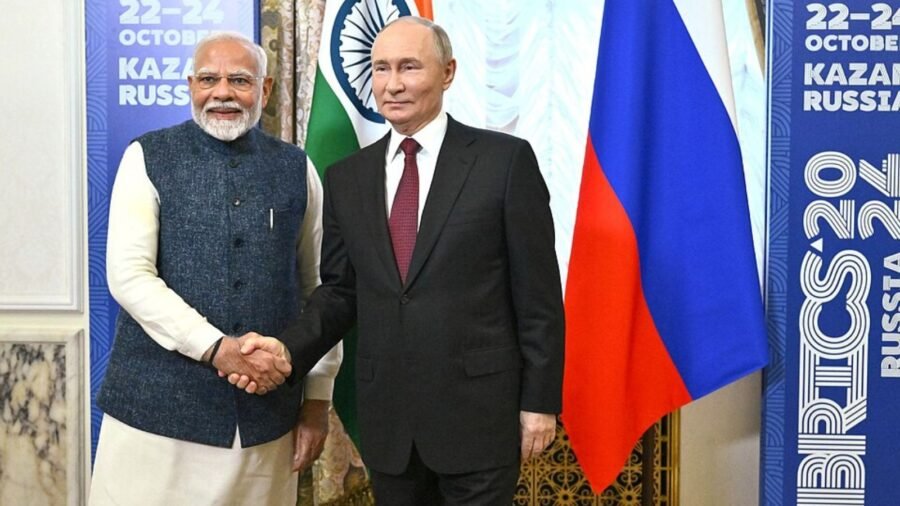
When Prime Minister Narendra Modi met President Vladimir Putin in Bishkek on the sidelines of the Shanghai Cooperation Organisation, he publicly repeated the counsel he has long offered Russia’s leader: End the seemingly endless war in Ukraine. The message was timely. Over the weekend, US President Donald Trump’s envoys for everything, Steve Witkoff and Jared Kushner, travelled to Moscow and Kyiv, with a similar message, bolstered by fresh peace proposals. Even as the guns briefly fell silent in honour of the mediators, their visit reintroduced a sliver of hope into a conflict that, until days ago, saw only continuous escalation. After more than four-and-a-half years, the war may at last be edging towards its endgame, or at least the negotiation of one.
For six months the American peace initiative had lost momentum, its oxygen consumed by another war entirely. Washington’s attention had been absorbed by Iran, and Ukraine boiled while the US got dragged in as a belligerent in the West Asian theatre. That Trump has now returned to the Ukraine file is confirmed by his follow-up call to Putin on Tuesday, asking for a swift end to the war to allow US-Russia ties to be restored. It signals that the Alaska process of 2025, which produced the Anchorage summit, the successive plans and counter-plans, and the rounds at Geneva and Abu Dhabi, had only paused. A peace plan, or at least a ceasefire, may yet materialise through a trilateral featuring Trump in the same room as Putin and Ukrainian President Volodymyr Zelenskyy.
Advertisement
Of course, yawning gaps in positions remain to be bridged on territory and security guarantees. Accounts circulating earlier had described Putin reducing Russia’s demands to a “3+2” formula: Crimea, Donetsk and Luhansk, with Zaporizhzhia and Kherson beyond. Russia holds Crimea and insists on the whole of the Donbas, including ground it has not taken. It has reportedly offered to let Kyiv keep the parts of Kherson and Zaporizhzhia it could not capture, against an easing of sanctions. That was, in essence, the bargain that collapsed when — as Secretary of State Marco Rubio admitted — Ukraine would not agree. For the moment, Washington can help keep the parties in the room; it cannot make Kyiv cede the Donbas, nor make Moscow accept less than it believes it has won.
Perhaps not coincidentally, days before the American envoys set out, External Affairs Minister S Jaishankar had shuttled along the same route, from Moscow to Kyiv, urging dialogue and diplomacy, and perhaps carrying a message from Moscow to Kyiv. Rather than propose a branded peace framework, as China, Switzerland and Turkey each did, only to see their efforts stall, India effectively worked inside the existing US peace track, amplifying the voice of the Global South, offering to help only if both belligerents asked, and no doubt keeping the Americans informed. India’s gambit would have served as a nudge to all parties. The message would have been a reminder to the principal mediator and to both warring sides that the alternative to talking is only more killing and more punishment to the global economy.
Here lies the argument too often lost in big-power choreography. The war in Ukraine is not the private business of the belligerents and their patrons. Its costs have radiated far beyond the theatre: In the price of energy and the security of food and fertilisers, in inflation and sovereign debt, and in the fraying of the multilateral institutions on which smaller states depend. Nations with no soldiers near the Dnieper have paid a heavy price for this war, and that gives them a legitimate stake in its ending. Peace in Ukraine is, in this sense, a global public good.
Advertisement
It follows that the pursuit of that peace cannot be the monopoly of Washington, Moscow and Brussels. The Global South, much of it distant from the front and all of it exposed to the fallout, has both an interest and a standing to press for a settlement. India, as this year’s BRICS chair and among the more credible voices of that constituency, is well placed to carry the message. Its nudge is therefore an act of representation. Far from presuming a role, India speaks for a constituency that is watching, is affected, and wants the guns silenced.
On energy, India has held a line that speaks for many such states: That cutting oil imports will not stop the war, that its citizens’ energy security is non-negotiable, and that sanctions for their own sake are no substitute for diplomacy. More broadly, all global conflict threatens India’s trajectory of growth that will give it the status of a developed economy in the next two decades. Wars, distant or near, can derail India from this trajectory.
The Ukraine settlement, when it comes, will be authored in Washington, Moscow and Kyiv, and, on current indications, sealed in a trilateral involving Trump, Putin and Zelenskyy. India will not be in that room. Its own test comes this weekend, as host of the BRICS summit in New Delhi, which will seat one belligerent from each of today’s wars, Russia from Europe and Iran from West Asia, but neither the United States nor any other mediator. India’s immediate task will be to steer a summit declaration that reflects the reality of these conflicts and does not merely echo the case of any single party in them, and a collective call for peace from a world that has paid for these wars without a say in them. That is the most a BRICS chair can do.
The endless wars will end at the table. India’s part is to keep nudging all parties in that direction and to keep insisting there be a table.
The writer is a former diplomat and distinguished fellow, ORF

‘Sham’ contracts, inflated revenues: Charges against Man City, penalties it could face
By Sohail Khan · 1 Oct
Amitabh Bachchan, 83, suffers knee injury after fall: ‘I had trouble standing up’
By Sohail Khan · 1 Oct