As garbage piles up in Haryana, why has the sanitation workers’ strike continued?
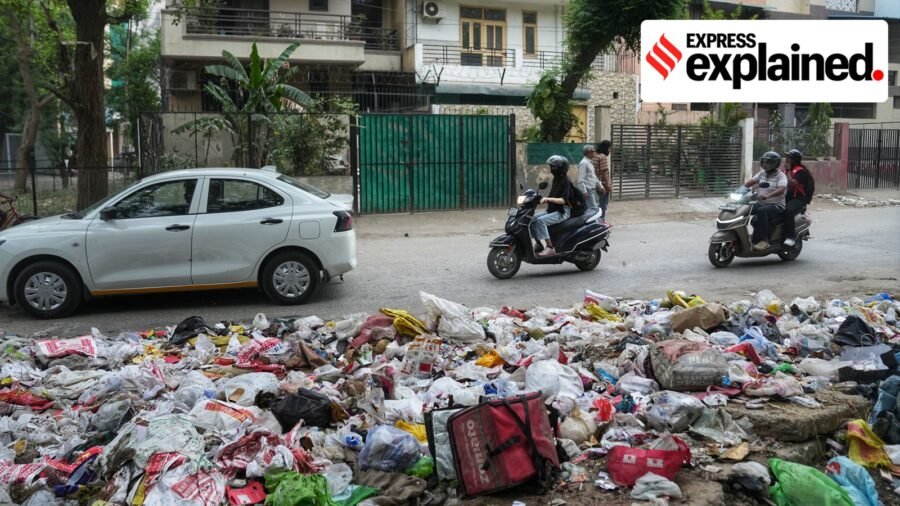
A standoff between agitating sanitation workers and the BJP-led Haryana government remains unresolved despite multiple rounds of talks over the past month.
With the strike now in its second month, here is what to know about the disruption in sanitation services in urban areas across the state.
Why are sanitation workers on strike in Haryana?
Sanitation workers went on strike on August 6, demanding regularisation of the services of 13,093 workers currently employed on municipal rolls.
In addition, the protesting workers are demanding that around 16,500 sanitation workers currently engaged through contractors under the outsourcing system for door-to-door garbage collection also be brought onto municipal rolls.
The state has around 3,400 regular sanitation workers. Besides regularisation, the workers raised 12 other demands, which the BJP-led Haryana government says have already been accepted.
What is the workers’ current salary?
The 13,093 sanitation workers currently receive a monthly remuneration of Rs 20,590. Under the government’s latest proposal, sanitation workers who have completed more than 10 years on municipal rolls would receive Rs 25,560 per month.
The workers, however, continue to insist on regularisation of their services. They argue that regularisation would make them eligible for a monthly salary of more than Rs 34,000, besides other benefits associated with regular government employment.
What is the hurdle in resolving the standoff?
Story continues below this ad
Haryana Social Justice Minister Krishan Bedi said six meetings had already been held between the government and the agitators to resolve the issue.
According to Bedi, there are legal hurdles in regularising the workers, and the government has sought a legal opinion on the matter. He also said the workers had sought regularisation for employees who had completed only two years of service.
Bedi claimed that no such policy existed anywhere in the country from 2001 to 2026.
Haryana Nagarpalika Karamchari Sangh president Naresh Shastri, who is leading the agitation, disputes the government’s contention. He said the union had not made an “impossible demand” by seeking regularisation for workers with two years of service, pointing to instances in Haryana when employees with shorter service periods had been regularised, including during the 1980s and 1990s.
What does the Opposition say?
Story continues below this ad
The principal Opposition party, the Congress, has backed the striking workers and demanded regularisation of their services. Former Chief Minister and Leader of Opposition Bhupinder Singh Hooda has challenged the BJP government’s contention that there can be no policy to regularise workers after two years of service.
Hooda said that during the previous Congress government, two policies issued on June 16 and June 18, 2014, provided for regularisation of employees who had completed three years of service. He claimed that the policies had subsequently been upheld by courts, including the Punjab and Haryana High Court and the Supreme Court.
Hooda also displayed a notification issued by the Congress government in Himachal Pradesh which, he said, provided for regularisation of contractual employees after two years of service. He alleged that the BJP government was denying contractual employees their rights by claiming that such regularisation was not possible.
How are residents coping with the sanitation crisis?
As garbage continues to pile up during the strike, residents and municipal authorities are struggling to manage waste in several urban areas.
Story continues below this ad
In Gurugram’s Suncity Township, for instance, the resident welfare association has hired additional labourers for sweeping and garbage collection. However, RWA chairperson Kusum Sharma said many of the workers do not turn up regularly.
In Hisar and Fatehabad, municipal officials, accompanied by police personnel, have attempted to clear accumulated garbage using JCB machines, particularly during the late evening and early morning hours. These efforts have, on several occasions, led to confrontations between striking workers and municipal officials, resulting in the detention of sanitation workers and the registration of FIRs against some of them.
With regular door-to-door collection disrupted, some residents are storing garbage at home, while others continue to dispose of it at designated collection points, where waste has accumulated.
In parts of Rohtak and Hisar, residents have also reported garbage being dumped in vacant plots and along roadsides. In Rohtak, Congress Seva Dal workers recently sprayed insecticide on garbage heaps in several locations, citing concerns over mosquitoes and the possible spread of disease.
What next?
Story continues below this ad
The government has proposed bringing the 13,093 sanitation workers employed on municipal rolls under the Haryana Contractual Employees (Security of Service) Act, 2024. The proposal would provide them with job security until the age of 60.
The protesting workers, however, have rejected the proposal. They maintain that contractual job security does not provide the same benefits as regularisation, particularly with regard to service benefits and post-retirement entitlements.
Meanwhile, the government has initiated action against the striking workers, dismissing 32 sanitation workers on Monday (September 7). It has also claimed that around 387 workers resumed duty on Sunday.
The striking workers, however, have said they will continue their agitation until their demand for regularisation is accepted.

40 years ago, October 1, 1986: First-ever Asiad gold for Usha
By Sohail Khan · 1 Oct
India’s elderly women need better social security cover
By Sohail Khan · 1 Oct