25 Years After 9/11: How One Morning Rewired The World
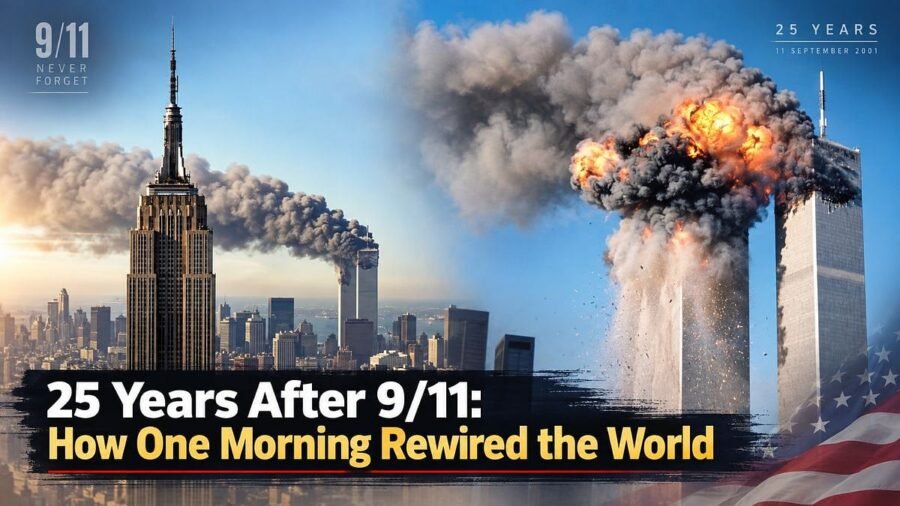
Twenty-five years after 9/11, the attacks continue to influence everyday life through tighter airport security, digital identity checks, intelligence sharing, financial monitoring and safer urban infrastructure. The article examines how that one morning reshaped globalisation, public perceptions of first responders and the world’s approach to security and resilience.
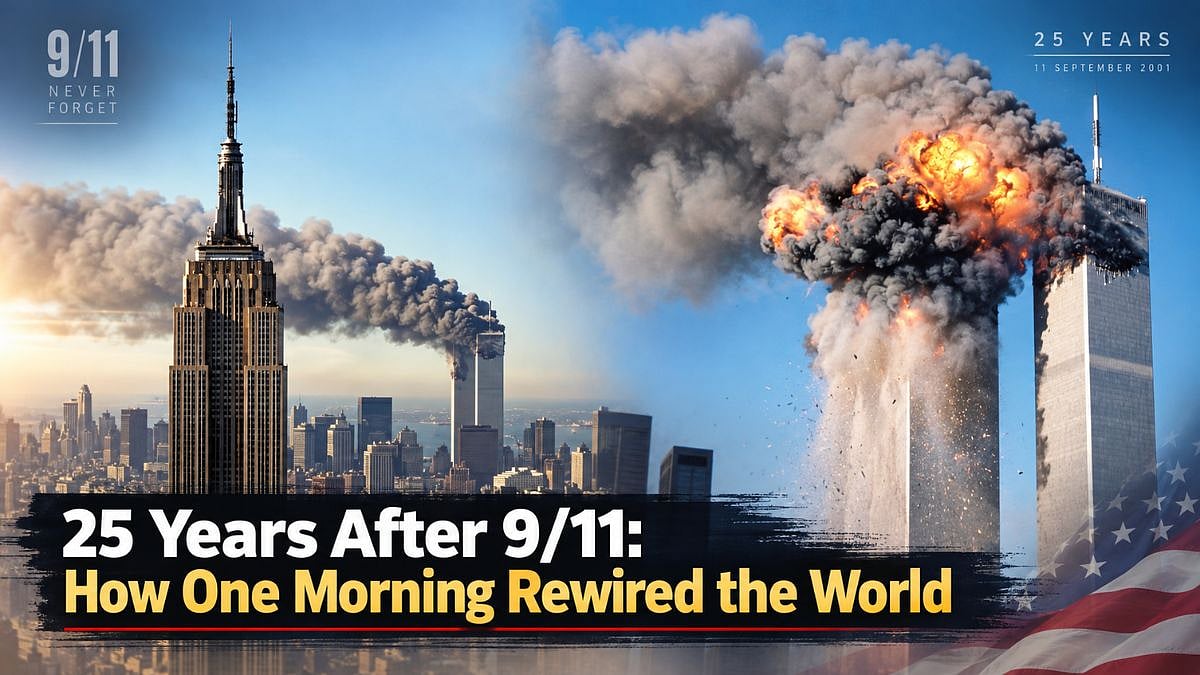
The September 11 attacks transformed global approaches to security, travel, identity and urban resilience | AI Generated File Image
If you were alive and awake on September 11, 2001, you would remember two things: the images and the weird, quiet feeling that the world had just changed its operating system while you were watching it live. It has now been 25 years. We are not here to re-litigate the wars or the politics; we are here to ask a brand question: How did that one Tuesday change the daily texture of life for 8 billion people?
Because it did. Quietly. Completely.
The Airport Became The Border
Before 9/11, an airport was a bus station with wings. You could go to Delhi airport in 1999 to drop your cousin off and walk him to the security gate. You could carry a full bottle of water. You could joke with the security guard.
`;
After 9/11, the airport became the most serious place in the world. The TSA in the US, the CISF in India, and every security line on earth were redesigned that week. The idea of removing shoes, belts, laptops, liquids under 100 ml, and full-body scanners did not exist on September 10.
The world invented a new ritual. 4 billion people a year now perform it: empty your pockets, prove you are not a threat, and then you may fly.
And it worked. Hijackings, which were 40-50 a year in the 70s and 80s, have dropped to near-zero since. The system is annoying, but it's the price of a world where 100,000 flights take off every day and almost nothing bad happens.
Brand America didn't just secure itself; it exported its anxiety, and the world copied it, because we all wanted the same guarantee: you can get on a plane and land safely.
The Identity Became Digital
On September 10, your passport was a paper booklet with a stamp. Your visa was a sticker. America didn't know how many foreign students were actually in classrooms. Tracking was an Excel sheet.
After 9/11, the world decided that paper identity was not enough. The US created DHS, but every country created something similar. India created NATGRID after 26/11, which was directly inspired by post-9/11 intelligence-sharing failures. Biometric passports, e-passports, SEVIS for students, API data for airlines, CCTV in cities—all of this got fast-tracked after 2001.
The little RFID chip in your Indian passport today, the DigiYatra face scan that lets you through Bangalore airport in 10 seconds, and the fact that your phone knows which gate you need to go to—that's the positive child of a paranoid parent.
We went from an analogue world, where you could be anonymous, to a digital world, where you are verified 20 times a day. Less romantic, far safer.
The Hero Changed Shape
Before 9/11, the global hero was a market hero—Steve Jobs, Michael Jordan, and Richard Branson. Even movie heroes were adventurers—Indiana Jones and Ethan Hunt.
After 9/11, the world fell in love with the first responder. The firefighter carrying someone down 80 floors. The NYPD cop. The random guy in a boat who showed up in Manhattan to ferry people out. The phrase "Never Forget" was not about vengeance; it was about gratitude for people who run towards danger.
That image reset what we celebrated. Suddenly the public servant, the soldier, the paramedic, and the nurse had a new cultural capital. That ethic later drove how we clapped for healthcare workers during Covid. That lineage starts on 9/11.
Even business heroes changed. Silicon Valley's post-9/11 pitch was "we can make you safer". Palantir was founded in 2003 to connect intelligence dots. Cloud computing, big data, and the entire data analytics industry got their first and biggest client: governments who wanted to prevent the next attack. The iPhone in your pocket has better encryption today because of that early push.
Globalisation Got A Speed Breaker
In 2000, Thomas Friedman was writing The Lexus and the Olive Tree: the world is flat, borders are dying, and trade will make everyone friends.
9/11 was the first speed breaker. It reminded the world that globalisation without security is just wishful thinking.
What happened next was not de-globalisation but smart globalisation—container screening, financial transaction tracking to stop terror funding, and tighter checks on dual-use tech. The world didn't stop trading; it started trading with ID.
For India, it was unexpectedly powerful. Before 9/11, the American conversation about Pakistan and India was hyphenated. After 9/11, America needed India as a partner who understood terrorism. The US-India counter-terrorism framework and intelligence sharing that led to LeT designations and eventually the civil nuclear deal in 2008—that trust was accelerated because both countries now spoke the same security language.
The world moved from naive interdependence to resilient interdependence. Less kumbaya, more insurance.
The City Learnt To Be Soft And Hard At Once
Look at any major city skyline today—Mumbai's BKC, London's Canary Wharf, and Dubai's downtown—those towers are post-9/11 buildings.
They have bollards disguised as planters, blast-proof glass, better evacuation cores, and buildings that can communicate with helicopters. The engineering of the One World Trade Center itself is a marvel—a 104-storey building with a concrete core so strong it could survive what the old one could not.
But those same cities also made their public spaces softer—more open and more memorialised. The 9/11 Memorial in New York, with its two voids where water falls endlessly, is the most visited memorial in the US. It taught cities how to remember without closing down.
So, 25 years later, what did that one morning do?
It did not make the world more negative; it made the world more grown-up.
It took a world that thought history had ended—remember, in the 90s everyone thought liberal democracy had won forever—and reminded it that history never ends. It has twists.
It made travel safer, identity smarter, and cities stronger and gave a generation a very clear example of what courage looks like when the cameras are rolling and there is no script.
Brand America took a hit, yes; every brand that gets attacked does. But Brand Humanity got a software update.
And we are still running on it.
Dr. Sandeep Goyal is Chairman of Rediffusion. He is also Consulting Editor of .

Add As a
Trusted Source