Women Are ‘Free’, Until They Actually Exercise Freedom
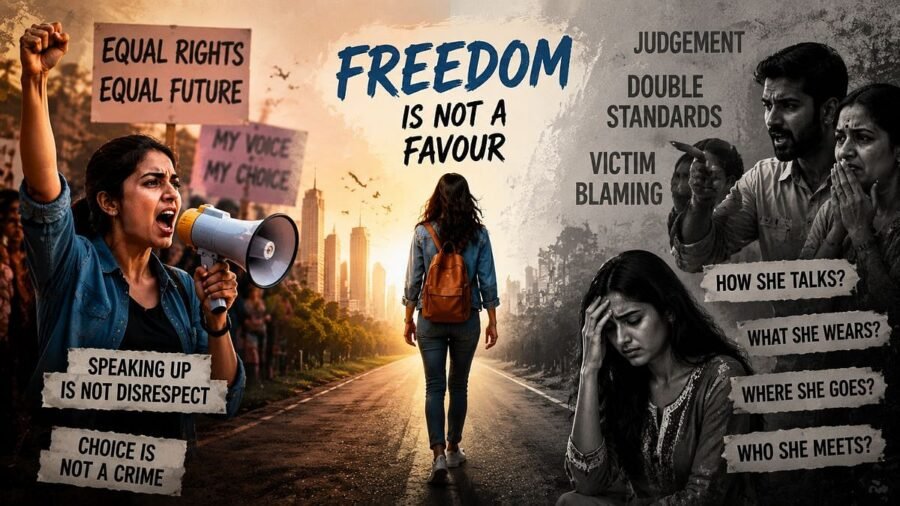
Women in India continue to face double standards when exercising freedom in speech, appearance, relationships, sexuality, family responsibilities and careers. Political claims of empowerment must be matched by social and workplace change, including shared care responsibilities, safer public spaces and stronger representation of women in leadership.

The article examines the social and professional barriers women continue to face while exercising personal freedom in India | AI Generated Representational Image
A man can abuse, threaten, insult, and humiliate someone in public and still be called aggressive or politically formidable. A woman using the same language can trigger a debate about culture. Suddenly, the woman herself becomes the subject. That contradiction seems to be the heart of Rahul Gandhi’s remarks in Pune after Prime Minister Narendra Modi’s comments about the “cultural shock” of young women protesters using abusive language at Jantar Mantar.
Politics may have triggered the argument. But our society has been writing its script for generations. Why does behaviour that barely registers when performed by men become a cultural crisis when performed by women?
Freedom With Conditions
The answer lies deeper than one protest or politician. India has created laws and institutions for women, but social permission remains conditional. A woman can speak, dissent, dress differently, pursue a career, choose her partner or assert sexual autonomy, yet every choice can invite judgement. Her freedom comes with invisible terms and conditions.
`;
The policing begins with speech and thought. A boy who speaks bluntly may be called confident. A girl who refuses to soften her views can quickly become arrogant or badly brought up. Men can be profane in politics and admired for their toughness. Women are asked to explain their tone before anyone addresses their argument. A strong-opinion woman can be labelled difficult before anyone engages with what she thinks.
This double standard is particularly grotesque in politics. Indian political discourse has been deteriorating into abuse, innuendo, personal attacks, and humiliation across ideological lines. The decay extends to social media, where content factories and anonymous handles churn out cheap potshots and character attacks. A political class that weaponises such behaviour has little credibility when it lectures society on civility.
Expectations At Every Stage
Identity brings another set of restrictions. Indian women are expected to be obedient daughters, accommodating wives, dutiful daughters-in-law, self-sacrificing mothers, and competent professionals. Each role comes with instructions, and rejecting them can quickly invite accusations of selfishness.
Appearance is another battleground. A woman’s clothes are still treated as a referendum on her character. Clothing is never an invitation to harassment or sexual violence, but every public choice does not automatically become an expression of dignity or decorum. The answer to perceived indecency is neither policing nor humiliation.
Mainstream cinema has also taught India how to look at women. For decades, popular films have rewarded the virtuous woman, sacrificial mother, and desirable heroine while making the sexually assertive or defiant woman a transgression to be punished or consumed. Powerful exceptions exist, but repetition becomes a social expectation.
The Double Standard On Sexuality
Sexuality carries the harshest penalty. A man’s sexual history can be a joke or badge of experience; a woman’s can become a verdict on her character. Stalking, harassment, sexual violence, and domestic abuse operate within this culture of entitlement, followed by questions about her clothes, drinking, company, location, and timing. The perpetrator’s conduct becomes the footnote. The woman is put on trial.
The quieter discrimination begins at home, where women remain the default managers of childcare, ageing parents, school appointments, medicines, and the family’s emotional load. Even in affluent and educated households, she is expected to remember, organise, anticipate, and absorb. The career penalty follows: fewer demanding assignments, assumptions about travel and availability, career breaks, and being the parent who stays home when anyone is sick. She can relocate for her husband’s career and later be told it was her choice. Years of these compromises can then be mistaken for a lack of ambition.
The cost is devastating. India continues to confront rape, domestic violence, sexual harassment, trafficking, stalking, and dowry-related violence. The digital world has added threats, sexual abuse, doxxing, and public shaming. A culture that excuses smaller violations makes larger ones easier to ignore.
Empowerment Beyond Political Claims
Political claims of empowerment deserve scrutiny. Politicians across the spectrum speak fluently about women’s safety, dignity, representation, and empowerment. Social transformation requires raising sons differently, allowing daughters to disagree, sharing care, changing workplace expectations, and making spaces safer for women everywhere. That work happens far from campaign stages.
Corporate India has its own uncomfortable contradiction. Governance regulation requires listed companies to have at least one woman independent director, yet compliance can reduce her appointment to a box to be ticked rather than a search for the differentiated perspective she can bring. If there is genuine conviction about women sharing corporate power, why stop at one? Mandate 50 per cent women on boards and make companies build the pipeline and change the succession. Most of India’s largest conglomerates still have few women in senior leadership while displaying impressive ESG credentials. “We cannot find enough women” often reveals how little effort went into finding them.
The test will be found in ordinary life. Can a daughter-in-law disagree without being called disrespectful? Can a wife refuse an expectation without being selfish? Can she speak angrily without being told how a woman should behave?
Women have spent generations learning to make themselves smaller, quieter, safer, and more acceptable. They have moderated their voices, managed their clothes, calculated their movements, carried disproportionate care responsibilities, and absorbed career penalties, often dismissed as simply the societal norm for Indian women. The real measure of empowerment is whether those compromises are finally shared by men. As a man writing about this, I would rather add to that conversation than presume to speak for women.
Until then, India’s argument about women’s freedom remains unfinished. The culture around women must stop treating female freedom as an act of defiance.
Dr Srinath Sridharan is a policy researcher and corporate adviser. X: @ssmumbai.

Add As a
Trusted Source