Will Anthropic’s new AI text watermarking method make Claude’s responses worse?

Anthropic has shared more details on how it plans to watermark text generated by Claude, amid growing concerns that a blanket, model-level implementation of watermarks could affect the quality of the AI models’ responses.
Any text longer than 200 tokens (~150 words) generated by future Claude AI models will carry a machine-readable watermark that is imperceptible to human users. The watermark cannot be removed by copying and pasting the content elsewhere, and may even persist after the content has been edited. Additionally, AI-generated image files will be attached with cryptographically signed provenance data to indicate whether the image file was processed using Claude.
Unlike image files, watermarking text is more challenging to do without altering the quality of the model’s outputs. It also has to be efficient to scale, inexpensive, invisible to readers, and difficult to remove. Anthropic has claimed that its chosen watermarking method ticks all these boxes.
Anthropic’s technique is based on Google DeepMind’s SynthID-Text research paper. It does not involve hiding invisible non-printing Unicode characters in the text, as some reports initially speculated, and will not impact speed and token consumption of the model. Anthropic also said that the watermarks will not contain personally identifiable information linking text to a user, organisation, or chat session.
As for the bigger question of whether watermarking will come at the cost of output quality, it helps to take a closer look at how the technology will work.
First, why is Anthropic making this change?
Anthropic is part of a growing list of major AI providers such as OpenAI, Google, Meta, and Microsoft who have voluntarily signed the European Union’s ‘Code of Practice on Transparency of AI-Generated Content’. But more precisely, the change is being implemented to comply with transparency obligations laid down in Article 50(2) of the EU’s AI Act, which went into effect on August 2, 2026.
While adherence to the Code is voluntary, the transparency requirements under the EU’s AI Act are legal obligations. Companies designated as AI providers are also required to roll out AI detection solutions that are compliant with the bloc’s privacy and data protection law. To this effect, Anthropic has said it is working on launching a watermark detection API (Application Programming Interface) in the coming months.
Story continues below this ad
Content generated using Anthropic’s existing Claude models will also carry hidden watermarks in the coming months.
What is the foundation of watermarking AI text?
Large language models (LLMs) generate a series of tokens, with each token representing chunks of words. Rather than generate a single token at a time, an LLM outputs a list of (say, 1,00,000) tokens, each of which is assigned a probability score based on the preceding text. The model then picks the token from the most likely options in a semi-random sampling process to generate the final output.
For example, in a partial sentence such as ‘The weather today was cold and…,” the next set of tokens are unlikely to represent the word ‘sugary’. The more likely tokens to be picked will represent either ‘overcast’ or ‘grey’.
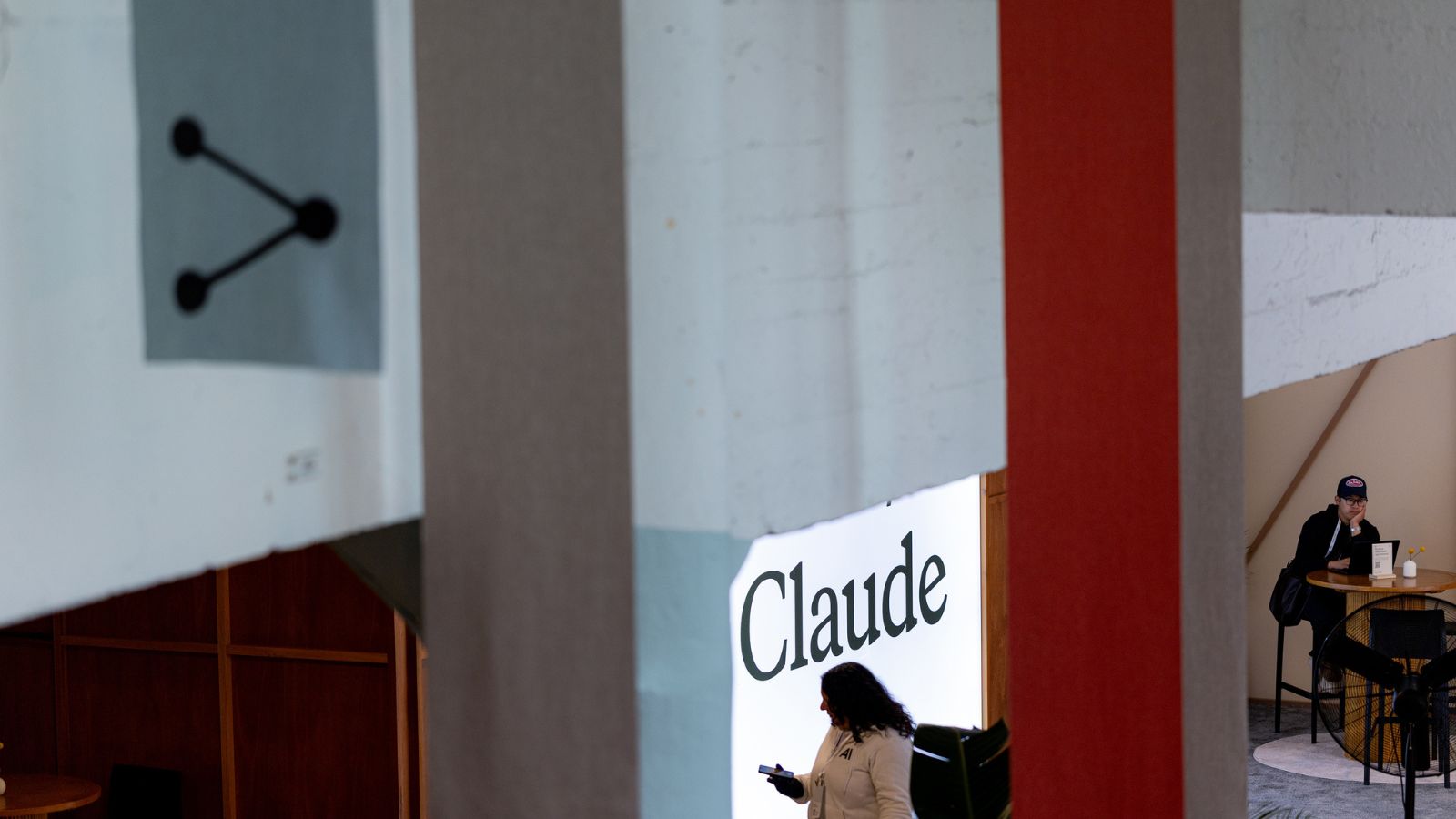 Attendees gather at the Anthropic’s Code W/ Claude event in San Francisco, May 7, 2026. (Jason Henry/The New York Times)
Note, LLMs are often described as non-deterministic systems because asking a model the same question will generate outputs that have a similar meaning, but the phrasing will be slightly different.
Story continues below this ad
At each decision point for generating the next token, the LLM makes a choice that is settled by a random number. But what if this process could be influenced to leave a detectable pattern in the model’s responses? That is the crux of the SynthID-Text watermarking approach pioneered by Google DeepMind in a research paper published in 2024.
How will Claude’s text watermarking work?
Anthropic has adopted a version of the SynthID-Text watermarking approach.
With SynthID, each token is assigned a separate SynthID score based on its previous tokens. The watermark is applied by adopting a sampling strategy like “out of the top five most likely tokens, pick the one with the top SynthID score.” This watermark can then be detected by calculating the aggregate SynthID score of a block of text. If it is found to be suspiciously high, it is very likely that the text is AI-generated.
Anthropic’s technique differs from SynthID mainly in how the watermark is detected as the former’s process involves a key. While the tokens picked by Claude will still be random, anyone with the key can check the sequence of tokens to see if it is consistent with the choices Claude would make if it were using the key.
Story continues below this ad
In the sentence, “The weather today was cold and…”, Claude is most likely to choose ‘overcast’ or ‘grey’. If the key favours ‘overcast’, and hundreds of such token choices consistently align with the key, the watermark is successfully detected and one can conclude that the text likely involved processing by Claude. The model’s choice continues to be random and its outputs will be non-biased. Translated text using Claude will also carry a watermark, according to Anthropic.
Will it impact output quality?
Anthropic said that it conducted internal testing, which showed no impact of this method on the content, level of creativity, or readability of Claude-generated text.
It also cited a Google DeepMind study, where a portion of Gemini users were asked to give thumbs-up and thumbs-down ratings. It found no statistically significant differences from the un-watermarked model outputs. Another controlled test by Google DeepMind showed human raters watermarked and un-watermarked answers side-by-side, and they saw no difference in quality.
However, some have pointed to holes in Anthropic’s explanation on why the watermarking will not affect the model’s creativity. Daring Fireball’s John Gruber argued that the technical premise of grey versus overcast not mattering much to the end-user is flawed. Calling it a “perverse adulteration” of what it means to write or read, Gruber wrote, “I want any LLM I use to choose the very best, most precise words at every single decision point.”
Story continues below this ad
Are there any other limitations?
The watermark only indicates that Claude was ‘likely’ involved in processing the content at some point. It cannot distinguish ‘Claude wrote this’ from ‘Claude heavily edited this’. It does not confirm if the text was human-written or whether it was generated by a different AI model as the detection key would only apply to Anthropic’s models.
 Chain-of-thought reasoning by a closed, proprietary model such as Claude Opus 4.8 is typically hidden.
Even with respect to Claude models, watermarking cannot be applied for small passages of text. It is also sparser on factual passages where there are fewer choices that can be made by the model without decreasing the accuracy of the text. This limitation extends to proofreading as well. There are fewer spaces where the watermark can exist.
Additionally, Anthropic’s watermarking method will not work reliably on AI-generated code since there is not much room for a choice where an exact output is required.

What is a kill switch, and why is it hard to build one for AI systems?
By Sohail Khan · 20 Sep
A smartwatch should fit your routine, not interrupt it. These five models go the extra mile
By Sohail Khan · 20 Sep
Nike Alphafly 4: 5 things (including the science) behind new marathon shoes
By Sohail Khan · 20 Sep