Why Marathi is now compulsory for Maharashtra’s auto, taxi drivers
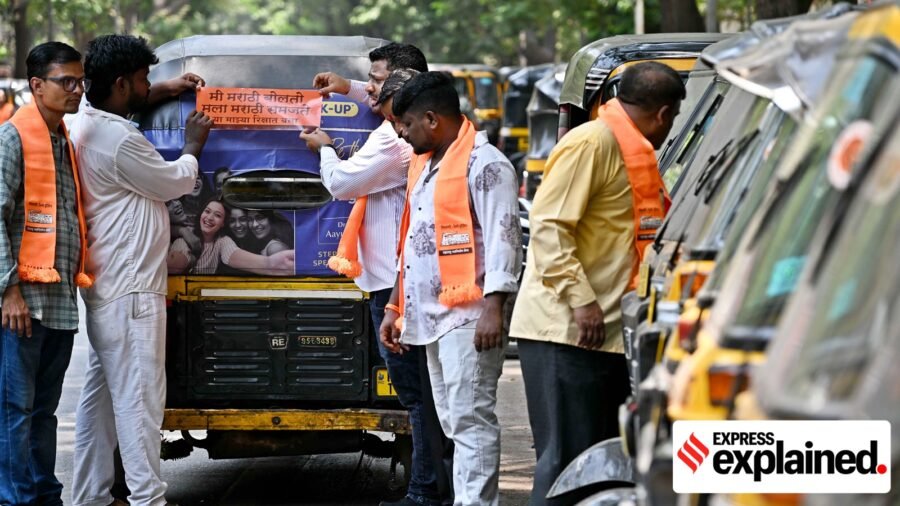
The Maharashtra government has begun enforcing a requirement that auto rickshaw and taxi drivers demonstrate a working knowledge of Marathi, making language proficiency a condition for continuing work.
The crackdown follows a 105-day training and assessment drive for drivers, but a large number have either failed the test or are yet to complete the training.
The move also revives a legal issue after the Bombay High Court had struck down a similar Marathi requirement for auto rickshaw permits in 2017, prompting questions over the legal basis of the government’s latest action.
Why the requirement?
The Transport Department’s stated reason is that drivers need to be able to communicate with passengers in the state’s native language. Officials have received complaints of drivers being unable to understand passengers’ instructions or communicate with them in Marathi.
The issue gained attention earlier this year after a pilot inspection by the Mira-Bhayander RTO found several autorickshaw drivers who, according to officials, lacked proficiency in basic Marathi.
Transport Minister Pratap Sarnaik subsequently announced that auto-rickshaw and taxi drivers would have to know Marathi. The department began a 105-day campaign on May 1 across 59 RTOs, sub-RTOs and language training centres.
The exercise involved training, as well as testing. More than 4,500 teachers from the Konkan Marathi Sahitya Parishad and Mumbai Marathi Sahitya Sangh trained drivers in basic conversational Marathi. The four-session course focused on everyday exchanges with passengers, including asking for destinations, discussing fares, understanding directions and responding to routine questions.
Story continues below this ad
Drivers who completed the course and passed the assessment were given certificates at an event in Thane on August 17.
What did the training achieve?
For some drivers, the classes were aimed at improving their confidence in speaking Marathi rather than teaching the language from scratch.
The numbers, however, show that thousands of drivers still need to clear the requirement. Of the nearly 1.25 lakh drivers who completed the programme in Mumbai, 7,750 failed the assessment and are required to reappear, while more than 14,000 had not completed the training.
And why autos and taxis in particular?
The government’s argument is that auto and taxi drivers interact with passengers throughout the day and need to understand basic instructions and communicate with commuters.
Story continues below this ad
But the requirement has also raised concerns among driver groups, particularly because many drivers are migrants and some are older workers with limited formal education. Unions have argued that the government should focus on training rather than penalising drivers whose livelihood depends on their licences.
The issue has particular significance in Mumbai, which has more than 2.8 lakh autorickshaw permits and around 20,000 taxi permits, covering an estimated five lakh drivers across shifts.
For driver unions, the concern is less about learning Marathi and more about what happens when language proficiency becomes a condition for employment. They have argued that the requirement could disproportionately affect migrant drivers and that failure to meet it should not result in the loss of a livelihood.
What is the legal question?
The requirement is not new, and neither is the legal challenge.
Story continues below this ad
In 2017, the Bombay High Court set aside a Transport Department decision requiring Marathi proficiency for auto rickshaw permits. The court held that auto rickshaws fall within the definition of “motor cabs” and that Rule 24 of the Maharashtra Motor Vehicles Rules, which prescribes language requirements for certain Public Service Vehicle (PSV) badges, specifically excludes motor cabs. These are metal badges bearing names, issued to every person granted authorisation to drive a PSV, except motor cabs.
The court held that Rule 24 could not be used to impose Marathi proficiency as a condition for an autorickshaw contract carriage permit. It also held that the government had to act within the Motor Vehicles Act and the rules framed under it.
The Transport Department, however, has maintained that the present exercise is about enforcing existing rules. Officials have also distinguished between permits and badges, arguing that Rule 24 applies to badges and that the 2017 judgment did not strike down the language requirement for badges.
The government subsequently made amendments to Rules 4, 78 and 85 to formalise Marathi proficiency as a condition for authorisation, permits and renewals. The draft rules were put out for objections and suggestions.
What happens to those who fail?
Story continues below this ad
Drivers will not lose their licences immediately. Those found lacking the required proficiency will first be given a notice and one month to learn Marathi.
If they fail to comply, their PSV badge and driving licence can be suspended for three months. Repeated violations could result in permanent suspension.
The department is also checking for other irregularities, including allegations that fake domicile certificates were used to obtain permits and badges.

Samantha Ruth Prabhu’s pregnancy coffee raises a question: How much caffeine is safe?
By Sohail Khan · 22 Sep
6 lessons from a public audit of the SIR in Delhi
By Sohail Khan · 22 Sep
AI experts warn against ‘apocalyptic’ rhetoric on risks
By Sohail Khan · 22 Sep