Why Khadgam remains the default Independence Day watch for Telugu audiences
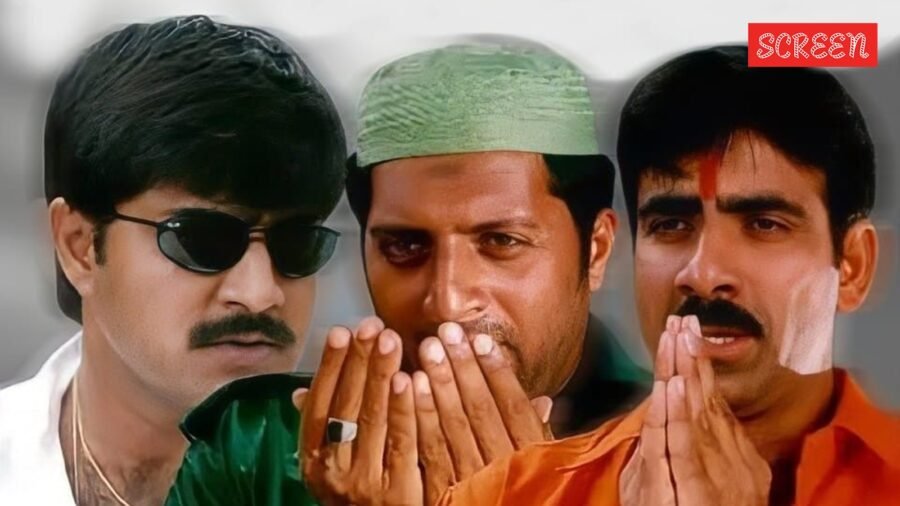
If you grew up in a Telugu-speaking household in the 2000s, there is a rhythm to August 15 that has nothing to do with the Prime Minister’s speech from the Red Fort. You would wake up when someone in the house has already switched on the TV. And within the first few seconds of audio, before you even look, you know what’s playing. It is the film Khadgam.
Twenty-four years after it first released, Krishna Vamsi’s 2002 action drama has become so deeply embedded in the Independence Day ritual of Telugu households that its annual telecast has become a tradition. The kind where you have seen the film 15 times and you still do not change the channel when Prakash Raj gets into his auto and starts talking about India.
Telugu cinema has produced dozens of patriotic films over the decades: Chiranjeevi’s Tagore, Rana Daggubati’s The Ghazi Attack, Varun Tej’s Kanche, and Adivi Sesh’s Major, among others. Some with bigger stars, some with bigger budgets. None of them gets rewatched every August 15 the way Khadgam does. What did Krishna Vamsi get right that everyone else got wrong?
Khadgam starts with three ordinary men living ordinary, messy, imperfect lives in Hyderabad and works its way up to the country.
Koti, played by Ravi Teja, is a broke, struggling actor whose one ambition is to hear someone on a film set call him “Babu.” Amjad, played by Prakash Raj, is a Muslim auto driver who is loud, warm, deeply religious and fiercely patriotic. His younger brother Azhar has been missing for a year under circumstances the family does not fully understand. Radhakrishna, played by Srikanth, is a police officer consumed by a hatred for Pakistan that runs so deep it colours every interaction he has, including with Indian Muslims.
Krishna Vamsi did not make one of them the hero and the others supporting characters. He gave each of them equal weight, equal emotional real estate and equal stakes. By the time the three men are drawn into a plot involving a captured ISI terrorist, a radicalised brother and a conspiracy to smuggle a prisoner across the border, the audience are watching three men they know, fighting for something they believe in.
Story continues below this ad
In 2002, barely a year after 9/11, Krishna Vamsi wrote a character who was unapologetically Muslim, deeply religious and fiercely Indian, all at the same time. Amjad does not apologise for his faith. He prays, he quotes scripture, he wears his identity openly. And his patriotism is not in spite of that, it is alongside it.
The film puts Amjad’s patriotism in direct conflict with Radhakrishna’s prejudice. Srikanth’s character openly distrusts Muslims. Amjad hears it, absorbs it and does not flinch. He does not try to prove himself. He simply continues being who he is until the other man’s prejudice crumbles under the weight of evidence. The moment near the end, when Radhakrishna apologises and Amjad responds by calling both him and Koti his brothers, saying blood does not define brotherhood, works because it was earned. Scene by scene. Suspicion by suspicion.
Prakash Raj won the Nandi Award for Best Supporting Actor for his performance in the film. But for an entire generation of Telugu audiences, Amjad was the first time they saw a patriotic Muslim character in a mainstream commercial film who was not a token, not a footnote and not a political statement.
Story continues below this ad
Khadgam deals with terrorism, radicalisation, communal prejudice and grief. On paper, it is a heavy film. In a theatre, it never feels like one, and the reason is Ravi Teja.
Koti begs for roles, gets rejected, rehearses dramatic scenes in his cramped room while his roommate tries to sleep. He is loud, tactless and completely unaware of how the world sees him. Koti’s desperation is funny, but it is also real. His loyalty to Amjad is played for laughs at first, but by the climax, it is the thing that puts him in the line of fire. The same man who spent the first half trying to become a fake hero spends the second half becoming a real one.
Why nothing else has replaced it
The films that came closest in intent were Kanche (2015), The Ghazi Attack (2017) and Major (2022). But none of them became an Independence Day tradition. None of them pulls you back the way Khadgam does. None of them makes you stop scrolling through channels on August 15 and sit down for the next two hours even though you already know every scene.
The difference is not quality but rewatchability. And rewatchability comes from characters you want to spend time with, not just heroes you want to salute. Even Krishna Vamsi himself has not been able to recreate what he did with Khadgam.
Story continues below this ad
The reason Khadgam endures is that it was never really about patriotism. It was about people from different walks of life. That combination of flawed people, who emote and make you laugh, is something you cannot manufacture. With Khadgam, it happened. And 24 years later, every August 15, it happens again.


Bardot auction in Paris fetches nearly one million euros
By Sohail Khan · 22 Sep