Why are Maharashtra’s auto-rickshaw, taxi drivers being issued notices for lacking Marathi language skills? | Explained
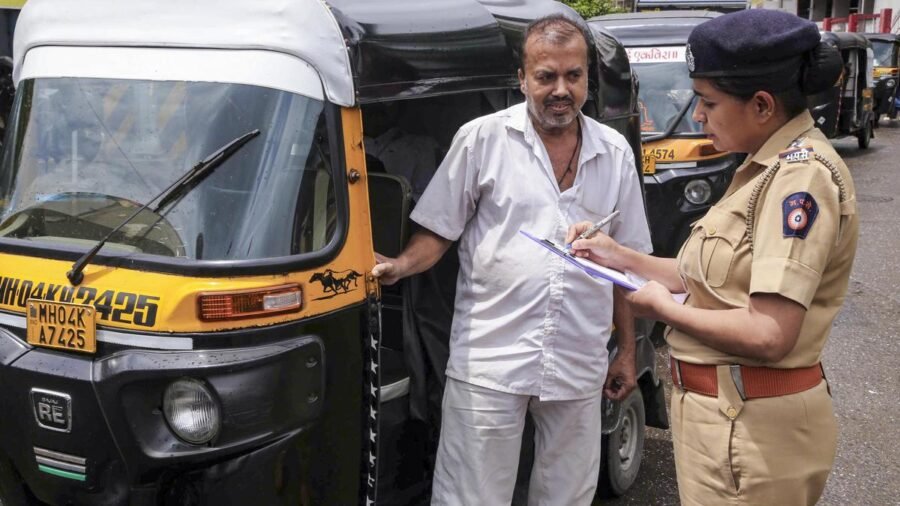
The story so far: On August 20, 2026, the Maharashtra Transport Department began an enforcement drive, issuing notices to auto-rickshaw and taxi drivers who failed to prove their functional knowledge of the Marathi language — now a mandatory requirement for driving passenger vehicles in the State. The enforcement drive will continue until September 30, and so far, around 2,500 such notices have been issued.
Since August 20, around 13,000 drivers have been tested in Mumbai and other parts of the state, according to the Transport Department. Drivers who fail the conversational assessment test receive a one-month notice to learn Marathi. “If they fail to comply with the one-month notice, their license will be suspended for three months,” Transport Minister Pratap Sarnaik stated.
Why are drivers being tested and notices being issued?
The State Transport Department implemented the Marathi requirement clause of the Maharashtra Motor Vehicles Rules, 1989, on May 1 through the Maharashtra Motor Vehicles (Amendment) Rules, 2026, after 37 years. However, after receiving criticism from auto-rickshaw unions, the drivers were given a grace period of three months to learn Marathi. That period ended on August 15, with the enforcement drive cracking down on drivers who failed to demonstrate a “working knowledge of Marathi” as per Rule 4(4), Rule 78, and Rule 85 of the Act.
How is the RTO impementing the drive?
The RTO authority is implementing a drive in two ways: first, by testing drivers’ working knowledge while issuing new badges; and secondly, as RTO marshals assess drivers at check nakas, petrol pumps, outside railway stations, and other spots where there is a frequent presence of auto-rickshaw and taxi drivers.
Marshalls are asking 10-15 questions based on everyday conversations between drivers and commuters. This includes questions such as: “Kite paise jhale?” (How much did it cost?), “Where do you want to go?”, “Please start the meter”, “How much time will it take to reach?”, “Do you have change?”, “How do I pay you, cash or online?”, and “Where is the rickshaw stand?”, among others. The list of questions and statements reflects everyday conversations.
If the drivers are failing to answer these questions or unable to make conversation, the notice is issued.
Why is the enforcement drive receiving flak?
Several auto-rickshaw drivers at the individual level are voicing their dissent against the ongoing enforcement drive. The drivers associated with the IC Colony rickshaw stand have observed a one-day strike and suspended their services. “Everyone has parked their rickshaws at the stand, refusing to provide service to commuters,” said Vivek Chaurasia, an auto driver from IC Colony in Borivali.
Several auto-rickshaw drivers in Mumbai, especially those from Dhaisar, Borivali, and Malad, have questioned how a person can learn Marathi in just four sessions a month. “Most of the drivers are avoiding the RTO’s check naka and driving on internal roads to skip the RTO drives. This has also caused problems with the availability of autos and taxis,” said Mr. Chaurasia.
His friend, who wished to remain unnamed, said, “Several drivers from U.P. have left for their hometowns with rickshaws, saying they will drive there or come back when things here are settled.”
What are the concerns regarding the adequacy of language training?
The drivers say that the one-month show-cause notice is baseless, as the infrastructure for learning working knowledge of Marathi has not been effective. Mr. Chaurasia, who completed his one-month course, said, “They only provided four sessions to learn Marathi, which is not sufficient. I am still struggling. I don’t know what to do next. I am stuck because I have EMIs to pay.”
Maharashtra has approximately 9.65 lakh licensed rickshaw and taxi drivers, with Mumbai having 4,62,387 auto-rickshaw and taxi license holders. According to the transport department, the training campaign provided lessons to only 1.65 lakh drivers. The question, therefore, arises: what about the eight lakh permit holders who did not participate in any training?
Several drivers are also confused about what constitutes a “working knowledge of Marathi,” as the law doesn’t define a standard framework.
On Monday (August 24, 2026), several auto-rickshaw drivers refused to provide their services, forcing commuters to wait for at least half an hour.

Alleged Myanmar-based extremists kill four Nagas in Manipur
By Sohail Khan · 25 Sep
DVAC searches premises linked to DMK’s Tiruvannamalai MP C.N. Annadurai
By Sohail Khan · 25 Sep