What two gramophones tell us about Vande Mataram
By Akhilesh Jha
Haripura was not merely another annual gathering of the Indian National Congress. In early 1938, Congress assembled there in Gujarat for its 51st Annual Session after the Congress Working Committee meeting in Calcutta in October 1937. And in those intervening months, much had changed in the way Vande Mataram was to be seen, heard and presented.
Advertisement
The ceremonial journey of the young President-elect Subhas Chandra Bose to the Congress pavilion became a spectacle of political imagination. For a four-mile journey from Haripura, Bose was carried to the pandal, curated by Nandalal Bose, in a magnificent rath. It was drawn by 51 bullocks. Richly caparisoned, their horns painted, the bullocks moved in pairs, each pair carrying tricolour flags upon their heads. And around their necks hung tuned bells. They were Vande Mataram bells with engraved letters.
Bose reached the session with singers and musicians who had travelled with him from Calcutta in the second-class bogies of the Nagpur Mail. RR Mukherjee was the master musician. As the Bengal troupe sang Vande Mataram, the senior leadership of the Congress, including Mahatma Gandhi, stood in attention. Sarojini Naidu found the Haripura Vande Mataram ‘exquisitely’ sung, with ‘deep and thrilling emotions’. Kamaladevi Chattopadhyay praised the young Bengali troupe for providing ‘a fine emotional setting for the whole session’.
The experiments with Vande Mataram can hardly be separated from what had happened only a few months earlier at the CWC meeting in Calcutta in October 1937. In many ways, the pride and position of the song had been compromised there. Haripura was determined to restore it.
Advertisement
It is important to remember that the Congress had, for years, referred to Vande Mataram as the ‘National Anthem’ in the proceedings and reports of its annual sessions. Many such reports during the 1920s were edited and prepared by Pt Jawaharlal Nehru, then serving as General Secretary of the Indian National Congress.
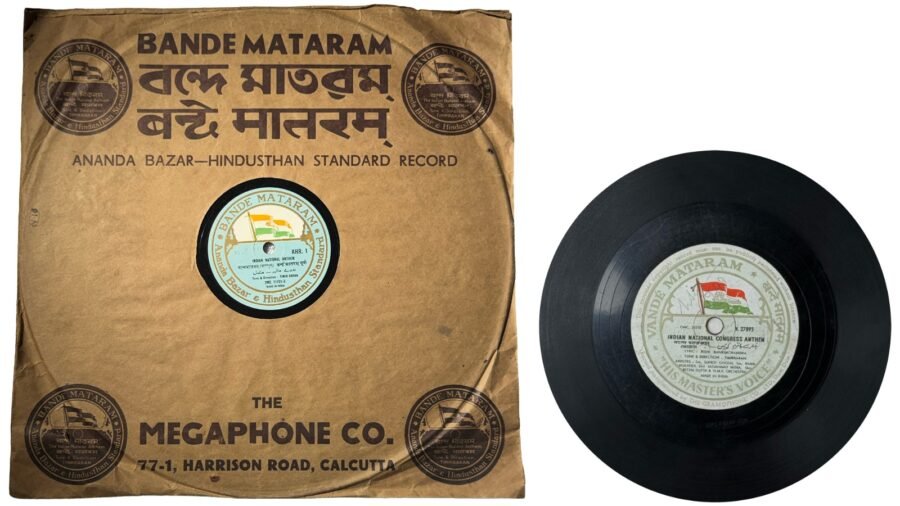
At Haripura, therefore, Vande Mataram was not being introduced to the Congress. It was being reaffirmed. And Bose did not allow that reaffirmation to remain confined to the Congress pandal. In 1938, he had a special gramophone record cut to restore the pride of Vande Mataram. The responsibility was given to the most credible name in Indian orchestration of the period: Timir Baran. For the first time, the complete Vande Mataram was composed in the two versions: a grand choral rendering as an anthem and an instrumental arrangement conceived in the character of a military march. Against the usual 10-inch-diameter gramophone record, this recording was issued on a 12-inch disc. The larger disc combined respect with the need to fit all six stanzas on one side.
The label had a tricolour bearing the charkha. Then came two declarations which, read against the events of Calcutta in 1937, appear almost like statements of resolve. The first was: BANDE MATARAM-SAMPOORN. Sampoorn, complete. Not two stanzas. All the stanzas were sung and recorded. The assertion of completeness was repeated on the label in Devanagari, Bangla and Nastaliq. Then came the second declaration, in bold capitals: INDIAN NATIONAL ANTHEM. There was no ambiguity.
Within a year, Bose’s relationship with the Congress changed dramatically. War, transfer of power and the Constituent Assembly followed, reshaping the debate over the National Anthem. Nehru’s Cabinet ‘tentatively’ chose Jana Gana Mana as the National Anthem in 1948, the Constituent Assembly formalised it through a ‘Statement’ on 24 January 1950.
The Constitution had been finalised on 26 November 1949. Babu Rajendra Prasad had signed its copies. The 1950 statement deserves careful attention. There was no distinction between a ‘National Anthem’ and a ‘National Song’ in what was read out on 24 January 1950. Jana Gana Mana was declared the National Anthem. Of Vande Mataram, the Statement said that it ‘shall be honoured equally with Jana Gana Mana’ and ‘shall have equal status’. The expression ‘National Song’ did not occur in that. The distinction sharpened in a Prime Minister’s Secretariat noting from 25 November 1955. Nehru referred to Vande Mataram as a ‘Special National Song’, departing from the language of equal status used in 1950. If both were performed, Vande Mataram was to open and Jana Gana Mana to close, though Nehru felt that, ‘as a rule’, both should not be performed at the same function. That noting was marked to the MHA, which maintained the distinction between ‘National Anthem’ and ‘National Song’. That distinction has no constitutional, legal or legislative basis.
Yet, between the monumental 1938 recording and the 1950 statement lies another, little-noticed gramophone record. The six stanza became four, pressed on a 10-inch HMV record. The label too changed: no longer ‘Sampoorn’, nor ‘Indian National Anthem’, but ‘Indian National Congress Anthem’. Why was ‘Congress’ inserted, and by whom? The record is silent. The question remains in the gramophone grooves.
Jha is a civil servant and author

Heart attacks in fit women in their 30s and 40s: The hidden risk doctors want you to know
By Sohail Khan · 29 Sep
40 years ago September 29, 1986: Violence and arrests in Punjab
By Sohail Khan · 29 Sep