Vandita Mishra writes: In the light of Jantar Mantar, Congress and BJP
Dear Express Reader
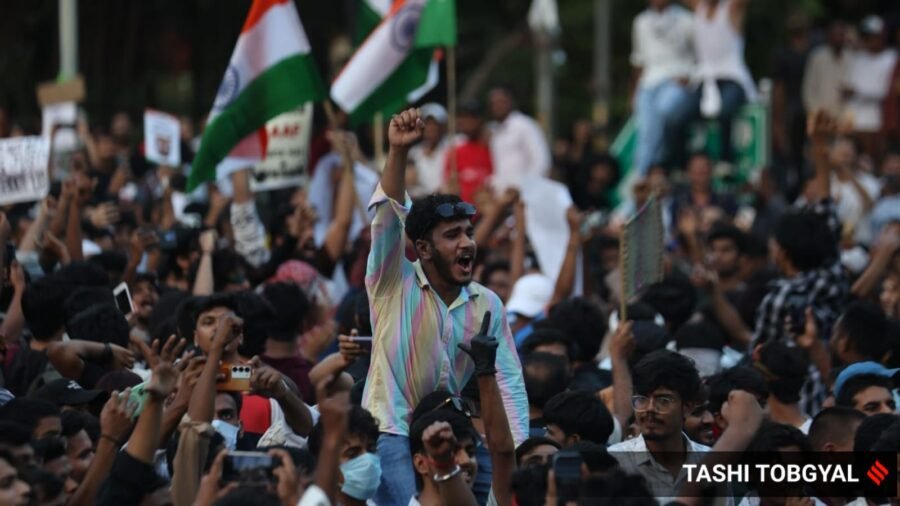
If the students’ movement is important for the light it throws on others and the silences it breaks long after its full-throated voice has faded — if “Gen Z” is not merely the new player of an old game — the question is: What has it made more visible, what looks clearer after Jantar Mantar, even if just a bit? From this vantage point, take a look at the BJP and Congress, the ruling party and its main Opposition, as they face the people, and as they go about their inner lives.
Advertisement
The BJP is in its third term at the Centre, a staleness is setting in. There is a restlessness, even among the believers. A journey through poll-bound Uttar Pradesh in June, just as the Jantar Mantar agitation was taking off in Delhi, turned up signposts of the Yogi-Modi double engine sputtering, and of other discontents gathering around the issue of exam paper leaks.
The issues are not new — price rise and corruption, education and jobs. But the first is given a sharper edge by a faraway war, while the students’ upsurge frames the last two more starkly. Education and jobs also present a twin challenge that defies the pre-election quick-fix. On education, too, the BJP’s choices over 12 years have now returned to haunt — of pouring its political capital and energy, despite the claims and boasts of the National Education Policy, into the conquest of institutions and advancing of ideological projects, instead of reforming systems and modernising processes.
Voices are also now being raised against the pall of fear that has made speaking up against the government costly for critics, and the wielding of “bulldozer justice” by BJP state governments against a voiceless minority especially, copying a template set in UP.
Advertisement
Add to that the “chanda chori” controversy at the Ram temple in Ayodhya, which singes the BJP-RSS leadership intimately, and the caste question, re-opened by anti-reservationists and by the backlash sparked by the UGC regulations against discrimination — the BJP seems back on the tightrope on Mandal, and newly defensive on Mandir.
The BJP that faces these new vulnerabilities is a party of growing resentments within. The tight Modi-Shah grip at the centre means that many of the discontents are not voiced openly, at least not in Delhi, but down the line, the cracks are showing.
The glee of BJP leaders in Bihar at their own party’s Bankipur rout, for instance, was a pointer to unease in the party with the anointment of Samrat Choudhary. Choudhary’s elevation as chief minister is part of a pattern of uninspiring state-level promotions and appointments by a high command that wants to retain control, above all. Or take the rumblings underway in the BJP’s West Bengal unit about opening the door too wide to let the defeated opponent in. The spectre of “Trinamoolification” of the party in a state where the mandate was more against the TMC than for the BJP is made worse by the absence of state-level BJP leadership that could calibrate the pace, manage the friction between new and old.
Murmurs can also be heard in the BJP’s senior leadership against the increasing outsourcing of decision-making to professional political consultancies. A party that has prided itself on its well-oiled machinery and its sprawl of committed karyakartas is being presented to-do lists and perception indexes by the omnipresent external agencies. When consultants are given too large a place at the table, senior BJP leaders point out, party forums can weaken and wilt.
On the other side of the political fence, it is now being said that Rahul Gandhi is pulling ahead of his own party. More than before, the journey through UP also showed that voters acknowledge that Gandhi is raising resonant issues, and persisting in taking the fight to the BJP.
But Gandhi’s outreach to the young, through the “Chhatron ki Goonj” programmes, for instance, or his dharna outside the PM’s residence recently, or his six-hour sit-in at a police station to force an FIR over a student’s pellet injuries — all frame a leader without the party. In fact, in the case of the latter two events, they showed the leader taking his party by surprise. Like his two cross-country yatras earlier, these events and programmes frame Gandhi’s breakthrough, while pointing to a Congress standstill.
The Bharat Jodo yatras, from Kanyakumari to Srinagar, and then from Manipur to Mumbai did turn public perceptions vis a vis Gandhi — they helped him climb out of the corner he had been pushed into by his own lack of a strong politics/government CV, and by the BJP’s propaganda machine. But since then, Gandhi seems to be making his way forward without carrying his party with him.
This is not just because Congress, out of power for long, is burdened with inertia and slowed down by factional infighting. It is also because of Gandhi’s scepticism towards the party he owns.
There are many images of this distrust. Of the yatris who flocked to Gandhi from civil society, marched alongside him during his two yatras, made common cause with him, only a handful were later inducted in Congress, little effort was made to create room for them in the party. The coterie that surrounds Gandhi and controls access to him is made of those who did not come up from the Congress ranks, and that almost seems to be his inner circle’s USP. It is Gandhi’s apolitical team, not his party’s youth wings, the NSUI or Youth Congress, that controls and curates the stage during “Chhatron ki goonj”.
Gandhi may well have decided that he is better off taking the plunge alone, until he can get the party of his dreams. But by not working through the party, and by distrusting its instruments and processes, he is complicit in leaving many of its organisational crises unattended.
The toll is especially visible in the poll-bound states of Punjab and UP. In UP, the Uttar Pradesh Congress Committee, dissolved in 2024 to jumpstart an overhaul ahead of the 2027 assembly election, is still to be reconstituted. In Punjab, there are no empty spaces, but there is open infighting, the party is divided into jostling camps that do not meet.
In the aftermath of the students’ movement, then, are two parties, which did not expect the sudden shaft of light on them, and which still seem blinded by it. They need to find their bearings again, and find a new way forward. That is their test, after Jantar Mantar.
Till next time,
Vandita
Recommended Readings:

Heart attacks in fit women in their 30s and 40s: The hidden risk doctors want you to know
By Sohail Khan · 29 Sep
40 years ago September 29, 1986: Violence and arrests in Punjab
By Sohail Khan · 29 Sep