UAE has found a way to turn desert sand into bricks
Benchmarks
Nifty24,154.55-53.21
FEATURED FUNDS★★★★★
Motilal Oswal Midcap Fund Direct-Growth
5Y Return
23.94 %
Invest Now
Enter search text:
Business News›News›Trending›UAE turns desert sand into construction bricks using a new method developed by scientists that doesn't need additional heat to harden and could reduce cement imports
Read Today's Paper
UAE turns desert sand into construction bricks using a new method developed by scientists that doesn't need additional heat to harden and could reduce cement imports
Synopsis
Researchers in the UAE have developed construction bricks using abundant desert sand and alkali-activated binders instead of conventional Portland cement. The laboratory-made bricks hardened under ambient conditions without additional heating and showed promising durability, including resistance to sulfate exposure, potentially offering a lower-energy alternative for construction.
UAE turns desert sand into construction bricks using a new method developed by scientists that doesn't need additional heat to harden and could reduce cement imports
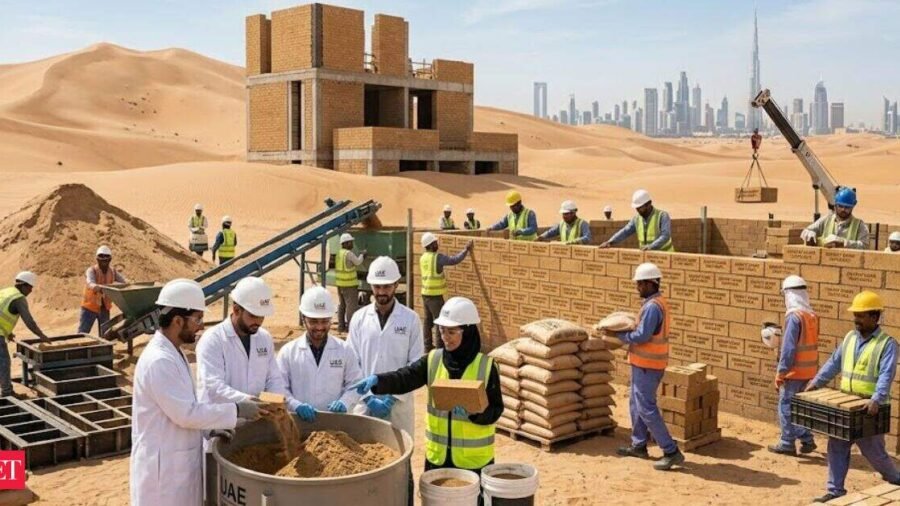
The UAE is exploring a new way to put its abundant desert sand to use in construction, with researchers developing bricks that can harden without additional heating.
Scientists from the University of Sharjah produced masonry bricks using UAE desert sand and alkali-activated binders, offering a potential alternative to conventional Portland cement-based construction materials.
The research, published in the Journal of Materials in Civil Engineering, examined whether desert sand could be incorporated into bricks while maintaining the strength and durability needed for construction.
Desert sand turned into construction bricks
Desert sand is abundant across the UAE, but its use in conventional concrete and construction has limitations because of the characteristics of its fine particles. The researchers therefore investigated a different approach by combining the sand with alkali-activated binder systems.
These binders can use industrial by-products such as fly ash and ground granulated blast-furnace slag, reducing dependence on ordinary Portland cement.
The resulting material was tested for properties including mechanical strength, water absorption and durability.
One of the more notable findings was that the bricks could be cured under ambient conditions, meaning they did not require additional heating to harden.
That could be important for reducing the energy requirements associated with manufacturing construction materials, particularly when compared with processes that require elevated temperatures.
Bricks showed resistance to sulfate exposure
The researchers also tested the material's durability under sulfate exposure.
Their results showed that the tested alkali-activated desert-sand formulations demonstrated promising resistance to sulfate attack. This could make the material particularly interesting for construction environments where sulfate-rich soil or groundwater can contribute to the deterioration of conventional cement-based materials.
The findings suggest that the material could have applications beyond simply making use of locally available sand.
Could reduce dependence on conventional cement
The research also points to a potential environmental advantage.
Ordinary Portland cement has a substantial carbon footprint because its production requires large amounts of energy and releases significant carbon dioxide. Replacing part of the conventional cement-based system with alkali-activated binders could therefore help lower the environmental impact of construction materials.
Using locally available desert sand could also reduce the need to bring suitable construction materials from elsewhere.
However, the researchers have not established that these bricks are already a commercially viable replacement for conventional bricks or cement-based products. The work remains at the research and testing stage, and larger-scale production, cost analysis and further environmental assessment would be needed before widespread adoption.
From desert waste to a construction resource
The study nevertheless highlights a potentially useful combination: locally available desert sand, industrial by-products and a binder that can harden without additional heating.
For the UAE, where desert sand is plentiful but construction materials can require significant resources to produce and transport, the approach could eventually provide a more locally sourced option.
The researchers' work therefore goes beyond simply finding another use for desert sand. It explores whether a material that is abundant in the region can become part of a lower-energy construction process while reducing reliance on conventional Portland cement.
Add 

(You can now subscribe to our WhatsApp channel)
(You can now subscribe to our WhatsApp channel)
Read More News on
UAE desert sanddesert sand bricksconstruction bricksPortland cementcement importssustainable constructionDesert sand construction bricksUAE


Enter search text:
Stories you might be interested in

Iran calls for diplomacy as Trump rejects plan
By Sohail Khan · 27 Sep
US claims successes in isolating Iran
By Sohail Khan · 27 Sep
India’s 1% luxury car club is getting crowded
By Sohail Khan · 27 Sep