Trump targets Iran’s military officials, cyber groups and shippers under ‘Op Economic Outcast’
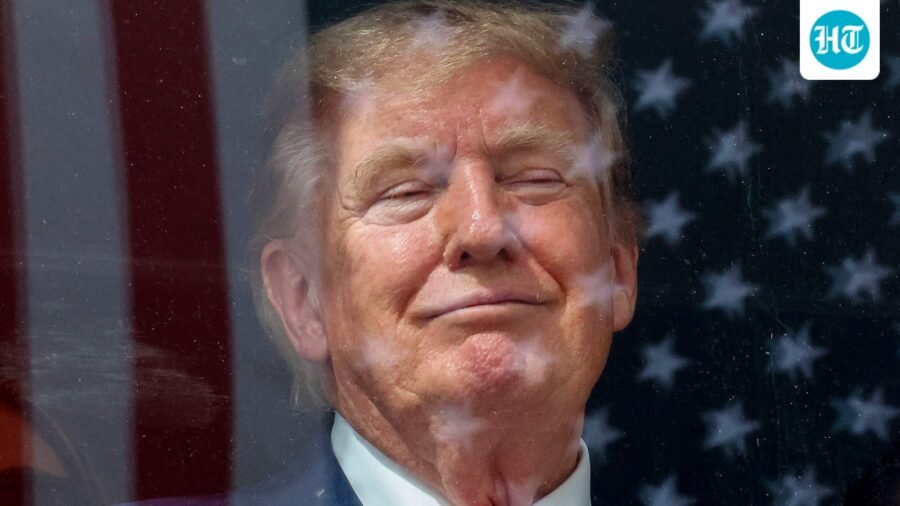
Trump targets Iran’s military officials, cyber groups and shippers under 'Op Economic Outcast'
The sanctions are part of Trump’s ‘economic D-day’, an effort to seemingly cut off Iran’s lifelines.
Updated on: Aug 25, 2026, 07:18:20 IST
Prefer HTon Google
Share via
Copy link
The United States has imposed new sanctions on Iranian individuals, companies and ships accused of supporting Tehran’s military activities, cyberattacks and illegal oil trade, the US state department said Monday.
The measures target networks involved in buying weapons, gathering intelligence, hacking US infrastructure and moving Iranian oil to generate revenue for Iran’s regime and the Islamic Revolutionary Guard Corps-Qods Force (IRGC-QF), department spokesperson Tommy Pigott has said.
“Today, the United States took sweeping action against multiple entities, individuals, and vessels enabling the Iranian regime’s destabilizing activities," he said in a statement.
The sanctions, announced on August 24, are part of US President Donald Trump’s ‘Operation Economic Outcast’ or ‘economic D-day’, an effort to seemingly cut off Iran’s lifelines.
Two Iran-based groups targeted
The US sanctioned DadeNegar Startup Studio and the Iranian Islamic Revolutionary Guard Corps Cyber-Electronic Command (IRGC-CEC).
The US accused DadeNegar of using commercial Chinese satellite images to help Iran identify US forces and bases in the Gulf during Operation Epic Fury — the joint bombing of Iran by the US and Israel on February 28.
The IRGC-CEC was sanctioned for obtaining information about US forces and bases that Washington said was used to support Iran’s targeting efforts. The US said both groups were involved in activities linked to Iran’s military procurement.
Iranian officials sanctioned
The sanctions also target seven Iranian officials accused of directing military operations and weapons programmes. Those named include former supreme national security council official Mohammad Bagher Zolghadr, IRGC commander-in-chief Ahmad Vahidi and Ali Abdollahi, commander of the Khatam al-Anbiya Central Headquarters.
IRGC Aerospace force commander Sayyid Hossein Mousavi Eftekhari and Iran’s conventional military commander Amir Hatami were sanctioned over their roles in the country’s ballistic missile and drone programmes.
Deputy defence minister for industrial and research affairs Seyyed Mahdi Farahi was targeted over his role in weapons procurement. Reza Talaei-Nik, spokesperson for Iran’s defence ministry, was also sanctioned.
Cyber operations also targeted
The US has also sanctioned an Iranian cyber group accused of hacking US critical infrastructure. Pigott said this was coordinated with the FBI, which last week charged eight Iranian nationals over cyberattacks on US energy companies, defence firms, hospitals and government offices.
The US rewards for justice programme is offering up to $10 million for information on five people accused of carrying out the attacks on behalf of Iran.
Sanctions target Iran’s oil trade
The US has also sanctioned Iranian and foreign companies accused of helping move Iranian oil and petrochemical products. Washington said the companies used “shadow fleet” ships and other methods to hide these shipments. The network includes shippers and brokers moving Iranian oil through the UAE, China, Singapore and Europe.
The US said the money from these sales helped fund Iran’s IRGC and other groups linked to the Iranian government.
US says more action is coming
“The United States will continue to disrupt, expose, and dismantle Iran’s military and proliferation activities, procurement schemes, malicious cyber operations, and illicit oil trade that sustains the regime’s malign behaviour,” the state department said.
Washington has also called on other countries to take action against the people and companies targeted by the sanctions.
Iran responds
Iran Parliament speaker Mohammad Bagher Ghalibaf said the US did not have the economic strength to restrict Iran’s ties with other countries.
“Americans know that no one buys their bombast; the United States is not in an economic position to further restrict its relations with other countries,” Ghalibaf said.
He added that Iran’s trading partners told Tehran that they were not taking the US warnings seriously. “Iran's trading partners, both in the media and through messages sent to us, have made it clear that they don't take these statements into account anywhere.”
Iran's ‘not a single drop of oil’ threat
Earlier, Iran warned that it could stop all oil exports from the Persian Gulf if the US continued its economic pressure on Tehran.
Mohsen Rezaei, secretary of Iran’s Supreme National Security Council, said, “If the economic war continues, not a single drop of oil will be exported, neither through the Strait of Hormuz nor from anywhere in the Persian Gulf.” He also said that Iran would consider any country supporting the US campaign against Tehran to be an “act of war.”
Hormuz remains important
The Strait of Hormuz remains a key route for global oil and LNG shipments. Saudi Arabia is using its East-West pipeline more to move crude through the Red Sea, while the UAE is running its Habshan-Fujairah pipeline at full capacity. Iraq is also expanding pipelines to move more oil without using Hormuz.
But alternatives for fuel and LNG remain limited. Qatar, a major LNG exporter, has no major route that can replace Hormuz.
Deep Dive
Powered ByAsk
See Less
Xi Jinping may press Trump to halt Taiwan arms sales during US visit
By Sohail Khan · 22 Sep

Alternatives to milk are losing moomentum
By Sohail Khan · 22 Sep