The Iran-US MoU ends today: how things stand, what lies ahead
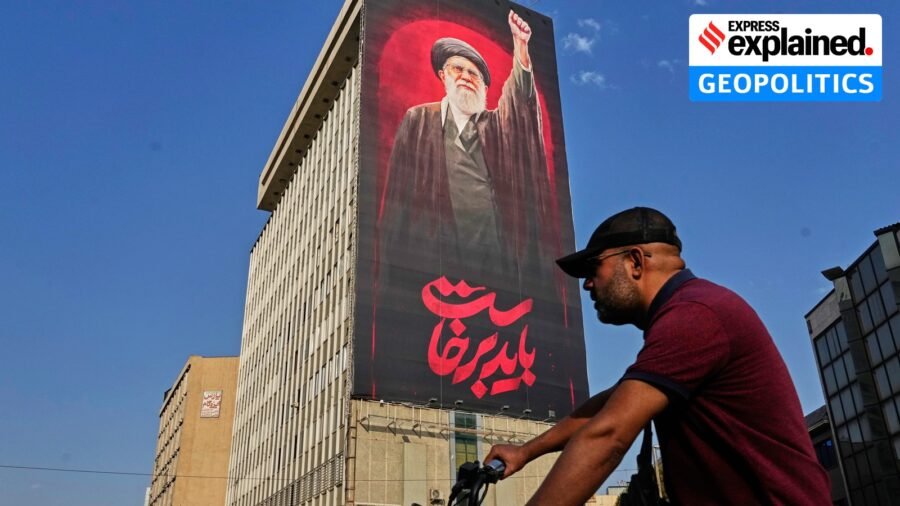
Two months ago, Iran and the United States signed a Memorandum of Understanding (MoU) to cease a war that began with Israel and the US striking Iran, and killing Supreme Leader Ayatollah Ali Khamenei, in February.
Over the next months, Iran got a new Supreme Leader, blocked the Strait of Hormuz with economic impact on the rest of the world, and attacked key oil and gas infrastructure in West Asia. The response went beyond what was initially anticipated, prompting calls for a ceasefire and a resolution to larger concerns, like Iran acquiring its own nuclear weapons.
On Monday (August 17), the MoU ended with several provisions violated in the interim. US President Donald Trump said of the agreement and Iran in July, “I think it’s over. I don’t want to deal with them anymore. They’re scum.” Here is what to know about the state of play now, and the outlook for peace in the region.
What was the Iran-US MoU?
The 14-point agreement covered issues ranging from control of the Strait of Hormuz to rebuilding Iran’s economy, battered by years of Western economic sanctions.
Some of these points were read as giving substantial advantages to Iran, arguably improving its theocratic regime’s position from before the war began. For example, it said that Iran will conduct dialogue with Oman “to define the future administration and maritime services in the Strait of Hormuz.” Before the war, the waterway saw ships pass — accounting for 20% of global oil and liquefied natural gas (LNG) flows — without any country allowing or withholding access. But now, Iran had a say in determining its future.
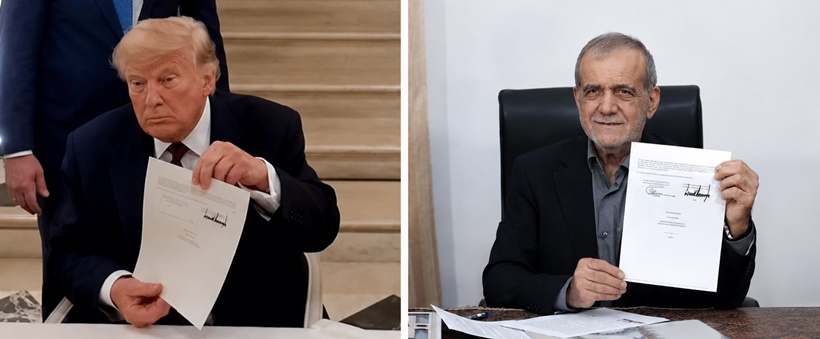 US President Donald Trump and Iranian President Masoud Pezeshkian hold up the signed MoUs.
While acknowledging the importance of the nuclear weapons issue, which has been a major point of contention for years, the two parties also agreed to leave specific discussions on it to a final deal. Finally, the MoU committed Iran and the US to “negotiating and achieving the final Deal, in maximum 60 days extendable with mutual consent.”
What has happened since its signing?
Provisions of the MoU have been violated on many counts, owing to the lack of trust between the parties. In fact, a July 25 analysis from The New York Times found that “nearly all of the agreement’s 14 points have been violated”.
Story continues below this ad
Consider the very first point, which begins with, “The Islamic Republic of Iran and the United States of America, and their allies in the current war, by signing this MoU, declare the immediate and permanent termination of military operations on all fronts, including in Lebanon, and undertake from now on not to initiate any war or any military operation against each other…”
Israel violated this provision through its attack on its northern neighbour, Lebanon. It has long argued for military action in southern Lebanon by citing the presence of Hezbollah, the Lebanese political party that also acts as a military group with support from Iran, the regional adversary for Israel.
Of late, the US has also criticised Israel’s military action in Lebanon, with Trump saying in June, “Too many people have been killed. You don’t have to knock down an apartment house every time you’re looking for somebody, because there are a lot of people in those apartment houses, and they’re not all Hezbollah.”
For its part, the US also struck Iran, which retaliated with strikes on US military bases in West Asia. The US attacks came after Iran targeted ships in the Strait of Hormuz, saying they did not coordinate with it when moving through the region.
So, what happens now?
Story continues below this ad
According to the AP, Iran said Monday it was working to finalise a joint statement with Oman on a plan to manage the transit of ships through the Strait of Hormuz. However, there is no word yet from either the US or Iran on broader negotiations to extend the MoU or reach a final deal.
On one hand, even the continuation of the MoU did not bring lasting peace to the region, or act as a starting point for deeper negotiations. On the other, the breakdown of even a temporary agreement points to worrying signs for the region’s future.
The MoU also breaks down as the US’s role in another West Asian conflict is yet to yield satisfactory results. On Monday, the day the agreement’s 60-day period ended, West Asia negotiator and Trump’s son-in-law Jared Kushner met Israeli Prime Minister Benjamin Netanyahu.
He also met Hamas chief Khalil al-Hayya earlier on Sunday for talks. These meetings are linked to the Trump-chaired Board of Peace’s peace plan for Gaza, which is conditional on Hamas’s disarmament and Israeli forces’ withdrawal from Gaza.
Story continues below this ad
Despite Hamas agreeing to disarm, Netanyahu has said they will not leave the region until the Palestinian group gives up arms “fully”. The stance has been interpreted as not only representative of the Israeli government’s hardline position, but also a political imperative, with legislative elections due in October — three years after Hamas attacked Israel. As of now, the Netanyahu-led ruling coalition is lagging in the polls.
Taken together, the developments in both Israel and Iran reflect continued uncertainty in West Asia, with the US having limited power to contain the fallout or aid parties in reaching a resolution.

Why the GST council needs a disability policy, not just rate cuts
By Sohail Khan · 8 Sep
‘Forever chemicals’ in sportswear: This is what happens when they touch your skin
By Sohail Khan · 8 Sep