Sunny Deol’s force to Emraan Hashmi’s silence: Batwara 1947, Awarapan 2’s divine connect

There can hardly be two films more different from each other than Batwara 1947 and Awarapan 2. If one excavates the past to make sense of the present, the other excavates our feelings about the past to make the present more profitable. One arrives carrying the weight of history; the other, the weight of memory. One is fronted by a yesteryear single-screen hero who became an emblem of a certain kind of Hindi-movie masculinity that was all force and fury; the other by a hero whose multiplex-born masculinity was defined by sensuality, cherished by a generation but never quite elevated into stardom. And yet, when you watch them closely, and back to back, the distance between the two begins to diminish. Beyond their wildly different surfaces, they are speaking, in strangely similar ways, about strangely similar things. Their kinship, then, goes well beyond the curious coincidence of Shabana Azmi appearing in both films.
A sense of time haunts both. With Awarapan 2, the nostalgia was almost inevitable. Its relationship with its 2007 predecessor was always going to be part of its appeal. Awarapan 2 understands that what it is selling is not simply a continuation of a story, but the return of a particular time. The mid-2000s, when a certain kind of Hindi-film melancholy had a home on television, when Emraan Hashmi’s brooding lovers could exist somewhere between the multiplex and the small screen, and when a song could preserve a film long after it had faded. The sequel turns that distance into its own emotional currency, taking a character who has been frozen in the memory of his audience and placing him, at last, in the present tense again.
Batwara 1947, meanwhile, is not simply a film about the past; it is a film that seems to have carried some of the past into its own making. Its historical subject is Partition, but its sense of time is also lodged in its form, in the way it is pitched, staged, shot and edited. Directed by Rajkumar Santoshi, it often resembles a film made in another time and age: theatrical, declamatory, emotionally unrestrained. And yet, the irony is that this datedness does not always diminish its potency. In portions, Batwara 1947 soars with a sincerity that Awarapan 2, for all its carefully cultivated nostalgia, can only manufacture. What makes the two films interesting together, then, is not simply what they remember, but the ways in which they make time visible. One film reaches into the past to retrieve a feeling; the other seems to have arrived from the past carrying one with it.
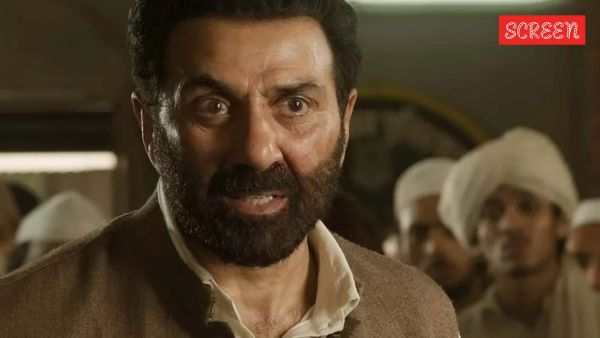 Batwara 1947 wears it’s testament to faith on its sleeves.
Faith is another thread that binds these films together, though Batwara 1947 wears it much more openly. Consider the scene in which Sikandar’s (Sunny Deol) factory is denied the land he had already purchased because its owner, at the last moment, refuses to give it to him for sheltering Mai (Shabana Azmi), a Hindu woman in a newly created Pakistan. The loss unsettles him; his wife and daughter are equally distraught. But when they tell Mai, she responds with the unhurried assurance of an elder at home: “God will show us the way.” The film soon makes good on her faith. Sikandar is granted a piece of land larger than the one he had lost, turning what could have been a simple plot resolution into something closer to an act of providence. It is a pattern the film returns to repeatedly. “May God protect you.” “By the grace of God.” “All thanks to the Almighty.” “He is the most merciful.” These are not simply lines of dialogue but a vocabulary through which its characters understand what happens to them.
At one crucial moment, when Hamida (Preity Zinta) finds herself in grave danger and cries out, “Oh God,” Sikandar arrives almost as an answer to the prayer. The film’s faith, however, is not simply the belief that the higher power will intervene. It is also a way of holding on to something when the world seems to have forfeited its moral compass. When Sikandar and Hamida despair at the cynicism unleashed by Partition and the hatred gathering around them, they wonder whether people have lost their faith in God. Later, when a law officer threatens to invoke the authority of the law, Sikandar draws a distinction of his own: he may do what the law permits, but he will do what his imaan commands. Hamida, too, refuses to imagine survival at the cost of surrendering her faith. And in the moment when Mai breaks into a devotional song, the film’s faith perhaps finds its most elemental form, belief turning into song, and song into prayer.
And needless to say, Awarapan has always been a film about faith. About love as worship, about the surrender that only love can demand, about the ways by which a love story makes you believe in something larger than yourself. Beyond all its gangster paraphernalia and wounded masculinity, it was always, in its strangest sense, a love story between an atheist and God. The film simply kept disguising this romance as something else. In the sequel, directed by Nitin Kakkar and written by Bilal Siddiqi and Vishesh Bhatt, that romance hides into the background, only to surface at the moments when the film most needs to believe in itself. And when it does, it becomes its greatest trump card, and perhaps its most cinematic saving grace. Without giving too much away, one of the year’s most beautiful moments on a big screen arrives when the most beloved song from the prequel finally fills the frame in all its glory, only to reiterate, how Shivam’s (Emraan Hashmi) story has always been incomplete without the divine.
Story continues below this ad
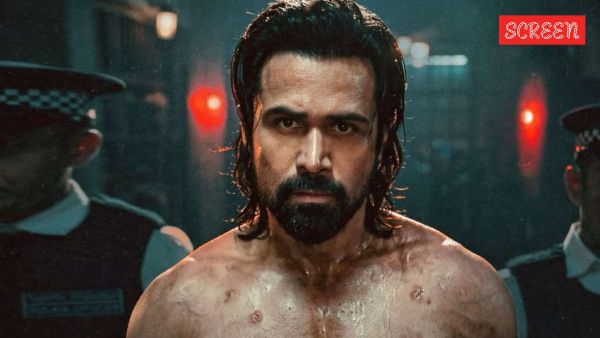 Shivam’s story has always been incomplete without the divine.
He is, after all, a man whose journey has always been governed by the twin ideas of karma and penance. Of sins that demand reckoning and wounds that demand atonement. So it is fitting that the film opens with the thought that you may be different, you may be distant, but God resides within you. The idea keeps returning in other forms. The taweez once again becomes the film’s emotional axis, his dead beloved yet again tells him that he is the chosen one, that he is meant to be an angel in a world of demons. Much of Awarapan 2, then, becomes a story about the divine returning to Shivam in ways he cannot quite recognise, appearing at the edge of death, pulling him back from it, and preserving his faith in the possibility of his own humanity.
So, unlike Sikandar, who believes in the divine and trusts that God will restore what has been wronged, Shivam is a man who must first be made to believe that only the divine can restore him. Yet both are, in their own ways, khuda ke bande, doing God’s work in their own time, in their own language, and according to the demands of their own faith. If Awarapan 2 believes that to free an oppressed soul is to free a little of mankind itself, Batwara 1947 endorses that to protect one oppressed soul is to restore something of mankind that has been lost. One screams; the other broods. One frees; the other shelters. One redeems through release; the other through refuge. But both have their own rishta purana with the divine.

Radha files complaint against sister Ambika, brother alleging ₹50 crore cheque fraud
By Sohail Khan · 21 Sep
Shah Rukh Khan, Suhana Khan and Gauri Khan visit Lalbaugcha Raja, watch
By Sohail Khan · 21 Sep